The New York Times – Protests fueled by deepening economic hardship have swept Iran for more than a week, as soaring inflation has driven frustrated traders and university students into the streets of major cities, including the capital, Tehran.
The demonstrations are the biggest in Iran since 2022, when the death of 22-year-old Mahsa Amini in police custody set off fierce anti-government protests, observers and human rights groups say. The current protests, however, have not reached the same scale or intensity as those that followed the death of Ms. Amini, who was detained for violating the country’s hijab rules.
But the protests are drawing scrutiny abroad. On Friday, President Trump said the United States would come to the aid of protesters in Iran if the government used lethal force against them. His comments came a day after reports from Iranian state media that at least one person had been killed in clashes between protesters and security forces. Iranian officials swiftly responded, saying they will act on any interference from the United States, including potentially targeting American bases and forces in the region.
On Saturday, Iran’s supreme leader, Ayatollah Ali Khamenei, called the protesters’ grievances “valid” but accused external forces of trying to exploit them to destabilize the country.
Why are people protesting?
Iran’s economy has been under sustained pressure for years, largely as a result of U.S. and European sanctions tied to its nuclear ambitions. That strain has been compounded by regional tensions, including a 12-day war with Israel last June, which further drained the country’s financial resources.
A steep decline in Iran’s currency has battered import-dependent businesses, angering shopkeepers and straining household budgets. Iran’s currency has lost roughly half its value against the dollar in 2025, and official figures show inflation exceeding 42 percent in December alone.
In response, merchants, traders and university students in several cities have staged days of protests, shuttering major marketplaces and holding demonstrations on campuses. On Wednesday, the authorities effectively shut down much of the country as they grappled with mounting public frustration over their handling of the economy.
How intense are the protests?
Demonstrations have spread to more than 100 locations in 22 of Iran’s 31 provinces, according to Human Rights Activists News Agency, an Iranian nonprofit registered in the U.S. that monitors the protests. Across social media and television stations, demonstrators have been shown chanting slogans including, “Death to the dictator” and “Iranians, raise your voice, shout out for your rights.”
The government identified the man killed in the protest late Wednesday as a 21-year-old member of a militia that works alongside the security forces. A rights group countered that, saying that he had been among the protesters.
Semiofficial news outlets and a human rights organization reported clashes and fatalities during protests in the western city of Lordegan on Thursday, though the accounts could not be independently confirmed.
Late on Friday and early Saturday, demonstrators gathered in several cities and towns, including in Alborz Province, which is west of the capital and in Fars Province in the southwest. Asal, a 20-year-old shopkeeper in Alborz, said she has continued to attend the protests for days despite security forces firing tear gas and paintball pellets at her and other demonstrators.
“It doesn’t matter to me if I die,” said Ms. Asal, who would be identified only by her first name for fear of reprisals. “If my country is set right by my death, I am content.”
How have officials reacted so far?
In previous rounds of unrest, Iranian authorities have often responded with force, using mass arrests and violence to suppress demonstrations. While security forces have similarly tried to put down the protests this time, the authorities have also signaled a willingness to engage with protesters and listen to their demands.
Iran’s government is dealing with several other crises, including water shortages, growing air pollution and the gnawing fear among many Iranians of another round of U.S. or Israeli military strikes.
President Masoud Pezeshkian has acknowledged what he called the public’s “legitimate” grievances and said the government must act quickly to address them. On Tuesday, he met with leaders of guilds, unions and chambers of commerce to discuss the country’s economic challenges, according to Iran’s state news agency, IRNA.
Amid the turmoil, the head of the central bank stepped down, and on Wednesday, Mr. Pezeshkian named a replacement, appointing the former economy minister, Abdolnaser Hemmati, to the post.
On Saturday, Mr. Khamenei, Iran’s supreme leader, said the traders’ complaints about the country’s difficult economic situation were “valid” and said he was aware that senior officials were working to address the problem. But he also blamed the economic crisis on outside forces, who he claimed were seeking to take advantage of the protests to undermine the country’s stability.
“This is the work of the enemy,” Mr. Khamenei said. “Protest is legitimate, but protest is different from riot. We can speak with a protester, but speaking with a rioter is pointless. A rioter must be put in their place.”
DUBAI, United Arab Emirates (AP) — Iran’s supreme leader insisted Saturday that “rioters must be put in their place” after a week of protests that have shaken the Islamic Republic, likely giving security forces a green light to aggressively put down the demonstrations.
The first comments by 86-year-old Ayatollah Ali Khamenei come as violence surrounding the demonstrations sparked by Iran’s ailing economy has killed at least 15 people, according to human rights activists. The protests show no sign of stopping and follow U.S. President Donald Trump warning Iran on Friday that if Tehran “violently kills peaceful protesters,” the United States “will come to their rescue.”
While it remains unclear how and if Trump will intervene, his comments sparked an immediate, angry response, with officials within the theocracy threatening to target American troops in the Mideast. They also take on new importance after Trump said Saturday that the U.S. military captured Venezuelan President Nicolás Maduro, a longtime ally of Tehran.
The protests, have become the biggest in Iran since 2022, when the death of 22-year-old Mahsa Amini in police custody triggered nationwide demonstrations. However, the protests have yet to be as widespread and intense as those surrounding the death of Amini, who was detained over not wearing her hijab, or headscarf, to the liking of authorities.
Khamenei makes first comments on protests
State television aired remarks by Khamenei to an audience in Tehran that sought to separate the concerns of protesting Iranians upset about the rial’s collapse from “rioters.”
“We talk to protesters, the officials must talk to them,” Khamenei said. “But there is no benefit to talking to rioters. Rioters must be put in their place.”
He also reiterated a claim constantly made by officials in Iran that foreign powers like Israel or the United States were pushing the protests, without offering any evidence. He also blamed “the enemy” for Iran’s collapsing rial.
“A bunch of people incited or hired by the enemy are getting behind the tradesmen and shopkeepers and chanting slogans against Islam, Iran and the Islamic Republic,” he said. “This is what matters most.”
Iran’s paramilitary Revolutionary Guard ranks include the all-volunteer Basij force, whose motorcycling-riding members have violently put down protests like the 2009 Green Movement and the 2022 demonstrations. The Guard answers only to Khamenei.
Hard-line officials within the country are believed to have been pushing for a more-aggressive response to the demonstrations as President Masoud Pezeshkian has sought talks to address protesters’ demands.
But bloody security crackdowns often follow such protests. Protests over a gasoline price hike in 2019 reportedly saw over 300 people killed. A crackdown on the Amini protests of 2022, which lasted for months, killed more than 500 people and saw over 22,000 detained.
“Iran has no organized domestic opposition; protesters are likely acting spontaneously,” the Eurasia Group said in an analysis Friday. “While protests could continue or grow larger (particularly as Iran’s economic outlook remains dire), the regime retains a large security apparatus and would likely suppress such dissent without losing control of the country.”
Deaths overnight in protests
Two deaths overnight into Saturday involved a new level of violence. In Qom, home to the country’s major Shiite seminaries, a grenade exploded, killing a man there, the state-owned IRAN newspaper reported. It quoted security officials alleging the man was carrying the grenade to attack people in the city, some 130 kilometers (80 miles) south of the capital, Tehran.
Online videos from Qom purportedly showed fires in the street overnight.
The second death happened in the town of Harsin, some 370 kilometers (230 miles) southwest of Tehran. There, the newspaper said, a member of the Basij, the all-volunteer arm of Iran’s paramilitary Revolutionary Guard, died in a gun and knife attack in the town in Kermanshah province.
Demonstrations have reached over 170 locations in 25 of Iran’s 31 provinces, the U.S.-based Human Rights Activists News Agency reported early Sunday. The death toll had reached at least 15 killed, it added, with over 580 arrests. The group, which relies on an activist network inside of Iran for its reporting, has been accurate in past unrest.
The state-run IRNA news agency separately reported on what it described as violence in Malekshahi County in Iran’s Ilam province, some 515 kilometers (320 miles) southwest of Tehran. It offered no specific details.
Hengaw, a Kurdish human rights group, and the Oslo-based group Iran Human Rights put the death toll at four in the violence there. Both groups accused Iranian security forces of opening fire on demonstrators.
The semiofficial Fars news agency, believed to be close to the Revolutionary Guard, alleged without offering evidence that demonstrators carried firearms and grenades. Firearms are more prevalent in western Iran, along the border with Iraq, but there’s been no clear evidence provided by the government to support allegations of demonstrators being armed.
The protests, taking root in economic issues, have heard demonstrators chant against Iran’s theocracy as well. Tehran has had little luck in propping up its economy in the months since its June war with Israel in which the U.S. also bombed Iranian nuclear sites in Iran.
Iran recently said it was no longer enriching uranium at any site in the country, trying to signal to the West that it remains open to potential negotiations over its atomic program to ease sanctions. However, those talks have yet to happen as Trump and Israeli Prime Minister Benjamin Netanyahu have warned Tehran against reconstituting its atomic program.
Human Rights Activists in Iran (HRA), through the dedicated efforts of its Department of Statistics and Publications, publishes its annual Gregorian calendar-based analytical and statistical report on the human rights situation in Iran for the one-year period (January 1, 2025, to December 20, 2025). This report is the culmination of the organization’s daily endeavors in recent years, forming part of a daily statistical project that began in 2009. It provides an analytical-statistical overview of human rights in Iran.
This annual report on human rights violations in Iran represents a synthesis of 10,826 human rights reports, gathered from 122 legal and news sources within the past calendar year. HRANA (Human Rights Activists News Agency) contributed 50.58% of the reports utilized in this publication, with 23.98% originating from official or government-affiliated Iranian sources, and the remaining 25.44% from other news or human rights sources.
In this 83-page report, various aspects such as women’s rights, workers’ rights, children’s rights, prisoners’ rights, etc., are briefly examined and statistically analyzed, accompanied by relevant charts for enhanced reader comprehension. According to this report, the focus of human rights monitoring in Iran, in comparison between the capital and other areas, remains unequal. This long-standing inequality shows that in the last year, reporting from non-central areas has decreased by 17.7% compared to the capital. This situation continues to indicate the lack of adequate monitoring of other areas of the country relative to the center by civil society.
Although this report predominantly reflects the extensive efforts of courageous human rights defenders in Iran, who bear significant costs in pursuit of their humanitarian ideals, it inevitably has limitations. These include restrictions on the activities of human rights organizations by the Iranian government and governmental impediments to the free flow of information. Consequently, while this report strives for accuracy, it cannot be considered entirely error-free or a complete reflection of the human rights situation in Iran. Nevertheless, it stands as one of the most precise, comprehensive, and well-documented reports on human rights violations in Iran, offering valuable insights for organizations and defenders of human rights to better understand the human rights situation in Iran, its challenges, and potential opportunities.
Download the full version of the report in PDF format
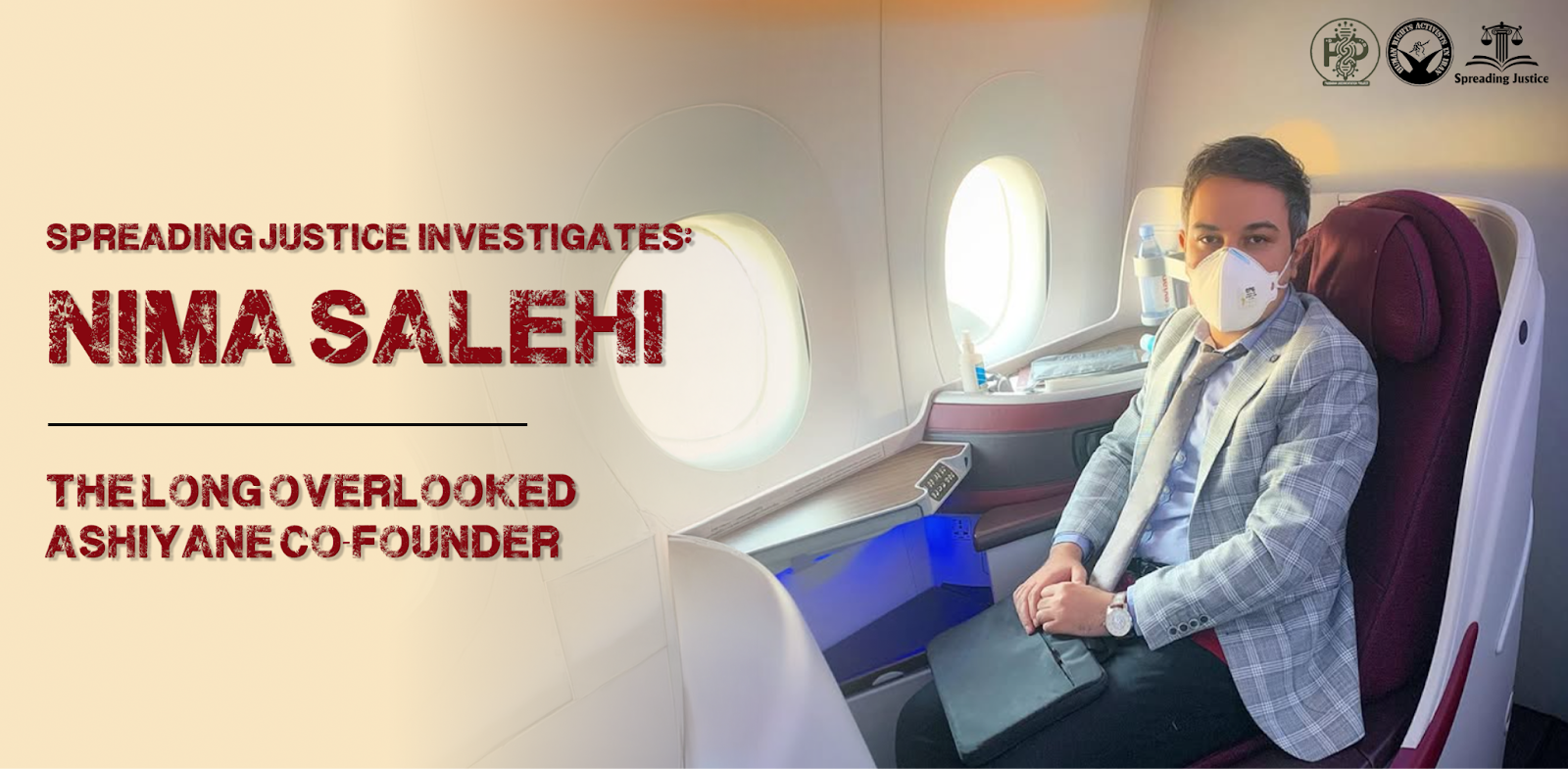
Over the past year, HRA’s Spreading Justice project has conducted a detailed investigation into Nima (Alireza) Salehi, identified as a central but long-overlooked actor in the Islamic Republic of Iran’s cyber repression architecture. Operating under the alias Q7X, Salehi co-founded and held a senior leadership role within the Ashiyane Digital Security Team, one of the most influential cyber groups aligned with Iran’s security apparatus.
Unlike Ashiyane’s founder, Behrooz Kamalian, who has been sanctioned by multiple jurisdictions for cyberattacks supporting state repression, Salehi has never faced comparable scrutiny or accountability. Despite his documented involvement in activities enabling surveillance, censorship, intimidation, and violations of numerous human rights, he continues to benefit from unrestricted global mobility, as evidenced by his extensive travel across Europe, the United States, Asia, and Africa.
By publicly exposing Salehi’s record, Spreading Justice urges states and implementing bodies to address this critical blind spot and to take immediate action to prevent individuals and entities that currently or previously facilitated digital repression from operating freely across borders.
WHAT IS ASHIYANE?
Ashiyane, meaning “nest” in Persian, is an Iranian hacking and security group founded in 2002 by Behrooz Kamalian. Initially, a small team of skilled hackers, it rapidly expanded into one of the most recognized and influential hacking groups in Iran. The group gained prominence through widespread website defacements, including attacks on foreign government sites, and by identifying vulnerabilities in Iranian websites, positioning itself as active in both black hat and white hat hacking.
Over time, Ashiyane built a broader cyber ecosystem, including a training center, a security company, and hosting services. Its hacking and security courses at Sharif University of Technology, later formalized into their own program, reflect the group’s role in cultivating a generation of Iranian cyber operators. Ashiyane achieved global visibility, ranking second worldwide for website defacements on Zone-H and being named “Best Hacking Team.”
HRA’s research confirms that the group maintained structural links with the IRGC and Iran’s Cyber Police (FATA). These ties shielded Ashiyane from restrictions imposed on other hacking groups. Both Kamalian (known as “Behrooz_Ice”) and Salehi (7XQ) appeared on Iranian state television as senior representatives of the Ashiyane Digital Security Team.
In interviews, including with Deutsche Welle Persian, Kamalian attempted to portray Ashiyane as an independent private group. Yet his own statements reveal deep integration with Iran’s cybersecurity and security infrastructure: Ashiyane collaborated routinely with state institutions, conducted large-scale political hacks later credited as victories of “Iran’s Cyber Army,” and provided training to authorities. Regardless of its formal status, the group functioned as an extension of the Islamic Republic’s security and propaganda apparatus.
Findings from Recorded Future and ARTICLE 19 show that Ashiyane’s cyberattacks, defacements, DDoS operations, and surveillance training were deliberate components of a broader strategy of digital repression, designed to block independent information, silence dissent, and intimidate activists and journalists. These activities directly undermined freedom of expression, privacy, access to information, and freedom of association and peaceful assembly, facilitating downstream abuses such as arbitrary arrest and ill-treatment.
A comprehensive analysis published in Insight Turkey reinforces Ashiyane’s foundational role in Iran’s cyber infrastructure. Far from signaling a decline, the group’s eventual closure highlighted how deeply embedded it had been within the state’s cyber apparatus and the broader system of digital repression it enabled.
The UK and EU, in their 2011 designations of Kamalian, captured this clearly: Ashiyane was “responsible for intensive cyber attacks both on domestic opponents and reformists and foreign institutions,” assisting the regime’s crackdown that involved numerous serious human rights violations.
WHO IS BEHROOZ KAMALIAN?
BEHROOZ KAMALIAN
Behrooz Kamalian, known as “Behrooz_Ice,” is widely recognized as the leading figure behind the Ashiyane Digital Security Team. Rising to notoriety in the mid-2000s through high-profile website defacements, he played a central role in developing Iran’s offensive cyber capabilities. Although he publicly minimized Ashiyane’s size, he acknowledged participating in politically motivated cyberattacks against American, European, and Israeli targets and maintaining cooperation with Iranian governmental and military institutions.
Iranian state-affiliated outlets attributed to him the hacking of hundreds to thousands of foreign websites in various campaigns. Cyber intelligence firms outside Iran consistently identify Kamalian as a pivotal actor in Iran’s hacker ecosystem.
In June 2018, his forum was permanently shut down, and reports surfaced of his potential arrest or the closure of Ashiyane’s office. Kamalian was sanctioned by the European Union on October 10, 2011, for his leading role in cyberattacks aimed at suppressing dissent during the post-election unrest, and was subsequently added to the United Kingdom’s consolidated sanctions list.
WHO IS NIMA (ALIREZA) SALEHI?
Nima Salehi, born November 24, year unknown, also known as Alireza Salehi, is an Iranian hacker and computer engineer who co-founded and served as the deputy leader of the Ashiyane Digital Security Team. A Blogfa post dated August 21, 2011, confirms he has used multiple names for more than a decade. Salehi studied computer security at the Alborz Technical and Engineering Institute.
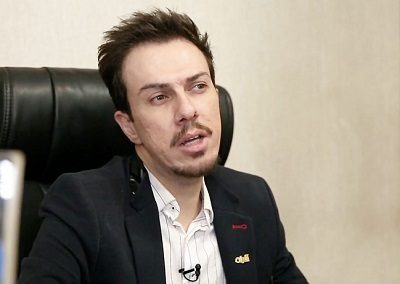
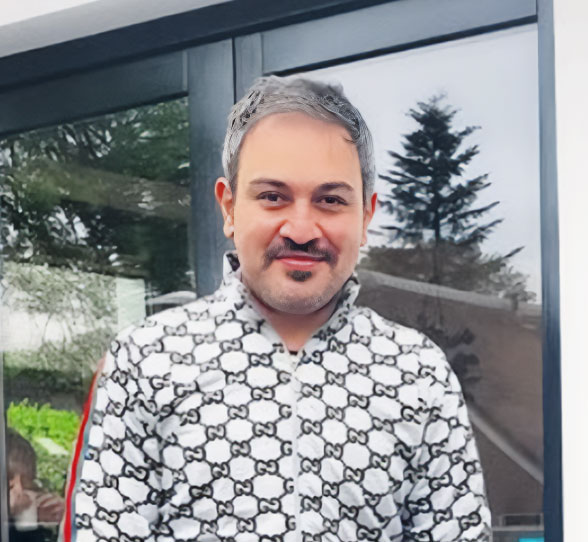
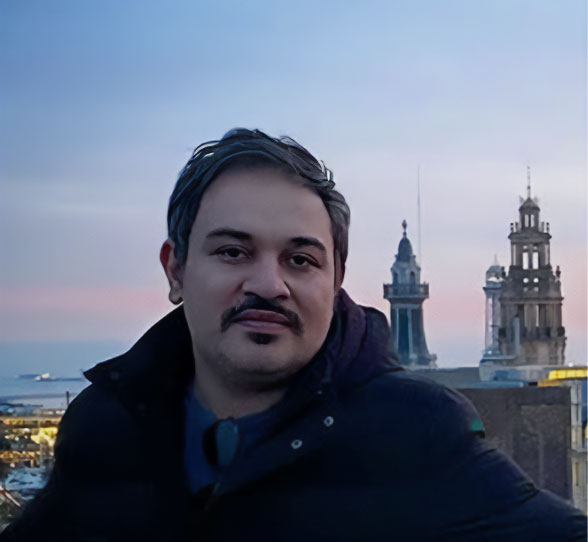
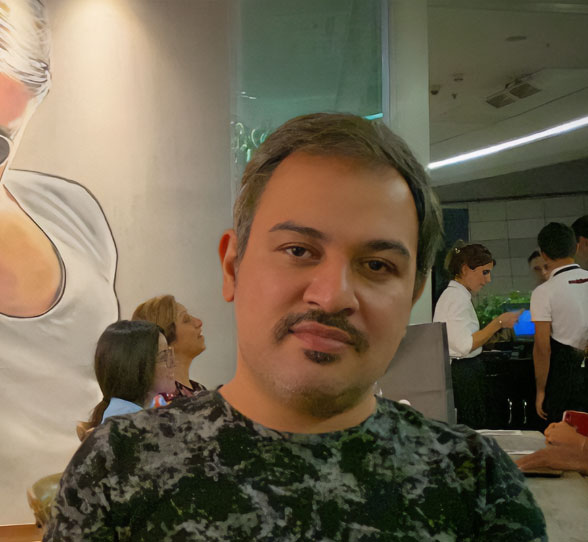
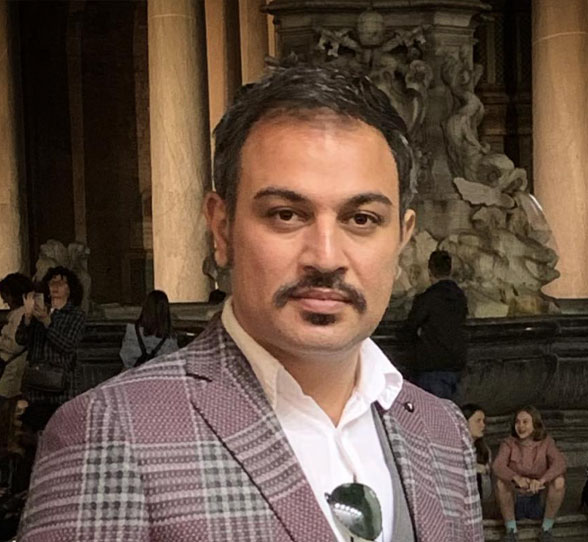
A few photos of Nima Salehi from various trips, taken from his public social media pages
Although he appeared openly in state media alongside Kamalian, Salehi has managed to avoid public scrutiny, sanctions designations, and accountability measures that targeted others in the same network. He remains a key figure who has operated in plain sight, bypassing the consequences faced by his counterparts.
OPEN SOURCE PROFILES AND DIGITAL FOOTPRINT
HRA’s research identifies several active or traceable online profiles associated with Salehi that illustrate his continued visibility and transnational movement. Despite his role in a group tied to state repression, he maintains accessible accounts on at least Instagram, LinkedIn, Facebook, and Telegram.
His personal profiles show extensive international travel. His LinkedIn profile reflects efforts to build a professional identity within international networks, while his Facebook account remains linked to Ashiyane’s broader digital presence. A Telegram channel associated with him, while unverified, aligns with common platforms used within Iran’s cyber ecosystem.
Together, these profiles reinforce a consistent picture: Salehi remains publicly active, connected, and unimpeded, despite his documented involvement in cyber activities that facilitated state repression.
HOW IS SALEHI ASSOCIATED WITH ASHIYANE AND BEHROOZ KAMALIAN?
HRA’s research confirms that Nima Salehi was not a peripheral operator but a central actor in Ashiyane. As co-founder, senior administrator, and Kamalian’s close operational partner, Salehi shaped both the group’s cyber activities and its extensive training programs.
Under the alias 7XQ, his name appears repeatedly in defacement logs and hacker community records linked to Ashiyane’s operations. ARTICLE 19 documents that both Kamalian and Salehi taught “Hacking and Security” courses at Sharif University of Technology and later directed broader training programs, contributing directly to the development of Iran’s cyber capabilities.
Salehi’s public appearances with Kamalian on Iranian state television further confirm his senior role. Despite this visibility, he has managed to avoid the sanctions and accountability measures imposed on other actors in the same network across multiple jurisdictions.
Given his documented role within Ashiyane and his partnership with Kamalian, HRA calls on implementing bodies to take immediate action to ensure that Salehi is no longer able to move freely across borders while benefiting from complete impunity.
TRAVEL HISTORY OF NIMA (AlIREZA) SALEHI AS CONFIRMED BY SPREADING JUSTICE; March 2017 – May 2025
*Note, a larger pin denotes more frequent travel to the given location
For more information on Salehi, Ashiyane, or the documented association, please contact Spreading Justice directly via the Contact Us form at https://spreadingjustice.org/contact-us/
بولتننیوز، «بهروز کمالیان؛ از هک ناسا و سایتهای اسرائیلی تا جذب فالوور برای سلبریتیهای دوزاری» (۱۶ آبان ۱۳۹۸)، بولتننیوز، https://www.bultannews.com/fa/news/638760/.
خبرگزاری جمهوری اسلامی ایران (ایرنا), “سایتهای رژیم صهیونیستی توسط یک گروه ایرانی هک شد” (۲۷ شهریور ۱۳۸۸)، ایرنا، https://www.irna.ir/news/7365500/.
Council Implementing Regulation (EU) 2025/689 of 4 April 2025 implementing Regulation (EU) No 359/2011 concerning restrictive measures directed against certain persons, entities and bodies in view of the situation in Iran, *Official Journal of the European Union* L 2025/689 (7 April 2025), accessed 24 August 2025, https://eur-lex.europa.eu/legal-content/EN/TXT/?uri=OJ:L_202500689.
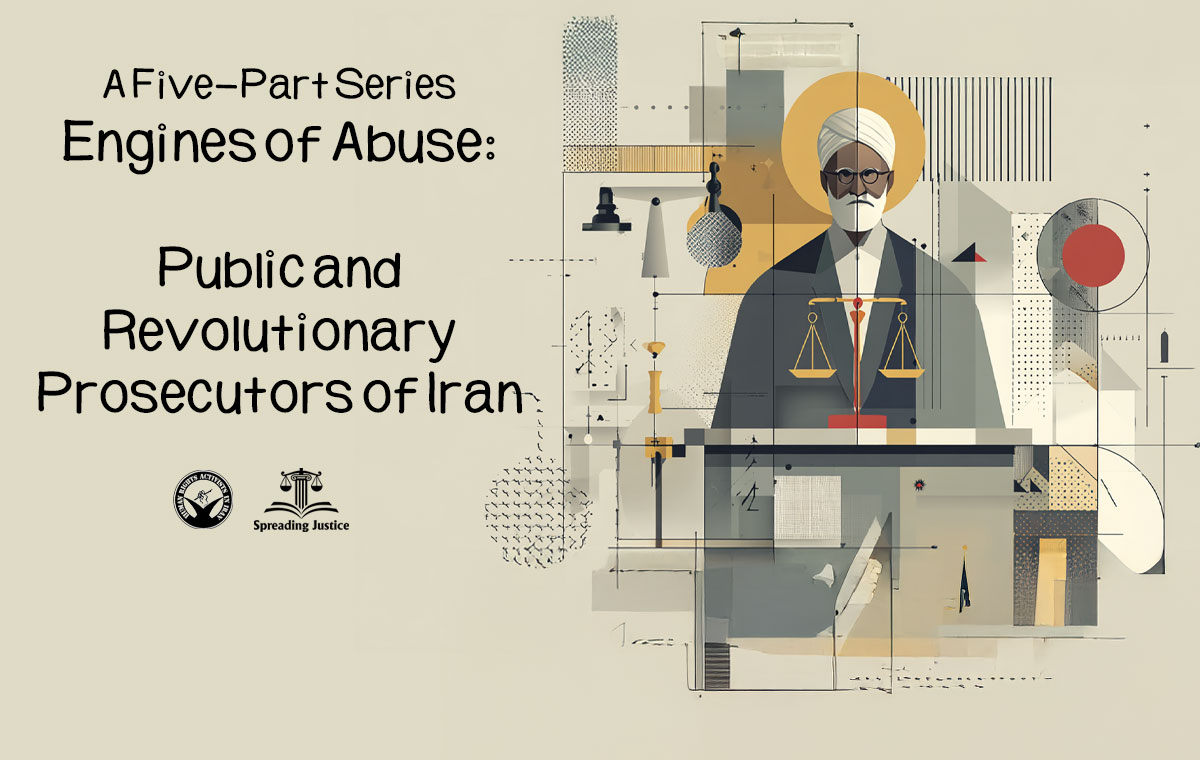
This report marks the first in a series of five forthcoming articles published by HRA through its Spreading Justice project, dedicated to shedding light on the roles within the Iranian regime that enable and sustain serious human rights violations, as well as violations of international law. The Spreading Justice database currently contains over a thousand profiles of individuals and entities implicated in systematic violations. This series aims not only to highlight who these individuals are and how the Spreading Justice project has documented their behavior, but also to examine how and why the positions they occupy perpetuate the entrenched cycle of repression and abuse. The series is published in the hope that a deeper understanding of the system of abuse will support ongoing efforts to hold Iran accountable and will also help shape recommendations for urgent reform.
Understanding the role of the Public and Revolutionary Prosecutor in Iran
The prosecutor serves as the representative of society before the court, with key responsibilities that include issuing indictments and overseeing the enforcement of judicial punishments[1]. He also supervises investigations and exercises administrative oversight over the implementation of judgments, meaning his deep involvement in the many cases marked by fair trial violations is inherent to the role.
Organizational Structure of the Prosecution Office
Prosecutors in Iran are generally classified into three levels based on their position and hierarchy, as follows
Prosecutor General
Provincial Capital Prosecutor, for example, Ali-Akbar Alishah, see Spreading Justice profile here
County Prosecutor, for example, Mehdi Amadeh, see Spreading Justice profile here
Each of these prosecutors is responsible for supervising the actions of their subordinate prosecutors:
The Prosecutor of the provincial capital county supervises county prosecutors within that province.
The Prosecutor General supervises all prosecutors nationwide
Duties of the Prosecutor
All activities within the prosecutor’s office are carried out under the prosecutor’s supervision. The prosecutor’s judicial responsibilities are organized into several main categories, including:
Handling offenses involving public rights and interests Offenses that concern public rights or interests do not require a private complainant. For instance, certain violations tied to public order or decency are pursued by prosecutors without the need for a private complaint, with both administrative and criminal dimensions. In such cases, the prosecutor holds the authority to initiate proceedings and ensure the matter is addressed.
Handling complaints of pardonable (private) offenses at the victim’s request These offenses are pursued only if the victim files a complaint. Once the complaint is submitted, the prosecutor is obligated to take action and address the matter.[2]
Issuing Indictments A core responsibility of the prosecutor is to prepare and issue an indictment. In Iran’s mixed system, the prosecutor directs the investigation, while the investigating judge conducts interrogations and oversees evidence gathering. Once the investigating judge submits the report confirming that the investigation is complete and the accused has been informed of the charges, the prosecutor drafts the indictment and submits it to the court to initiate the trial.[3]
Oversight of Punishment Enforcement
According to the regulations on the implementation of punishments such as hadd penalties, capital punishment, limb amputation, qisas (retribution in kind) for life and limb, injury compensation (diyat), flogging, exile, banishment, compulsory residence, and prohibiting residence in particular areas[4]:
According to Article 31[5], punishments involving capital punishment, stoning, qisas for limb, and limb amputation are carried out under the continuous and direct supervision of the prosecutor. According to Article 15[6], in cases where a sentence has been issued for public execution at a designated location, if the court has not specified the area, the place of execution is determined by the proposal of the criminal sentence enforcement judge and the approval of the prosecutor.
Case Study: Isfahan House
A striking example of the Prosecutor’s conduct can be seen in the actions of the Public and Revolutionary Prosecutor of Isfahan County, Seyed Mohammad Mousavian[7]. Acting in his official capacity, Mousavian issued the indictment against the defendants in the Isfahan House case[8] following the nationwide protests of 2022. This indictment ultimately led to the executions of Saleh Mirhashemi, Majid Kazemi, and Saeed Yaghoubi.
The executions were carried out despite the release of an audio file[9] in which Majid Kazemi made clear that he had been tortured, threatened, and subjected to sexual abuse during interrogation. These coerced confessions, extracted in flagrant violation of both Iranian law and international human rights standards, became the foundation for the indictment and subsequent death sentences.
By relying on statements obtained through torture, the prosecutor not only failed in his duty to uphold justice but also actively contravened one of his most fundamental legal obligations: to ensure that indictments are not based on evidence obtained under coercion. This conduct represents not simply a lapse in judgment but a profound violation of law, contributing directly to the wrongful and arbitrary deprivation of life. Unfortunately, this is not an isolated incident, but rather part of a broader and routine pattern in the Iranian judiciary.
Spreading Justice Information on Public and Revolutionary Prosecutors of the Past and Present
Name
Current Position
Link
Location
Jalal Afaghi
General and Revolutionary Prosecutor of Ardabil County
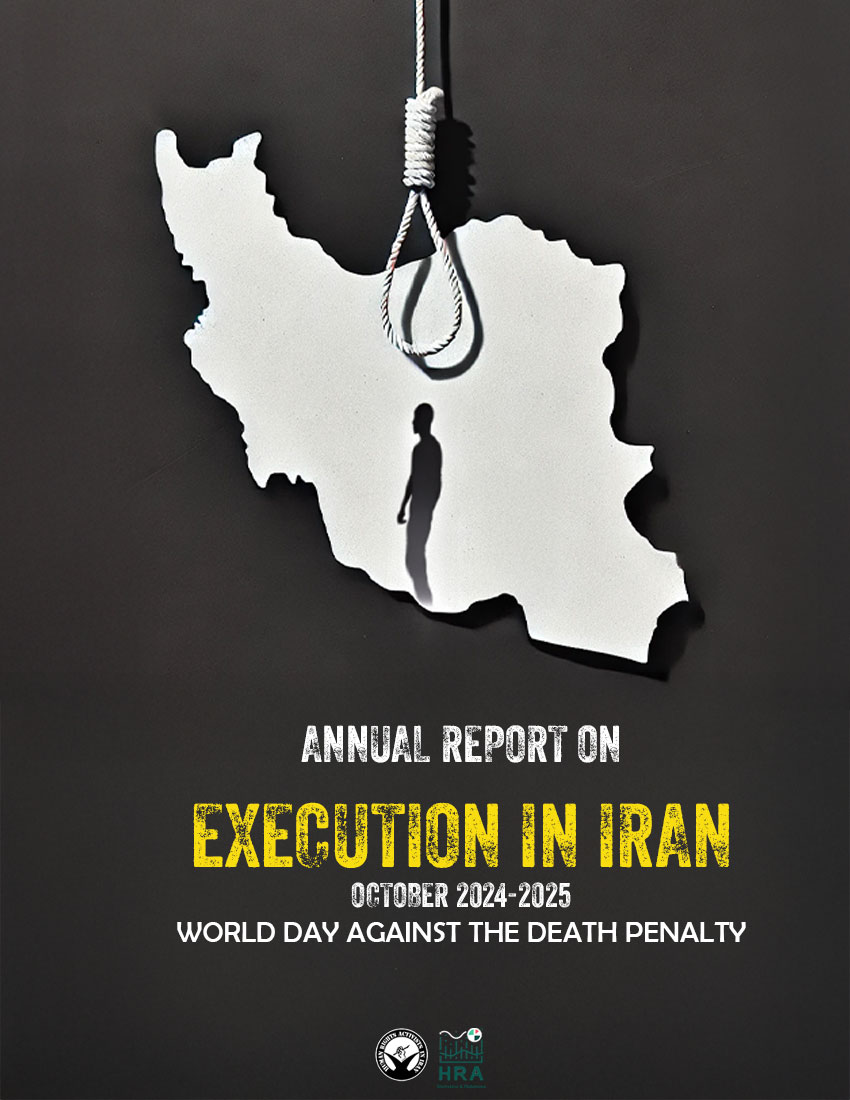
On the occasion of the World Day Against the Death Penalty, Human Rights Activists in Iran (HRA) expresses grave concern over the striking escalation of executions carried out by the Islamic Republic of Iran. According to verified data from HRA’s Statistics and Publication Department, at least 1,537 individuals were executed between October 10, 2024, and October 8, 2025, marking an 86% increase compared to the previous period and the highest figure recorded in the past decade.
A Decade-High Record of State Killings
HRA’s review of ten years of data reveals that after a brief decline between 2015 and 2019, executions have risen sharply each year since 2021, peaking in 2025. This year’s total, 1,537 executions, is cause for grave concern, in particular as over 94% of the 1,537 executions were carried out in secret, without public announcement or acknowledgment by authorities. This pattern which underscores the regime’s deliberate efforts to conceal the true scale of its violence.
The statistics are deeply troubling:
8 public executions were recorded
3 juvenile offenders were executed
49 women were executed, a 113% increase in female executions compared to the same period last year
Drug-related executions accounted for 48.3% of total executions, whilemurder charges accounted for 43.5%.
Trials in which victims were sentenced to death were routinely characterized by the use of coerced confessions obtained through torture or other forms of ill-treatment, and by the absence of essential fair trial guarantees as required under international law.
The Death Penalty as a Tool of Political and Social Control
HRA’s analysis indicates that this surge is not incidental but a state policy of intimidation. Amid an escalating economic crisis, domestic protests, and growing social dissent, the authorities have used executions to project fear and assert control.
While Iranian officials claim that the death penalty serves as a deterrent to crime, there is no credible evidence to support this assertion, and international human rights bodies have consistently found that capital punishment does not have a unique deterrent effect.
Regional Disparities and the Machinery of Death
According to HRA’s data, Alborz Province, home to overcrowded prisons such as Qezel Hesar, recorded the highest number of executions (14.6%), followed by Isfahan (8.4%) and Fars (7.9%). In proportional terms, smaller provinces such as South Khorasan, Qom, and Yazd exhibited the highest execution rates per capita, demonstrating how local judicial systems, particularly revolutionary courts, are key enforcers of intimidation through capital punishment
A Decisive Moment for Global Action
The ongoing and numerous executions imposed following unfair trials, often based on forced confessions extracted under duress, without the presence of legal counsel, constitute a serious violation of the right to life.
HRA calls on the authorities of the Islamic Republic of Iran to:
Immediately establish a moratorium on all executions with a view to absolute abolition of the death penalty.
Commute all existing death sentences and undertake a comprehensive review of all existing death penalty cases.
Ensure transparency by publishing official data on all death sentences, including the identities of those sentenced, the charges against them, and the trial details.
Guarantee fair trial rights, including access to legal counsel and prohibition of torture or coerced confessions.
Investigate and hold accountable all officials responsible for unlawful executions, and ensure that all officials responsible, including judicial and security personnel involved in ordering or implementing such executions, are held to account in accordance with international standards.
Allow independent monitoring by the UN Special Rapporteurs on Iran and on Extrajudicial, Summary, or Arbitrary Executions.
HRA calls on the international community to:
Call on the Islamic Republic of Iran to immediately establish a moratorium on executions with a view to the full abolition of the death penalty.
Urge Iran to adhere to fair trial standards, as well as review and amend domestic legislation that permits the systematic use of the death penalty.
Support the UN Fact-Finding Mission on Iran (FFMI) and the Special Rapporteur on Iran to ensure the inclusion of unlawful executions in reporting.
Utilize international accountability mechanisms, including the coordinated use of targeted human rights sanctions against those responsible for implementing or ordering unlawful executions.
Strengthen support for and protection of Iranian civil society actors, including families of victims, journalists, and human rights defenders documenting executions.
Ensure that victims and their families have access to effective remedies and reparations, and urge the Iranian authorities to immediately end the harassment and intimidation of victims’ relatives.
The international community bears a collective responsibility to ensure that the stories of more than 1,500 Iranians do not end in silence. Each execution carried out in Iran represents not only the unlawful taking of a life but also the suppression of dissent, the devastation of families, and the normalization of state violence.
On this World Day Against the Death Penalty, HRA calls for coordinated and principled international action to end the widespread and arbitrary use of capital punishment in Iran. Halting these violations requires sustained global pressure and steadfast solidarity with those inside the country who continue to fight for life, dignity, and justice.
Download HRA’s 2024–2025 Report on Executions in Iran
Three years ago, on September 16, 2022, Mahsa Jina Amini, a 22-year-old Kurdish-Iranian woman, died in the custody of Iran’s so-called “morality police” after being detained for allegedly wearing her hijab improperly. Mahsa’s brutal death in detention ignited the Woman, Life, Freedom movement, the largest wave of protests Iran had seen in decades.
As we approach the third anniversary, HRA seeks to shine a light on the progress of the movement despite ongoing repression at the hands of the State, and calls for accountability in light of ongoing impunity.
In its 2024 report, the International Independent Fact-Finding Mission on Iran (FFMI) concluded that the State was responsible, stating, “Based on the evidence and patterns of violence by the morality police in the enforcement of the mandatory hijab on women, the mission is satisfied that Ms. Amini was subjected to physical violence that led to her death. On that basis, the State bears responsibility for her unlawful death.”
While the FFMI’s findings make clear the State’s responsibility, there has been little to no justice for Mahsa’s death or the violent crackdown that followed. Still, in the face of impunity, the movement has endured, shifting from the streets into new forms of expression and defiance.
From the Streets to Cyberspace: The Movement Endures
Though the government’s brutal crackdown forced the majority of protests off the streets, the Woman, Life, Freedom movement has not ceased. It has transformed, and it is thriving.
Today, it lives in digital spaces and in acts of daily resistance. Women across Iran are increasingly visible without hijab in public places from Tehran’s markets and cafes to airports and bazaars, despite the State’s constant surveillance and repeated threats. Videos circulating online show women walking unveiled alongside peers who veil by choice, an image that powerfully illustrates a modern Iran, made only possible by the demands of the movement.
One woman, speaking with HRA on the status of mandatory hijab today, stated: “Every time I walk outside without a hijab, I know I risk harassment, arrest, or worse. But I also know that if I stay silent, nothing will ever change. This is not just about a piece of cloth, it is about dignity, choice, and the right to live as a free human being.”
The state has, indeed, sought to maintain control, deploying AI surveillance, reviving so-called morality patrols under new names, shuttering businesses, and attempting to codify the repressive Hijab and Chastity Bill. Yet enforcement has faltered. The widespread acts of defiance by Iranian women have significantly raised the political and social costs of enforcement. This shift has constrained the state’s capacity to implement its most punitive measures. Notably, in December 2024, authorities were compelled to delay the rollout of the Hijab and Chastity Bill; This is a testament to the enduring strength of the Woman, Life, Freedom movement. Even in the face of extraordinary repression and ongoing harassment, there is a clear impact of civil resistance.
Over the past three years, however, Human Rights Activists in Iran (HRA) have documented the profound toll of repression that followed both in the immediate aftermath of Mahsa’s death and throughout the movement. The numbers paint a picture that demands action.
At least 552 people were killed during the height of the Woman, Life, Freedom protests between (09/2022-11/2022).
According to government officials, at least 34,000 were arrested during the same period.
In the aftermath, as the street protests subsided;
At least 12 detainees linked to the Woman, Life, Freedom protests have been executed, and 8 have been sentenced to death, currently awaiting execution.
At least 33,818 people have reported confrontations with authorities, citing a warning for not observing proper hijab laws.
654 women have been arrested in relation to improper hijab.
1,386 businesses have been shut down either temporarily or permanently for allowing unveiled women onto their premises.
7 travel bans have been issued.
Citizens continue to face summons, are subject to physical and psychological torture, including through coerced forced confessions, face travel bans, and, in at least one case, a 31-year-old mother of two was shot and left paralyzed after police opened fire on her vehicle, which had been flagged for impoundment under compulsory hijab enforcement.
Call to Action: Toward Accountability
Despite the progress Iranians have carved out for themselves, three years later, repression persists, with no accountability for the death in detention of Mahsa Jina Amini or for the crimes against humanity that followed, most notably gender persecution. This campaign of persecution has manifested in arbitrary arrests, torture, sexual and gender-based violence, enforced disappearances, and unlawful killings.
A Mother, whose daughter was killed by the police at the height of protests in 2022, told HRA, “The government may ignore us, may erase names from the news, may even threaten us into silence, but they cannot erase the consequences of what they have done.” She continued, “My daughters’ siblings ask us why no one is punished, why no trial is held, and why the killers walk free. We have no answer for them, only silence and tears. Our daughter is gone, but our pain is not; it stretches forward, shaping our lives.”
This ongoing impunity emboldens perpetrators and perpetuates cycles of abuse. The scale and nature of these violations require an urgent, coordinated international response.
Today, on the third anniversary of the death in detention of Mahsa Jina Amini, HRA calls for:
Robust, targeted accountability efforts through the use of universal jurisdiction, particularly by states with the mandate and capacity to act, including but not limited to Germany, Sweden, Norway, and the United Kingdom. These jurisdictions have shown leadership in advancing justice for international crimes and should move swiftly to investigate crimes against humanity, including gender persecution, committed in Iran.
The strategic and coordinated use of targeted human rights sanctions, ensuring that those most responsible, including low-level but high-impact perpetrators, are designated..
The advancement of international investigative mechanisms, including strong support at the UN Human Rights Council for the work of the FFMI as a critical pathway to truth and accountability.
Concrete support for survivors and families of victims, ensuring that their rights to truth, justice, and reparations are at the center of all accountability efforts.
Sustained international pressure to ensure that Iran’s leadership cannot evade responsibility.
In Iran, the FFMI and independent investigations by civil society, including HRA in partnership with UpRights, have documented concrete evidence that persecution on the basis of gender, amounting to crimes against humanity, has taken place since at least September 16, 2022. States have a clear obligation under international law to investigate, prosecute, and remedy systematic human rights violations, including those amounting to violations of international law. The international community must act in line with these obligations, ensuring that accountability is not delayed or denied. The courage of Iranians has changed the social fabric of their country. The international community must match this bravery with decisive action.
The New York Times – Iran has for decades practiced what critics call hostage diplomacy, a policy of detaining foreigners and dual nationals to leverage them for prisoner swaps and the release of frozen funds. In the aftermath of the 12-day war with Israel and the United States, Iran is once again targeting Americans.
At least four Iranian Americans — two men and two women — are in Iranian custody, according to human rights groups, lawyers and Hostage Aid Worldwide, a nonprofit organization that was founded by former hostages to aid families and that is in touch with the current detainees’ friends and families.
Three of the Americans are in jail, and one has been barred from leaving the country, they said.
The detentions are likely to increase the already tense political climate between Tehran and Washington after the United States joined Israel’s attack on Iran and bombarded and severely damaged three of its nuclear sites in June.
Nuclear negotiations with Washington have not resumed since the war in June, but Iran’s foreign minister, Abbas Araghchi, said this past week in an interview with local news media that he and the U.S. special envoy, Steve Witkoff, have been communicating directly through text messages.
President Trump has said that he would not tolerate countries’ wrongful detention of Americans and that their release is a top priority for his administration. Mr. Witkoff’s office did not respond to a question on whether the detention of dual American citizens was brought up in communications with Mr. Araghchi.
The State Department has said that it is “closely tracking” reports of Americans being detained in Iran. “For privacy, safety, and operational reasons, we do not get into the details of our internal or diplomatic discussions on reported U.S. detainees,” it said in a statement on Monday. “We call on Iran to immediately release all unjustly detained individuals in Iran.”
Iran’s mission to the United Nations declined to comment on the detentions. Iran’s Ministry of Intelligence said in a statement on Monday that it had arrested at least 20 people who were working as spies or operatives for Israel in cities across Iran.
The four detained Iranian Americans had all lived in the United States and had traveled to Iran to visit family, according to the rights groups. The families of three of the Americans have asked that their names not be published for fear it could make their situations worse.
Two of the four were arrested by security agents in the immediate aftermath of Israel’s attacks on Iran in June, according to the Human Rights Activists News Agency (or HRANA) and Hengaw, independent rights groups based outside of Iran.
One is a 70-year-old Jewish father and grandfather from New York who has a jewelry business. He is being questioned about a trip to Israel, according to the rights groups and the man’s colleagues and friends.
The other is a woman from California who was held in the notorious Evin prison. But her whereabouts is now unclear after Israel attacked Evin in June and the prison was evacuated, according to rights groups and Kylie Moore-Gilbert, an Australian British scholar who was imprisoned in Iran for two years and released in 2020.
Iran is also holding another Iranian American woman, who was first imprisoned and prevented from leaving the country in December 2024. She is currently out of prison, but her Iranian and American passports were confiscated, according to her U.S.-based lawyer who asked not to be named to discuss sensitive information.
The woman works for an American technological company and runs a charity for underprivileged children in Iran. But after the recent war, the Iranian judiciary elevated her case and charged her with espionage, according to her lawyer — a serious crime that can carry many years in prison and even the death penalty.
At least one other Iranian American citizen, the journalist Reza Valizadeh, is imprisoned in Iran. He is a former employee of Radio Farda, the Persian-language news outlet that is part of the State Department-funded Radio Free Europe. Radio Farda has said in a statement that he was arrested in October 2024 while visiting family in Iran. He was sentenced to 10 years in prison on charges of “collaborating with a hostile government.”
Two senior Iranian officials who asked not to be named because they were not authorized to speak publicly confirmed that Iran had recently detained two dual American citizens — the New York man and the California woman. They said it was part of a wider crackdown focused on finding a network of operatives linked to Israel and United States.
The crackdown comes as Iran’s president, Masoud Pezeshkian, has encouraged Iranians in the diaspora to return to Iran. He said last week that he would speak with the ministries of intelligence and judiciary to facilitate those returns, according to local news reports.
“We have to create a framework so that Iranians living abroad can come to Iran without fear,” Mr. Pezeshkian said.
But Ali Vaez, the Iran director for the International Crisis Group, said last week: “The Iranian government has a sordid history of cracking down domestically following intelligence failures, and seizing foreign nationals as a cynical form of leverage. And at a time when Tehran and the Trump administration are already at loggerheads over nuclear diplomacy, the arrests could add another significant area of contention.”
The State Department issued a new warning after the war, telling Americans not to travel to Iran “under any circumstances.” In a statement in English and Persian, it says that Americans, including Iranian Americans, “have been wrongfully detained — taken hostage — by the Iranian government for months, and years. The threat of detention is even greater today.”
The news of the Americans’ detentions has rattled the Iranian American community, including several people previously detained in Iran. Many of them are often the first point of contact for families who find themselves navigating the frightening ordeal of having a loved one arrested in Iran.
Siamak Namazi, an Iranian American businessman who was held for eight years in Iran before being released as part of a U.S.-Iran deal in 2023, said that since the war with Israel, the number of Americans detained in Iran has grown.
“Some cases are public; others remain under wraps, often due to poor advice that silence is safer,” he said. “Securing their release must be a core U.S. priority in any future diplomatic engagement with Tehran,” added Mr. Namazi, who is on the board of Hostage Aid Worldwide.
In New York’s tight-knit Jewish Iranian circles, news of one member’s detention spread quickly and brought anxiety. Iran has arrested at least five Jewish Iranians in its postwar crackdown and has summoned 35 more for questioning, according to Skylar Thompson the deputy director of HRANA.
Michael Crowley and Sanam Mahoozi contributed reporting.
Farnaz Fassihi is the United Nations bureau chief for The Times, leading coverage of the organization. She also covers Iran and has written about conflict in the Middle East for 15 years.
Jerusalem Post – Two Jewish American nationals were among the 35 Jews who were arrested in Iran’s Tehran and Shiraz last month for allegedly having ties to Israel, KAN revealed in a Monday report.
The 35 Jews who were arrested were part of a government crackdown by the Islamic Republic that began right after the 12-day war between Iran and Israel in June, according to a report by HRANA, the Human Rights Activist News Agency.
Five of those arrested are still detained, including one of the two American Jews. The other, an Iranian-American Jew from Los Angeles, was released on bail. He arrived in the country to visit family.
The one American Jew still imprisoned had initially left Iran for New York three decades ago, but returned to also visit relatives.
Releasing the remaining detainees
An additional 11 Jews were released from detention in recent days, according to the report, and efforts are still being made for the remaining five detainees’ release, the report said.
“The two Americans arrived at the wrong place at the wrong time,” KAN quoted a source involved in the efforts to release them as saying.
A report earlier this month quoted a senior Iranian communal leader, who lives in Los Angeles, as saying that Islamic Republic authorities are checking the cell phones of those they arrest, looking for records of any calls to the Jewish state.
“Most Iranian Jews have family in Israel,” he explained.
During Operation Rising Lion, many Iranian Jews reached out to check on the safety of their relatives in Israel.
Boston Globe – The crackdown that many Iranians feared has begun.
Having weathered the Israeli onslaught, the Islamic Republic of Iran is shifting its focus to the home front — carrying out mass arrests and executions, erecting new security checkpoints, and warning citizens against online activity deemed sympathetic to Israel.
As an Iranian-American who has lived and worked as a journalist in Iran — and who spent 100 days imprisoned there — I feel both anguish and dread watching history repeat itself. The leaders of the United States, Israel, and the Islamic Republic are jockeying over claims of victory, while human rights abuses and the everyday suffering of ordinary Iranians have started to fade, once again, from the headlines.
During the 12 days of war, more than 700 people were accused of being “Israeli operatives” and were arrested, according to the state-affiliated Fars News Agency. Human rights groups report that hundreds more have been detained. Among them are activists, writers, professors, musicians, and former protesters, according to the US-based Center for Human Rights in Iran. At least 300 people have been detained for their online activities and for posting content related to Israel’s attacks on Iran, according to the Human Rights Activists News Agency.
Meanwhile, Iran’s parliament has passed a bill that authorizes flogging or imprisonment for the use of internet services such as Starlink and expands punishments — including the death penalty — for those accused of collaborating with Israel or the United States. Authorities have executed at least six people on charges of spying for Israel since the war began.
It’s no surprise that a regime blindsided by a foreign enemy’s highly coordinated attacks would now move swiftly to root out what it sees as security threats.
But the regime is not just fighting foreign adversaries. It is using the war as a pretext to crack down on domestic dissent.
Having experienced firsthand the lack of due process and transparency within the Islamic Republic’s judicial system, I have no doubt that many innocent people will be punished for crimes they did not commit.
In 2009, after six years of living and working in Iran as a journalist, I was arrested and accused of spying for the United States. My interrogators claimed that the CIA had paid me to use a book I was writing about Iran as a cover for espionage.
“It’s not possible you could be conducting so many interviews,” one insisted, “only for a book.”
Like many Iranian political prisoners, I was held in solitary confinement and subjected to grueling interrogations, unable to inform anyone of my whereabouts. The authorities threatened my loved ones, fabricated evidence, and warned that espionage could result in many years in prison, and even the death penalty.
For decades the regime has accused journalists, civil society leaders, women’s rights activists, lawyers, academics, environmentalists, and humanitarian workers of committing crimes against the state — sometimes under a charge of espionage.
During my time in Tehran’s notorious Evin Prison, I met other inmates facing charges like “propaganda against the state,” “acting against national security,” “spreading corruption on earth,” and espionage for foreign governments. These inmates included student activists and peaceful protesters who had done nothing more than exercise basic human rights. Two of my cellmates, both leaders in the Baha’i community, were sentenced to 20 years in prison.
My own sentence was eight years, but I was lucky. After an international campaign for my release, I was freed after 100 days in prison.
Countless others — especially those without the support of a foreign government or the attention of the international media — have not been so fortunate.
The regime expends enormous resources interrogating citizens, monitoring internet activity and phone calls, pressuring people to inform on one another, and tailing them in the streets, in cars, even on flights abroad.
“If the system worked well, they would have found the real spies and prevented Israel from doing so much damage,” an Iranian friend told me. “But instead, the regime took people like you and claimed you were spies.”
Today, many of those being swept up in the regime’s dragnet appear to be suffering the same fate. Detainees are being fast-tracked through unfair trials in kangaroo courts without legal representation or due process, according to the Center for Human Rights in Iran.
The Iranian regime is responding with repression because “it knows it won’t collapse due to foreign intervention alone,” says Rebin Rahmani, a board member of the Paris-based Kurdistan Human Rights Network. “It’s only when external attacks weaken the regime and widespread domestic protests emerge that it faces a real existential crisis,” he says. “That’s why it has responded with such intense repression of the people.”
This crackdown, in other words, was predictable.
Afsoon Najafi, whose youngest sister, Hadis, was shot and killed by security forces during nationwide protests in 2022, told me, “A large percentage of Iranians will again be killed by the Islamic Republic because the regime’s agents are full of resentment toward Iranians. And the regime’s own agents also know that we know they’re scared.”
Regardless of whether US and Iranian officials resume negotiations over Iran’s nuclear program, the Trump administration has an opportunity to show that human rights matter, too. That means, among other things, supporting Iranians’ access to information — for example, by restoring full funding to Voice of America Persian, a crucial source of uncensored news for millions in Iran.
American citizens can also play a role. By calling their members of Congress and expressing support for measures like the IRAN Act, they can help Iranians circumvent internet restrictions and connect with the outside world. Even posting social media content about Iran’s human rights abuses can amplify the voices the regime tries to silence.
Steps like those from the American people, even if their message isn’t taken up by Congress and the current administration, would still send a clear signal to Iran: Human rights abuses will not be ignored.
When I asked an artist in Tehran what she hoped the world would understand about the Iranian people now that a fragile cease-fire is in place, she said on condition of anonymity, “I don’t know what the people of the world can do, but I want them not to be indifferent to the pain we’re enduring.”
“At the very least,” she added, “let us remain in the news. Let them keep an eye on us.”
If the world fails to keep an eye on the Iranian people, we risk silently sanctioning yet another chapter of repression in the Islamic Republic of Iran.
*Roxana Saberi is a journalist and author of “Between Two Worlds: My Life and Captivity in Iran.”