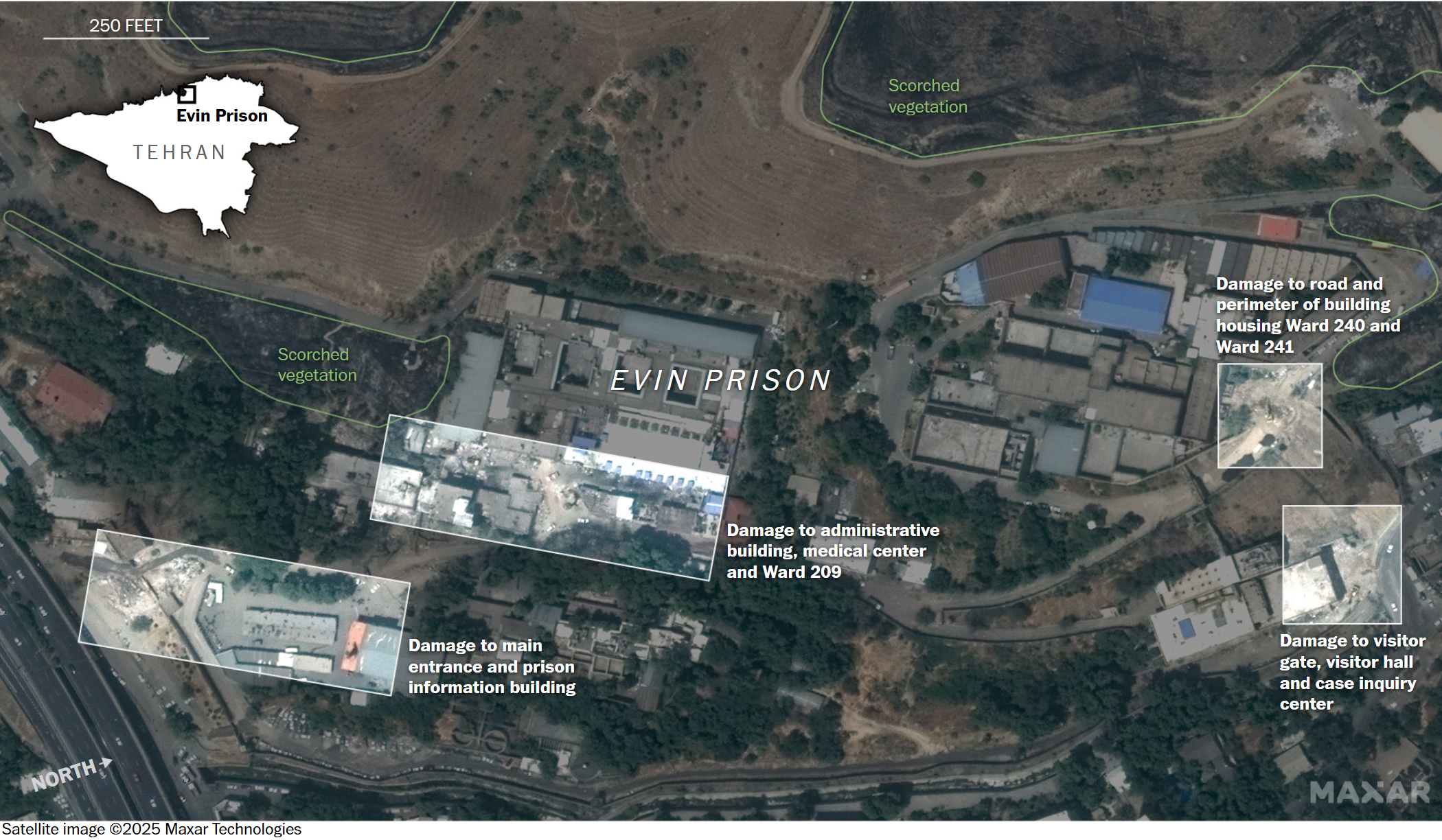


The post Israeli strike hit four areas in notorious Tehran prison. Civilians among the dead. appeared first on Human Right Activists In Iran.


The post Israeli strike hit four areas in notorious Tehran prison. Civilians among the dead. appeared first on Human Right Activists In Iran.
The Economic Times â Satellite radar data from Oregon State University, analyzed by The Daily Telegraph, indicates that during the recent 12-day conflict between Iran and Israel, six Iranian missiles penetrated Israeli airspace and struck five military facilities, including a major air base, intelligence centers, and a logistics hub.
These impacts are in addition to at least 36 other Iranian missiles that penetrated Israelâs air defense systems, which caused damage to residential and industrial buildings.
While most Iranian missiles were intercepted, the success rate of Iranâs strikes improved as the war progressed, possibly due to improved launch tactics or the deployment of more advanced missile systems.
This analysis also reveals that Iranâs success in penetrating Israeli defenses with its missiles peaked at 16 per cent by the seventh day of the war, before declining thereafter.
Satellite data indicates that Iran adapted its attack strategy to overwhelm Israeli defenses by using fast missiles alongside slower drones to divert attention.
Despite this, about 84â87 percent of Iranian missiles were intercepted, according to various sources.
Human Rights Activists in Iran (HRANA), a US-based organization, reported that more than 900 people have been killed and over 3,000 wounded as a result of Israeli strikes on Iran.
The Iranian health ministry has stated that the number of wounded exceeds 4,000.
The post Israel hid massive damage from Iranâs missile strike; satellite images reveal 5 military bases hit appeared first on Human Right Activists In Iran.
MSN â More than 650 people have been killed in Iran following a massive Israeli bombing campaign launched a week ago, an activist group said on Friday.
The US-based Human Rights Activists News Agency (HRANA) reported that 657 people had died and 2,037 injured in the nationwide airstrikes.
The Iranian government does not publish daily figures on casualties.
The HRANA relies on a broad network of informants and publicly available sources.
The group said the dead included at least 263 civilians and 164 members of the military.
Another 230 fatalities remain unidentified.
The network also reported damage to civilian infrastructure, including a projectile striking a childrenâs hospital in Tehran, which did not result in injuries.
In the western province of Ilam, a fire station was damaged, HRANA said, while an Israeli attack on a car factory in western Iran triggered a large fire.
Israel maintains that its objective is to prevent Iran from acquiring nuclear weapons, which it considers an existential threat.
The post Over 650 die in Iran after first week of Israeli strikes appeared first on Human Right Activists In Iran.
The Indian Awaaz â A fragile ceasefire has brought a much-needed reprieve to millions of civilians caught in the deadly crossfire of the Iran-Israel conflict, which has reportedly claimed close to 900 lives. U.S. President Donald Trump, who characterized the intense hostilities as a â12-day war,â announced that both nations had simultaneously sought his administrationâs intervention for peace.
The truce was declared after Iranian state media reported that a ceasefire had been âimposed on the enemy,â following what Tehran described as a military response to âU.S. aggression.â This announcement came just hours after Iran launched missile strikes on the U.S. Al Udeid Air Base in Qatar, a retaliatory move that significantly escalated the conflict by directly involving American forces.
The Human Rights Activists News Agency (HRANA) reported a staggering toll of at least 865 fatalities in Iran as of June 22nd. This includes 215 military personnel, 363 civilians, and 287 unidentified individuals. More than 3,300 people have also been injured. These figures are considerably higher than those released by Iranian health authorities, which reported 224 deaths and over 2,500 injuries. Both sources, however, underscored that the majority of casualties were civilians.
The humanitarian crisis in Iran has deepened dramatically. Initially targeting military infrastructure, Israeli airstrikes increasingly struck residential areas and even prisons. This escalation has led to massive internal displacement, forcing millions to abandon their homes. Among the deceased were aid workers, children with disabilities, and nuclear scientists, highlighting the widespread and indiscriminate impact of the violence. Iranâs judiciary specifically noted that parts of Tehranâs Evin Prison, known for holding political detainees, were also targeted by Israeli forces.
In Israel, the human cost has also been severe. Iranian missile strikes have resulted in the deaths of at least 24 civilians and nearly 600 injuries. The southern city of Beersheba bore the brunt of attacks in the final hours before the ceasefire, with emergency services confirming at least three deaths and multiple injuries. Rescue teams are currently sifting through rubble in damaged buildings, searching for survivors.
President Trump confirmed that his diplomatic and security teams worked tirelessly overnight to broker the truce, which reportedly took effect around 4 a.m. local time. Israeli strikes on Iranian cities ceased shortly before the ceasefire, despite a significant intensification of hostilities in the lead-up to the agreement.
Israeli Prime Minister Benjamin Netanyahu has yet to issue a public statement regarding the ceasefire. However, reports indicate that he convened an emergency meeting of the Security Cabinet, instructing ministers to refrain from public comments on the agreementâs terms.
The rapid escalation over the past 12 days has overwhelmed emergency services in both nations. Hospitals are struggling to cope with the influx of wounded, while rescue teams continue their efforts to clear debris and provide assistance to those affected. The UNHCR and other international humanitarian agencies have urgently called for immediate de-escalation, robust protection for civilians, and unhindered access for critical relief operations.
Despite the declared truce, an air of uncertainty persists. Iran has stated its willingness to halt its responses if Israeli attacks cease, but Israeli officials have largely remained silent on the agreementâs specifics. The conflict has starkly illustrated how quickly regional tensions can spiral into full-scale warfare, with ordinary citizens disproportionately bearing the devastating consequences.
The post Ceasefire Brings hope to War-Weary Civilians as Iran-Israel Conflict Claims Over 900 Lives appeared first on Human Right Activists In Iran.
All Israel News â Iranian President Masoud Pezeshkian congratulated the Iranian people for their âhistoric punishmentâ of the âenemy aggressorâ during a speech to celebrate Iranâs victory over Israel in a victory parade in Tehran, according to the regime-affiliated Fars News Agency.
âAfter the courageous resistance of your great and history-making nation, we are witnessing a ceasefire and cessation of the 12-day war that was imposed on the Iranian nation by the adventurism and incitement of the Zionist regime,â Pezeshkian stated.
âDuring this period, the world watched the authority of the great Iran, which enjoyed the support of its people, and although the beginning of this imposed war was a terrorist enemy, its end was marked by the will and authority of the great people of Iran. Today, in a situation where the enemy aggressor agreed to stop fomenting war, he suffered a severe and historic punishment,â Pezeshkian continued.
Iranian Quds Force Commander Esmail Qaani was also seen for the first time since the start of the campaign against Iran, when he participated in the victory celebrations in Tehran.
Later on Wednesday morning, during an Iranian cabinet meeting, Pezeshkian said, âThe Zionist regimeâs actions made us realize more than ever that it is all the people of Iran â not just one party, one minority, or one group â who are capable of defending the country.â
Despite Pezeshkianâs statements, reports coming out of Iran prior to the regimeâs decision to cut off internet access in the country, indicated that the government has begun to use the Basij Force, a kind of paramilitary force, infamous for cracking down on dissent and for violent oppression of Iranian protesters.
Iranian accounts on social media posted messages detailing police and Basij checkpoints set up throughout Tehran, in an attempt to find people protesting the regime, taking pictures of Israeli strikes, or engaged in other anti-regime behaviors.
In his speech to the cabinet, President Pezeshkian personally thanked the Basij Force.
The Public Relations Department of the Islamic Revolutionary Guard Corps (IRGC) announced the details of the funeral ceremony of the IRGC commanders killed by âthe brutal Israeli aggressionâ during Operation Rising Lion.
According to the Fars News Agency, the public funeral ceremonies for âthe senior martyred commanders, along with other martyred commanders of the Zionist regimeâs brutal aggressionâ will be held on Saturday, June 28, in Tehran, while the funeral for IRGC commander Hossein Salami, and Brig,-Gen. Haj Masoud Shanei, his office director, will be held June 26 in their hometown of Golpayegan.
Meanwhile, the Far News Agency claimed that three Mossad spies were executed by hanging earlier this morning, in the Urmia Prison in the western part of the country.
âThree spies affiliated with the terrorist intelligence agency of the Zionist regime, Mossad, were executed by hanging in Urmia,â the site reported.
Fars News said the three men, Idris Ali, Azad Shojaei, and Rasoul Ahmad Rasoul, were accused of smuggling assassination equipment into Iran. The three were charged with ââwaging war against Godâ (moharebeh) and âspreading corruption on earthâ (efsad fel-arz) through collaboration with hostile foreign governments.â
However, despite the accusation of contributing to the assassination of government figures, the three were not connected to any of the recent assassinations during Operation Rising Lion.
Iran International, a news site affiliated with opposition movements, said the three Kurdish [men] were implicated in the killing of Mohsen Fakhrizadeh, an Iranian nuclear physicist and scientist who headed Iranâs nuclear program until his surprise killing in November 2020.
Fakhrizadeh was killed by a remotely-operated machine gun, rigged with facial recognition software, and satellite uplinks. While the operation is largely believed to have been carried out by the Mossad, it required willing participants to bring in the components, assemble them, and make sure the system was operating properly.
The three men, who ran a liquor smuggling operation, are accused of smuggling the components into Iran.
However, Iran International cited sources familiar with the families in Iran, who claimed the men were forced into giving a confession through torture.
The Human Rights Activist News Agency (HRANA) reported that so far, 823 Iranian citizens have been arrested on security charges since the start of the war. HRANA said that 286 individuals were arrested for activities on social media or for publishing posts about the Israeli attacks, while 537 were arrested for âsecurity reasons.â
Iranian police announced that checkpoints will continue throughout Iran despite the end of the conflict, according to Iran International.
The news outlet cited the spokesperson of the Internal Affairs Commission, who said in a speech that the police deputies have called for the strengthening of checkpoints.
The post Iran celebrates end of war as âvictoryâ over âenemy aggressorâ while hunting for internal dissidents appeared first on Human Right Activists In Iran.
NEWS AZ â The death toll in Iran from Israeli military strikes has risen to 1,054, with 4,476 others injured, the US-based Human Rights Activists News Agency (HRANA) announced.
Of those killed, 417 were civilians, and around 2,000 of the wounded were non-combatants, according to HRANA, News.Az reports, citing Iranian media.
A ceasefire between Iran and Israel took effect earlier in the day and remains in place.
Since the start of the conflict, at least 823 people have been arrested in Iran, the human rights group added.
The post Iran death toll hits 1,054 amid Israeli strikes as ceasefire comes into effect appeared first on Human Right Activists In Iran.
Worldcrunch â When rockets began raining down on Tehran the night of June 13, and open military conflict between Israel and Iran erupted, it wasnât just the skies that went dark. Almost immediately, internet speeds in Iran dropped sharply. Access to already-blocked platforms and websites became even more restricted. Then, on June 18, the government cut off nearly all connections to the outside world. For 72 hours, 91 million people were plunged into a digital void: no WhatsApp, no Google, no email, no VPN, no way to reach beyond the countryâs borders.
It was the most severe internet blackout in the history of the Islamic Republic, and full access still hasnât been restored. At present, network connectivity remains at just 20% of normal levels. NetBlocks, the organization that tracks global internet disruptions, reported almost no data traffic flowing between Iran and other countries between June 18 and June 21. Not even during past crackdowns, like the November 2019 protests or the 2022 âWomen, Life, Freedomâ movement, was the digital shutdown so complete. Back then, at least some inbound data traffic still trickled through.
Officially, Iranâs Ministry of Communications claimed the blackout was a defensive move, designed to shield the population from Israeli cyberattacks. And there had indeed been attacks in the days leading up to it, targeting banks, government servers, and military infrastructure.
The cyber war between Iran and Israel, however, didnât start last week. It goes back much further.
A âNational Internetâ megaproject
One early turning point came in 2010, when the Stuxnet virus sabotaged Iranian centrifuges in the Natanz nuclear facility, setting back the countryâs atomic program by years. In response, Tehranâs leadership began working to safeguard its digital infrastructure from outside attacks.
Thatâs when the so-called âNational Internetâ megaproject was born. At its core, the plan is to build a nationwide intranet, cut off from the rest of the world. The idea is that the government can flip the switch whenever it sees fit. Some observers now fear that what was meant to be an emergency measure could become the new normal. The system was first deployed during the 2019 protests, not just to block demonstrators from organizing but also to stop videos and photos from spreading. The blackout ended up lasting longer than the unrest itself, likely to stress-test the system and find weak spots.
âSince 2019, all international traffic has been routed through a single hub,â says Azadeh Akbari, Assistant Professor of Digital Transformation at the University of Twente in the Netherlands. âThe state has completely centralized the infrastructure. It makes surveillance easier and serves as a show of authoritarian power.â
The National Internet was largely developed under former Communications Minister Mohammad-Javad Azari Jahromi, a one-time intelligence officer. The idea was to create a self-contained infrastructure, complete with domestic search engines, messaging apps, email services, and online banking, modeled on Chinaâs system.
This network has now been reactivated. For the most part, itâs still running. Iran has homegrown alternatives to nearly every major online service, from a ride-hailing app to its own version of Amazon. But one thing is notably absent: social media and messaging platforms. Iranian alternatives do exist, but hardly anyone trusts them.
As a common joke goes: âIranian messengers have three checkmarks: one for the sender, one for the recipient, and one for the guy reading over your shoulder.â Many Iranians would rather stay out of touch for days than risk using those apps. Even when the government announced on June 19 that foreign numbers could now be registered, supposedly to let people abroad contact loved ones inside Iran, few people took the offer seriously.
A 72-hour blackout
While the government pitches the shutdown as a protective measure, many people experience it as a terrifying loss of control. In brief conversations with those whoâve managed to get online, one word keeps coming up: âpowerlessness.â For Iranians abroad, the 72-hour blackout meant total silence from family members, just as bombs were falling.
For the first time, even telephone lines were restricted. Calls from foreign numbers to Iranian phones were blocked, cutting off what was often the last reliable line of communication. While the Israeli bombs and missiles were striking, that silence caused widespread panic.
From a strategic standpoint, shutting off the internet may have made sense. Reports suggest that high-ranking officers were located and killed using the GPS data from their phones. Akbari, who specializes in digital surveillance, suspects the regime may have used the total blackout to move Supreme Leader Ali Khamenei to a safe location. Israelâs Defense Minister had openly threatened to target him.
But this digital blackout didnât just sever family ties. It stripped civil society of its most vital tools in an instant. Despite years of war rhetoric, the government had no warning system in place for missile attacks, something that was standard even during the Iran-Iraq war in the 1980s. In the early days of the conflict, it was civil society that stepped in, using Telegram channels and Twitter accounts to share air raid alerts. That too disappeared when the shutdown took full effect.
Iran ranks near the bottom (176 out of 180) in Reporters Without Bordersâ press freedom index. Trust in state media is virtually nonexistent, and the national broadcaster is seen as a mouthpiece for propaganda. The war was barely covered, with most airtime dedicated to boasting about supposed victories over Israel. In that vacuum, independent news outlets and social media often serve as the only real sources of information. Without access to them, the public is left completely in the dark.
Some government offices, however, managed to stay online. This was discovered by internet activist Mark Pashmforoush and his team, who have been working on digital freedom tools since the 2019 shutdown. He developed a VPN service called Oblivion. According to his findings, some government agencies began selling VPNs at inflated prices during the blackout. But these connections were under state control. Anyone who used them became traceable, and therefore, vulnerable. A double win for the surveillance state.
False hope in Starlink
Many have pinned their hopes on Elon Muskâs satellite internet system, Starlink. But this, too, has proven misleading. âStarlink is not legally authorized in Iran,â says Pashmforoush. âRight now, about 30,000 receivers are active in the country, but the price has shot up to around $3,000 per device.â Before the war, they went for about $850. On top of that comes a monthly fee of roughly $100, a steep price for most Iranians.
The risks are just as high. Starlink hardware must be smuggled in, dodging countless checkpoints along the way. Using it can lead to espionage charges in kangaroo courts. In the worst cases, it could result in the death penalty. Even forgetting to turn on a VPN when logging into a government website could make a user identifiable. The fear of being tracked is real.
And yet, the need to connect to the outside world is stronger. Pashmforoush, who monitors Telegram groups dedicated to Starlink sales, has seen demand steadily rising.
The so-called war-related shutdown, along with the entire National Internet project, is being marketed by the state as a show of âdigital sovereignty.â In reality, it targets the very digital spaces that hold society together, says Azadeh Akbari. Having once been a womenâs rights activist in Iran, she is intimately familiar with the governmentâs methods. What she sees now is a shift from digital authoritarianism to full-blown digital totalitarianism.
âThe digital sphere is just an extension of social life,â Akbari says. âCutting it off destroys support networks, neighborhood bonds, grassroots organizing: everything that keeps a society functioning during a crisis.â
The post How Iran Used War With Israel To Stress Test Its Chinese-Style Internet Controls appeared first on Human Right Activists In Iran.
In 2024, Iran executed at least 930 individuals, the majority for charges that failed to meet the threshold of âmost serious crimesâ required under international law.
Furthermore, given the systemic lack of fair and transparent trials within the Iranian judiciary, even executions for crimes that may meet this threshold constitute arbitrary deprivations of life, in clear violation of international human rights standards. Currently, 54 political and security prisoners in Iran face the death penalty, including two women. One of these women is being persecuted for her humanitarian work in refugee camps, where she supported individuals forcibly displaced by the Islamic State. These cases underscore the urgent need for robust international action to hold Iran accountable for its widespread and unlawful use of capital punishment as a tool of repression.
Pakhshan Azizi, a female resident of Mahabad, was arrested on August 4, 2023, and detained in Tehranâs Evin Prison under harsh conditions. Accused of âBaghiâ through alleged membership in opposition groups, she was sentenced to death and four years of imprisonment by the Tehran Revolutionary Court, presided over by Judge Iman Afshari, sanctioned by the United Kingdom and Canada for his role in serious human rights violations, particularly for violations for the right to a fair trial and the right to freedom of expression of political protesters. Judge Afshari also sentenced three of Aziziâs family members to one year in prison for the charge of âassisting a criminal to evade trial and convictionâ. They were initially arrested alongside Azizi but were released on bail.Â
The Supreme Court has recently upheld the sentence imposed by Afshari, raising urgent concerns about the imminent threat to Aziziâs life.Â
Her lawyers have highlighted that the evidence presented to the Supreme Court demonstrated that she had had no involvement in military activities. Further, Ms. Azizi has been solely engaged in humanitarian efforts, providing services to vulnerable women and children, namely to those directly impacted by the Islamic State in Sinjar. Numerous pieces of evidence support Ms. Aziziâs claim that she has worked in refugee camps housing displaced Yazidis in Syria. Certification Letter from the Kurdish Red Crescent and Shams Rehabilitation Organisation detail her service caring for women and children survivors of conflict. These letters confirm her volunteer role at multiple camps including Al-Hol and Nowruz. Numerous pieces of evidence supporting Ms. Aziziâs humanitarian activities have been presented. Her lawyers have expressed concern over the rushed handling of the case and called for a thorough and fair review of the evidence.
HRA highlights that the use of capital punishment in cases like Ms. Aziziâs is part of a broader strategy by Iranian authorities Ms. Azizi has faced prolonged detention, denial of legal representation. This is not her first encounter with state repression; she was previously detained in 2009.
HRA is closely monitoring Ms. Aziziâs case alongside the 53 other individuals facing the death penalty, including Varisheh Moradi, another woman currently detained in Evin Prison.Â
The international community must unequivocally condemn the use of the death penalty. Governments, human rights organizations, and global institutions should urgently call on Iranian authorities to commute Ms. Aziziâs sentence, ensure her access to a fair trial, and halt the executions of other political prisoners in Iran.
International organizations and donors involved in humanitarian relief efforts in Syria, in particular, should urgently speak out against Ms. Aziziâs death sentence. As a dedicated aid worker who has contributed to humanitarian efforts, her commitment to alleviating human suffering underscores the injustice of this cruel and disproportionate punishment.
Â
The Latest Comprehensive List of 54 Political and Security Prisoners Sentenced to Death in Iran
The post Female Humanitarian Aid Worker Among 54 Political Prisoners, 2 Women, Facing Execution in Iran appeared first on Human Right Activists In Iran.
Human Rights Activists in Iran (HRA), through the dedicated efforts of its Department of Statistics and Publications, publishes its annual Gregorian calendar-based analytical and statistical report on the human rights situation in Iran for the one-year period (January 1, 2024, to January 1, 2025). This report is the culmination of the organizationâs daily endeavors in recent years, forming part of a daily statistical project that began in 2009. It provides an analytical-statistical overview of human rights in Iran.
This annual report on human rights violations in Iran represents a synthesis of 9,487 human rights reports, gathered from 116 NGOs and news sources within the past calendar year. HRANA (Human Rights Activists News Agency) contributed 38.91% of the reports utilized in this publication, with 26.63% originating from official or government-affiliated Iranian sources, and the remaining 34.47% from other news or human rights sources.
In this 86-page report, various aspects such as womenâs rights, workersâ rights, childrenâs rights, prisonersâ rights, etc., are briefly examined and statistically analyzed, accompanied by relevant charts for enhanced reader comprehension. According to this report, the focus of human rights monitoring in Iran, in comparison between the capital and other areas, remains unequal. This long-standing inequality shows that in the last year, reporting from non-central areas has decreased by 8.8% compared to the capital. This situation continues to indicate the lack of adequate monitoring of other areas of the country relative to the center by civil society.
Although this report predominantly reflects the extensive efforts of courageous human rights defenders in Iran, who bear significant costs in pursuit of their humanitarian ideals, it inevitably has limitations. These include restrictions on the activities of human rights organizations by the Iranian government and governmental impediments to the free flow of information. Consequently, while this report strives for accuracy, it cannot be considered entirely error-free or a complete reflection of the human rights situation in Iran. Nevertheless, it stands as one of the most precise, comprehensive, and well-documented reports on human rights violations in Iran, offering valuable insights for organizations and defenders of human rights to better understand the human rights situation in Iran, its challenges, and potential opportunities.
The post Annual Analytical and Statistical Report on Human Rights in Iran for the year ²â°Â˛â´ appeared first on Human Right Activists In Iran.
The Islamic Revolutionary Guard Corps (IRGC) has long been a shadowy force, with its operations largely hidden from the international community. Its influence on Iran and the broader Middle East has been both profound and destructive. Now, after two years of intensive research, the Pasdaran Documentation Project (PDP) is launching an unparalleled resource that seeks to bring transparency to the IRGCâs activities. This project marks the culmination of extensive work involving thousands of documents and the identification of key IRGC units and personnel alongside a legal analysis of incidents attributed.
Available at www.iranpdp.org, this database provides unprecedented access to detailed information on the IRGC.
Founded by Human Rights Activists (HRA), the Pasdaran Documentation Project was established to shed light on the structure, operations, and influence of the IRGCâa state within a state in Iran. The IRGCâs activities have not only shaped Iranâs political landscape but also contributed to widespread human rights abuses and violations of international law.
The projectâs core objective is to identify the IRGCâs personnel, units, and key players as a step toward dismantling the regimeâs power structure. By exposing the individuals and entities involved in abuses across decades, the project helps create a roadmap for judicial and quasi-judicial accountability, including international targeted sanctions, and state-led prosecution under international law.
The projectâs underlying philosophy stems from the belief that public awarenessâand open-source accessibility to underlying informationâis the key to change. For decades, the IRGC has operated behind a veil of propaganda, with many Iranians and global observers unaware of its extensive illicit activity. This project intends to break this cycle by offering transparent, accessible, and meticulously researched information on the IRGCâs structure and activity.
In the projectâs first phase, the structure and chain of command were created through an in-depth analysis of books derived from Iran, first-hand accounts, open-source data, and more. This comprehensive research would not have been possible without a pioneering technological solution developed by HRA.
HRA has designed an innovative software called NALA, a multilingual research facilitation tool specifically created to enhance data analysis and streamline content discovery. NALA processes data in multiple languages, identifies key themes using custom keyword lists, and retrieves relevant material with precision. Its advanced filtering system minimizes errors and saves time, making it an indispensable tool with sustainable applications that extend far beyond its original purpose. The integration of NALA into the PDP has enabled a level of depth, accuracy, and efficiency that would otherwise be unattainable.
Understanding the IRGC is critical not only for those directly affected by its actions but also for the global human rights community. The IRGC was established in 1979 to protect and export Iranâs Islamic Revolution. Over time, it has morphed into a militarized and economic juggernaut with unparalleled influence over Iranian politics, military actions, and regional affairs. Its tentacles reach far beyond Iranâs borders, impacting conflicts in Syria, Iraq, Lebanon, and Yemen and extending its ideological and military support to Iran-backed groups such as Hezbollah and Hamas.
What makes the IRGC particularly dangerous is its multifaceted approach to controlâusing both brute force through its military wing, the Quds Force, and soft power through an intricate web of economic, political, and media influence. It has committed or facilitated endless human rights violations, including torture, unlawful detention, extrajudicial killings, and the repression of political dissent.
At the heart of the Pasdaran Documentation Project is its public-facing website, a powerful tool that offers an in-depth look into the IRGCâs operations. This online database will be the first of its kind, providing easily accessible and verifiable data on the IRGC, including:
The Pasdaran Documentation Project is more than just an archiveâit is a living resource designed to empower activists, policymakers, and legal experts. By providing open access to verifiable data, the PDP will serve as a cornerstone for human rights advocacy and lay the groundwork for initiating investigations into the IRGC and its members for future prosecutions.
The Pasdaran Documentation Project is an invaluable resource for anyone seeking to understand or challenge the IRGCâs power. HRA encourages human rights activists, legal experts, and policymakers to explore the website, use its tools, and help shine a light on the IRGCâs activities. By working together, we can build a future where the IRGCâs influence is curbed, and justice is served.
For media inquiries, detailed reports, or additional information, please contact us at [email protected]. The PDP team is available for interviews, in-depth briefings on methodology and contents unveiled, and to assist in the preparation of news reports and background understanding regarding the IRGC.
This is just the beginning. The work of exposing the truth and ensuring justice continues as PDP is updated daily with new information.
The post Introducing the PDP: An Unprecedented Resource on Iranâs Islamic Revolutionary Guard Corps appeared first on Human Right Activists In Iran.