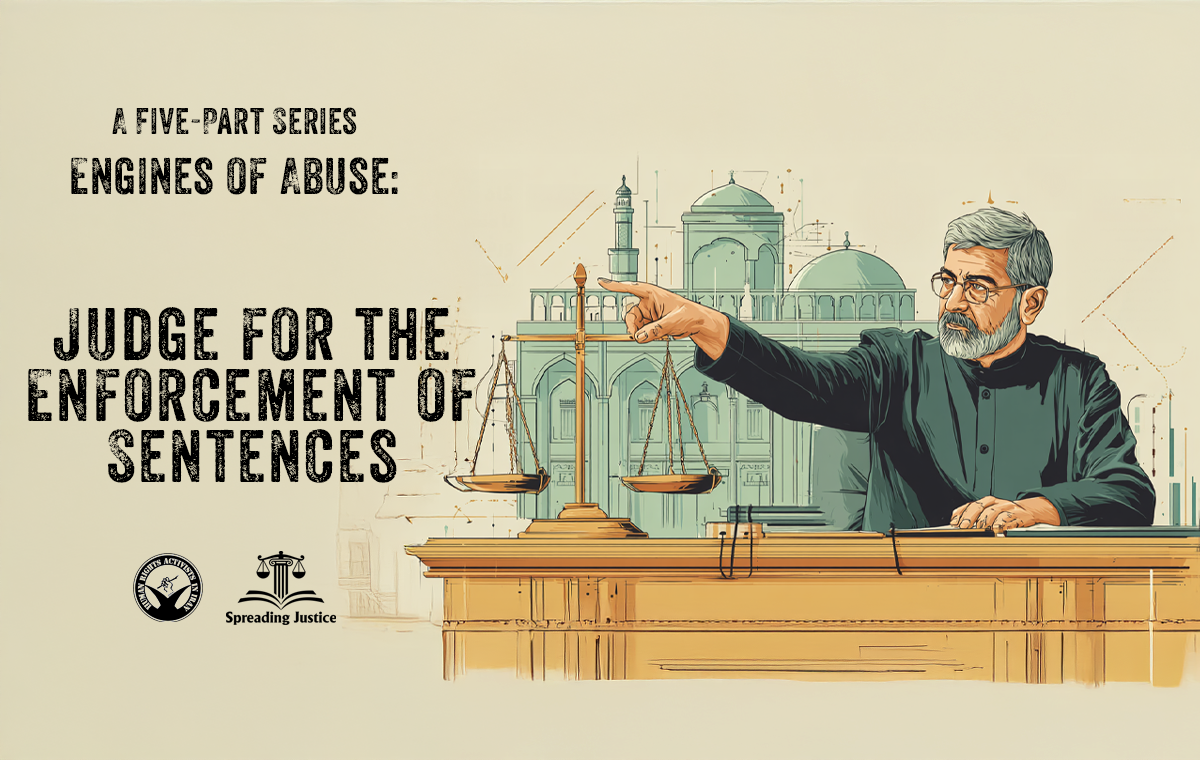
This report marks the second in a series of five articles published by HRA through its Spreading Justice Project, dedicated to shedding light on the roles within the Iranian regime’s system that enable and sustain serious human rights violations, as well as violations of international law.
The Spreading Justice database currently contains over a thousand profiles of individuals and entities implicated in such abuses. This series aims not only to highlight who these individuals are and how the Spreading Justice project has documented their behavior, but also to examine how and why the positions they occupy perpetuate the entrenched cycle of repression and abuse. The series is published in the hope that a deeper understanding of the system of abuse will support ongoing efforts to hold Iran accountable and will also help shape recommendations for urgent reform.
Understanding the Judge for the Enforcement of Sentences in the Iranian Legal System
In Iran’s criminal justice system, the judge responsible for enforcing sentences (known as the Judge for the Enforcement of Criminal Sentences) plays a key role in implementing judicial rulings and overseeing the treatment of prisoners. This judge becomes involved after a person is convicted and begins serving their sentence, ensuring that the punishment is carried out as directed at sentencing. He also monitors the legal status and rights during imprisonment.
According to the Criminal Procedure Code passed in 2013 (1392)[1], the enforcement of sentences of the incarcerated prisoners is the responsibility of the Prosecutor, and the “Department for the Enforcement of Criminal Sentences,” under his supervision and authority, undertakes this responsibility in jurisdictions designated by the Head of the Judiciary within the Public Prosecutor’s Office.
Additionally, the Department for the Enforcement of Criminal Sentences, or one of its units, can, with the approval of the Head of the Judiciary, be stationed in prisons or correctional institutions. In judicial districts (bakhsh), the enforcement of criminal sentences is the responsibility of the Head of the Court for the Enforcement of Sentences.
The duties of the Judge for the Enforcement of Criminal Sentences, based on Article 489 of this code,[2], are as follows:
- (a) Issuing orders for the enforcement of enforceable criminal sentences and supervising the manner of their execution
- (b) Supervising prisons in matters related to prisoners
- (c) Providing opinions on prisoners eligible for pardon and conditional release in accordance with laws and regulations
- (d) Granting leave to convicts based on laws and regulations
- (e) Making decisions regarding elderly convicts, individuals with mental illness or serious physical conditions, and other convicted persons in need of special care and attention, such as authorizing their hospitalization in medical centers in accordance with relevant rules and regulations
- (f) The performance of any other duties established by laws and regulations concerning the enforcement of punishments, or assigned to the Judge for the Enforcement of Sentences or the Prison Supervisor.
It is worth noting that according to Article 494 of the same code[3], the process of enforcing a sentence begins upon the order of the Judge for the Enforcement of Criminal Sentences and cannot be halted unless explicitly stipulated by law.
Also, pursuant to Article 495 of the same Regulation, criminal judgments are executed by order and under the supervision of the Judge for the Enforcement of Sentences. In cases where, according to the law, the execution of a judgment must be carried out by ministries, governmental institutions and companies, public non-governmental organizations, or other bodies explicitly named by law, the Judge for the Enforcement of Sentences, while issuing the enforcement order and providing the necessary instructions, shall supervise the manner of execution and the actions taken by those entities.
Accordingly, the decision to carry out all sentences, including punishments such as execution, flogging, and amputation, is made by this judicial authority. Although the Judge for the Enforcement of Sentences does not determine the type of punishment (as this responsibility lies with the sentencing court), the final implementation of corporal punishments or the death penalty cannot proceed without the judge’s written order. This is in direct contradiction with the International Covenant on Civil and Political Rights[4], to which Iran is a state party, and which strongly prohibits cruel and inhuman punishments such as flogging and amputation.
According to HRANA’s Statistics Department, the denial of medical care for prisoners has a documented history. 2,057 cases of denial of medical care have been documented between November 2022 and November 2025.
Most recently, according to HRANA[5], between September 16 and 25, 2025, three women, including political prisoner Somayeh Rashidi, along with Soudabeh Asadi and Jamile Azizi, died in Qarchak Prison due to a lack of medical care.
Or in another case, HRANA reported that Ashkan Fahim, a political prisoner held in Mahabad Prison, has been denied medical furlough or transfer to medical facilities outside the prison despite suffering from heart disease and severe vision impairment[6]. According to this report, the Mahabad prison infirmary lacks even the most basic medical facilities. Therefore, based on the decision of the Judge for the Enforcement of Criminal Sentences to obstruct medical care for a sick prisoner constitutes a violation of the right to physical and mental health under Article 9 of the Basic Principles for the Treatment of Prisoners [7], which states that “Prisoners shall have access to the health services available in the country without discrimination on the grounds of their legal situation.” It also contravenes the Nelson Mandela Rules[8], particularly Rules 24, 25(1), and 27, which require prompt, adequate, and clinically independent medical care for all prisoners. This, among other internationally binding obligations.
Spreading Justice Database on Judges for the enforcement of the Sentences
| Name | Current Position | Location |
| Zargar | Judge for the enforcement of the sentences of the Public and Revolutionary Justice Office of Mashhad | Mashhad |
| Mohammad Mehrdadi | Assistant Prosecutor and Head of Branch 1 of the Enforcement of Judgments Office of Evin Prosecutor’s Office” | Tehran |
| Esmatollah Jaberi | Assistant Prosecutor for the Enforcement of Criminal Judgments | Tehran |
| Name | Previous Position | Current Position | Location |
| Mohammad Nasiri-Pour | Judge of the Evin Prosecutor’s Office for the enforcement of those sentenced to death | Unknown | – |
| Amir-Hossein Tarian | Assistant Public Prosecutor of the first branch of the enforcement unit of the Evin Prosecutor’s Office (Holy Martyr) | Head and Investigator of the First Investigation Branch of Evin Prosecutor’s Office (Holy Martyr) | Tehran |
[1] “Iran Criminal Procedure Code (Ayin-e Dadresi Keyfari), Print Edition,” Ekhtebar (PDF), accessed 24 August 2025, https://www.ekhtebar.ir/wp–content/uploads/2014/05/قانون–آئین–دادرسی–کیفری–پرینت.pdf.
[2] Mizan Online, “Duties of the Criminal enforcement Judge,” published 04 Shahrivar 1402 (≈ 26 August 2023), Mizan Online, https://www.mizanonline.ir/fa/news/4731299/%D9%88%D8%B8%D8%A7%DB%8C%D9%81-%D9%82%D8%A7%D8%B6%DB%8C-%D8%A7%D8%AC%D8%B1%D8%A7%DB%8C-%D8%A7%D8%AD%DA%A9%D8%A7%D9%85-%DA%A9%DB%8C%D9%81%D8%B1%DB%8C.
[3] “Iran Criminal Procedure Code (Ayin-e Dadresi Keyfari), Print Edition,” Ekhtebar (PDF), accessed 24 August 2025, https://www.ekhtebar.ir/wp–content/uploads/2014/05/قانون–آئین–دادرسی–کیفری–پرینت.pdf.
[4] “International Covenant on Civil and Political Rights,” OHCHR, adopted 16 December 1966, accessed 24 August 2025, https://www.ohchr.org/en/instruments-mechanisms/instruments/international-covenant-civil-and-political-rights.
[5] Hrana, “Qarchak Prison in Varamin: Consecutive Deaths Due to Lack of Medical Care and Treatment Facilities”, 25 September 2025, https://www.hra-news.org/2025/hranews/a-56792/
[6] HRANA, “Deprivation of medical care for Ashkan Fahim in Mahabad prison,” published 29 July 2025, HRANA, https://www.hra-news.org/2025/hranews/a-55774/
[7] “International standards on the right to physical and mental health”, UN, https://www.ohchr.org/en/special-procedures/sr-health/international-standards-right-physical-and-mental-health
[8] “The United Nations Standard Minimum Rules for the Treatment of Prisoners”, UN, https://www.unodc.org/documents/justice-and-prison-reform/Nelson_Mandela_Rules-E-ebook.pdf