Human Rights Activists in Iran (HRA), through the dedicated efforts of its Department of Statistics and Publications, publishes its annual Gregorian calendar-based analytical and statistical report on the human rights situation in Iran for the one-year period (January 1, 2025, to December 20, 2025). This report is the culmination of the organization’s daily endeavors in recent years, forming part of a daily statistical project that began in 2009. It provides an analytical-statistical overview of human rights in Iran.
This annual report on human rights violations in Iran represents a synthesis of 10,826 human rights reports, gathered from 122 legal and news sources within the past calendar year. HRANA (Human Rights Activists News Agency) contributed 50.58% of the reports utilized in this publication, with 23.98% originating from official or government-affiliated Iranian sources, and the remaining 25.44% from other news or human rights sources.
In this 83-page report, various aspects such as women’s rights, workers’ rights, children’s rights, prisoners’ rights, etc., are briefly examined and statistically analyzed, accompanied by relevant charts for enhanced reader comprehension. According to this report, the focus of human rights monitoring in Iran, in comparison between the capital and other areas, remains unequal. This long-standing inequality shows that in the last year, reporting from non-central areas has decreased by 17.7% compared to the capital. This situation continues to indicate the lack of adequate monitoring of other areas of the country relative to the center by civil society.
Although this report predominantly reflects the extensive efforts of courageous human rights defenders in Iran, who bear significant costs in pursuit of their humanitarian ideals, it inevitably has limitations. These include restrictions on the activities of human rights organizations by the Iranian government and governmental impediments to the free flow of information. Consequently, while this report strives for accuracy, it cannot be considered entirely error-free or a complete reflection of the human rights situation in Iran. Nevertheless, it stands as one of the most precise, comprehensive, and well-documented reports on human rights violations in Iran, offering valuable insights for organizations and defenders of human rights to better understand the human rights situation in Iran, its challenges, and potential opportunities.
Download the full version of the report in PDF format
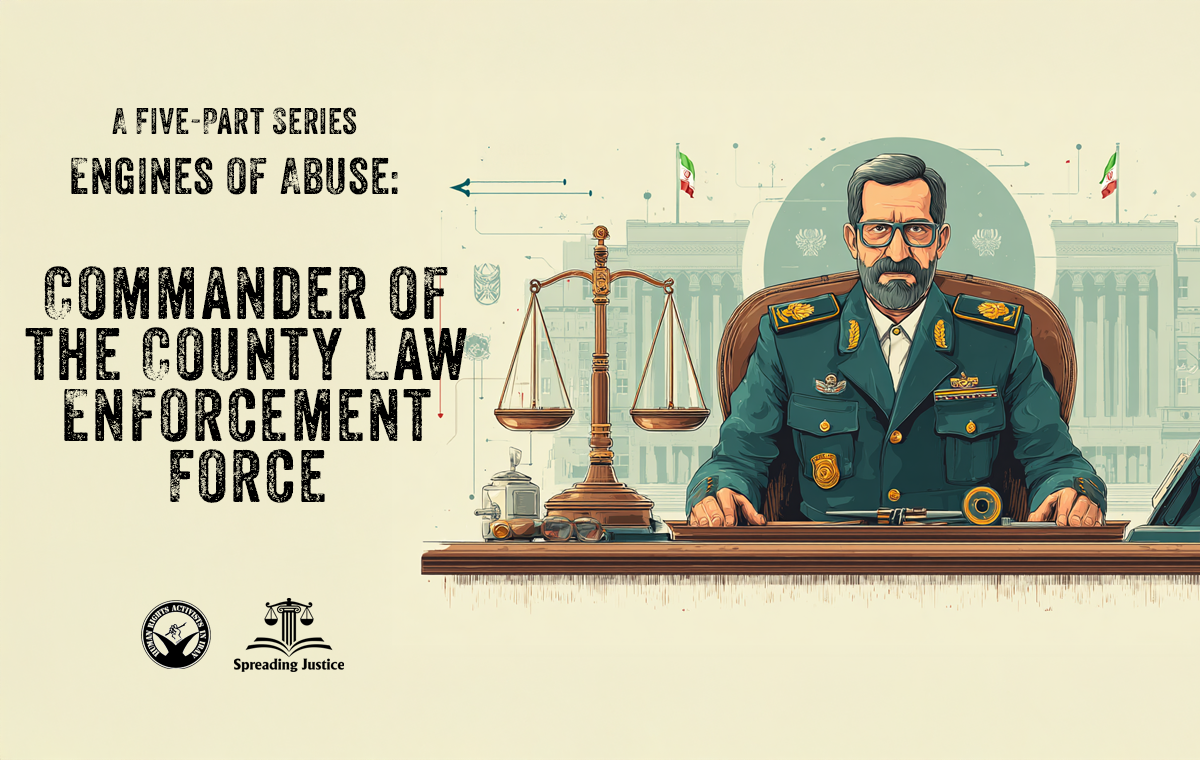
This report is the final article in a five-part series published by Spreading Justice, a project of Human Rights Activists in Iran (HRA). The purpose of this series is to expose individuals within the Iranian regime who facilitate and support serious human rights violations and breaches of international law.
Currently, the Spreading Justice database contains profiles of over a thousand individuals and entities implicated in such violations. This series of articles has not only introduced these individuals but also analyzed the positions they occupy, positions that perpetuate the institutionalized cycle of repression and human rights violations, and examines how and why these roles contribute to the reproduction of such abuses.
Under Iranian law, the general duties of the Law Enforcement Command of the Islamic Republic of Iran[1] are defined clearly. Although the law does not detail the specific responsibilities of a “County Law Enforcement Commander,” one can infer these duties based on the mandates of county governors and local security authorities.
According to Iranian law, the general mission and duties of the force include:
Establishing order and security and ensuring public and individual peace.
Confronting and continuously combating all forms of sabotage, terrorism, uprisings, and actions that disrupt national security, in cooperation with the Ministry of Intelligence.
This can be understood to include securing the environment for legal and authorized gatherings, organizations, demonstrations, and activities, as well as preventing and confronting unauthorized gatherings and protests and dealing with unrest, disorder, and illegal activities.
While the Law Enforcement Command of the Islamic Republic of Iran is responsible for obtaining news and intelligence within its jurisdiction and cooperating with other intelligence bodies, it is required to immediately submit any political or security-related information encountered in the course of its duties to the Ministry of Intelligence after such information is gathered and compiled.
In addition, the Law Enforcement Command must, upon request, provide the necessary personnel to support the Ministry of Intelligence’s intelligence-gathering missions. These personnel are placed under the Ministry’s operational control, thereby directly linking the Law Enforcement Command to the activities of the Ministry of Intelligence.
Article 15 of the same law further provides that cooperation with other armed forces of the Islamic Republic of Iran, including the Basij Resistance Forces, may take place when necessary and subject to coordination with the Islamic Revolutionary Guard Corps (IRGC).
Accordingly, given the role of the County Law Enforcement Commander and their institutional links to the County Security Council[2], the County Governor, and other security and law enforcement bodies, directing local forces to carry out these responsibilities falls within the scope of the commander’s duties.
The County Law Enforcement Commander is also a member of the County Security Council, which may convene extraordinary sessions in urgent situations.
Case Study: Role of the County Law Enforcement Commander in Human Rights Violations
During the nationwide protests of 2022, at least three citizens were killed in the city of Sari alone. Dozens of other protesters were injured or arrested by security and law enforcement forces. Abdollah Hassanzadeh Moghaddam[3], serving as the Law Enforcement Commander of Sari County and a member of the County Security Council, played a fundamental role in the violations of citizens’ rights committed by law enforcement forces in Sari.
Investigations by HRA at the time confirmed that law enforcement forces used pellet guns during the crackdown.
For example, Mohammad Javad Zahedi Saravi[4] was killed in Sari during the suppression of protests by the pellet gunfire of the Law Enforcement Command of the Islamic Republic of Iran (FARAJA). According to investigations that took place at the time, HRA found that four-pellet shotgun rounds (9 pellets) struck his head and internal arteries. In this case, the use of pellet guns by law enforcement is undeniable, and the forensic medical report confirmed that his death resulted from shotgun pellet impacts (multiple high-velocity projectiles causing perforations in the lungs, liver, and spleen, as well as hemorrhagic shock due to massive bleeding).
Such firearms are typically used in hunting, sport, and sometimes in warfare or law enforcement. HRA has also reported that, based on testimonies and credible video evidence, pellet wounds were not limited to the lower body of protesters, but also appeared on various parts of the body, from the face to the upper torso. This practice was not limited to the city of Sari.
Spreading Justice’s Information on Past and Current County Law Enforcement Commanders
[1] Law on the Duties and Structure of the National Security Council, adopted on July 17, 1990, The Research Center of the Islamic Consultative Assembly (Majles). Available at: https://rc.majlis.ir/fa/law/show/91805
[2] Law on the Duties and Structure of the National Security Council, adopted on August 30, 1983, The Research Center of the Islamic Consultative Assembly (Majles) . Available at: https://rc.majlis.ir/fa/law/show/90807
This report marks the fourth in a series of five articles published by HRA through its Spreading Justice Project, dedicated to shedding light on the roles within Iran that enable and sustain serious human rights violations, as well as violations of international law. The Spreading Justice database currently contains over a thousand profiles of individuals implicated in such abuses. This series aims not only to highlight who these individuals are but also to examine how and why the positions they occupy perpetuate the entrenched cycle of repression and abuse.
Definition and Nature of the “Prison Warden” in the Legal System of the Islamic Republic of Iran
The administration of all facilities for holding incarcerated persons (including prisons, detention centers, juvenile correctional institutions, and camps) is vested in the Prisons and Security and Corrective Measures Organization of the Islamic Republic of Iran. The “Head of the Penal Institution (Prison Warden)” is the highest executive authority in each facility and is entrusted with implementing laws and regulations, maintaining order and security, supervising staff, protecting prisoners’ rights, and coordinating with judicial authorities.[1]
The Role of the Prison Warden in Upholding Prisoners’ Rights
Based on the Executive Regulation of the Prisons and Security and Correctional Measures Organization (2021), the prison warden is obliged to:
Ensure the implementation of laws, decisions of classification and disciplinary councils, and orders of judicial authorities;
Supervise the behavior of staff toward prisoners and their families;
Safeguard the institution’s security, prevent the entry of prohibited items, and manage incidents (including death, suicide, etc.);
Organize welfare, healthcare, nutrition, education, employment, and rehabilitation programs;
Pursue the use of electronic systems to record prisoners’ status and rights (Judiciary of the Islamic Republic of Iran, 2021, Article 9 and relevant chapters on structure and principles).
Consequently, many of the violations of prisoners’ rights are attributable to the prison warden when: (a) the warden personally commits unlawful conduct (such as degrading or violent behavior), or (b) the warden fails to fulfill supervisory and preventive duties, and such failure results in a violation of rights.
Understanding the Role of the Prison Warden in “Carrying Out Capital Punishment and Hudud (prescribed penalties under Islamic criminal law) Penalties.”
The Regulation on the Procedure for the Execution of Sentences of Hudud, Capital Punishment, Amputation, Qisas of Life, Limb and Injury, Diyah, Flogging, Exile, Banishment, Mandatory Residence, and Prohibition of Residence in Certain Locations (Regulation No. 9000/27863/200, dated 17 June 2019, issued by the Iran Head of the Judiciary)[2] sets specific duties for the prison warden and/or deputy warden, including:
Article 8: The criminal enforcement judge and the prison warden or deputy are obliged, before the execution of the sentence, to verify the identity based on valid identity documents or other conclusive evidence. If such documents are not presented or accessible, identity must be confirmed through inquiry with the Civil Registration Organization and other relevant authorities, and the results must be recorded in the case file.
Article 35: The prison warden or deputy, acting solely in an administrative capacity, is obliged, pursuant to the order of the criminal enforcement judge, to facilitate the prisoner’s meeting with designated individuals.
Note: The meeting referred to here is the prisoner’s last meeting before execution. However, the regulation itself does not use the term ‘last meeting,’ and instead refers simply to a ‘meeting.’
Article 39: In cases where the place of execution is outside the prison (i.e., a public execution), the prison warden or deputy, in addition to participating in the execution of capital punishment, is obliged to verify the incarcerated person’s identity against the court judgment by reviewing identity documents or other reliable evidence, confirm it, and sign the official record.
Article 43: Preparation of the execution arrangements, following the notification by the Enforcement Judge, is among the duties of the prison warden or the deputy. The notification of the execution must be given at least 48 hours in advance to allow for the necessary arrangements.
Article 44: After the execution of a capital punishment, the criminal enforcement judge must prepare an official record of the proceedings, which must be signed by the prison warden or deputy, the forensic physician or trusted physician, the victim’s heirs or their lawyer or representative (if present), and the local police chief or deputy.
This regulation was enacted pursuant to Article 216 of the 2013 Islamic Penal Code[4] and Article 549 of the 2013 Code of Criminal Procedure[5].
In many Iranian prisons, violations extend beyond domestic laws governing detainee treatment to breaches of international legal standards. For example, Article 10 of the International Covenant on Civil and Political Rights—which requires the humane treatment of prisoners and respect for their inherent dignity—is routinely violated through the actions of, and under the responsibility of, prison wardens in Iran.For example, in September this year, Babak Shahbazi[6] was executed in Ghezel Hesar Prison in Karaj on charges of “espionage and intelligence and security cooperation with Israel.”
Allahkaram Azizi[7], the head of Ghezel Hesar Prison in Karaj, played a central role as the official responsible for coordinating and supervising the implementation of judicial rulings. He was instrumental in preparing the grounds, issuing orders, overseeing the presence of security and medical personnel, and carrying out the execution.
In another case, a prisoner named Amir Neysi[8] died in Ahvaz Central Prison due to a severe infection and lack of adequate medical care in prison.
According to a report by HRANA, he had recently contracted an internal infection, and despite a rising fever and the worsening of his physical condition, prison authorities refused to transfer him to a medical facility outside the prison.
Khosrow Torofi[9], the head of this prison, who is responsible for the supervision and protection of the lives of prisoners, is responsible in part for these violations.
Spreading Justice Information on the Prison Wardens of the Past and Present
One of the core goals behind establishing the Spreading Justice initiative was to show how officials implicated in human rights violations continue to be promoted, protected, or kept in their posts despite the allegations against them.
Recently, however, the Prisons, Security, and Corrective Measures Organization, part of Iran’s Judiciary, has restricted access to the news section of its website for users outside Iran. This has prevented the documentation of key information, including the new workplace assignments of former prison wardens. These updates now appear to be deliberately concealed, obscuring their movement up the chain of command.
Despite this, Spreading Justice continues to complete and update these records through alternative methods. To counter such tactics, our database enables users to download PDF versions of reports and other relevant documents, ensuring that even if similar restrictions are imposed elsewhere, the removal of online content will not prevent access to essential information.
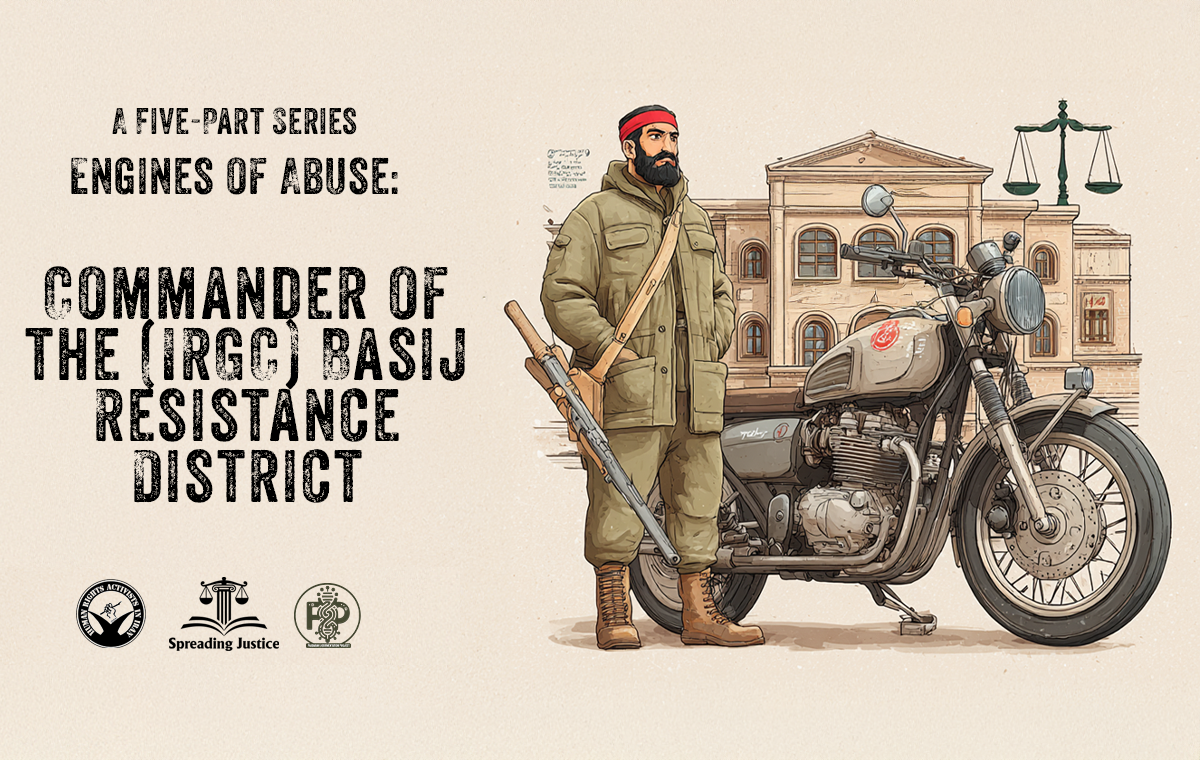
This report constitutes the third installment in a five-part series published by Human Rights Activists (HRA) through its Spreading Justice project. This publication, uniquely within the series, is produced in collaboration with HRA’s Pasdaran Documentation Project and examines local IRGC commanders. The series, Engines of Abuse, aims to shed light on the roles within the Iranian regime’s legal and security apparatus that enable and sustain serious human rights abuses and violations of international law. The Spreading Justice database currently contains profiles of more than a thousand individuals implicated in such violations. Beyond identifying these individuals, the series also analyzes how and why the positions they hold perpetuate the entrenched cycle of repression and abuse.
Although Iranian law outlines the general duties and organizational structure of the Islamic Revolutionary Guard Corps (IRGC), the legal texts do not explicitly detail the full range of duties and powers of the Commander of the IRGC. However, by drawing on provisions within the IRGC Statute (1982)1, the IRGC Employment Regulations Act (1983)2, and the Disciplinary Regulations of the Armed Forces of the Islamic Republic of Iran3, the mandate, operational scope, and practical authority associated with this position can be inferred, and as such are laid out briefly below.
As the highest-ranking IRGC official at the county level, the County IRGC Commander plays a central role in implementing the IRGC security, cultural, social, and developmental missions. This geographic unit—variously referred to in official materials as a county or district constitutes the primary arena in which IRGC policy is translated into practice. The commander serves as the critical link between the Provincial IRGC Command and the operational ranks within local Resistance Districts and Bases, ensuring that IRGC directives are executed and adapted to local conditions.
Within this structure, the County IRGC Commander is also referred to as the Commander of the County Basij Resistance District. He acts as the IRGC’s official representative in the area and operates directly under the supervision of the Provincial IRGC Commander. According to the IRGC Employment Regulations Act, this position must be filled by a special Basij member or a permanent IRGC officer who meets the required standards of ideological commitment, technical competence, and operational experience. He is responsible for tasks across four domains: training, operations, discipline, and administration. In practice, this makes the County IRGC Commander not merely a coordinator but an active executor of IRGC strategy, entrusted with broad authority over all IRGC and Basij activities within the county.
Legal Basis for the County IRGC Commander’s Position
Article 94 of the IRGC Employment Regulations Act (1983)4 establishes that the commander of a Resistance District, equivalent to the County IRGC Commander, is responsible for leading and managing Basij units in training, operational matters, disciplinary enforcement, and administrative oversight. This article provides the legal foundation for the commander’s authority within the IRGC hierarchy.
Articles 35 and 36 of the IRGC Statute (1982)5 further define the Basij’s overarching objectives, including cultivating societal readiness to defend the Islamic Republic, conducting military and ideological training, organizing popular forces, supporting relief and development efforts, and safeguarding the Islamic Revolution.
Together, these provisions delineate the statutory framework that empowers the County IRGC Commander and embeds the role within the administrative, political, and military apparatus of the Islamic Republic.
Duties of the County IRGC Commander
Drawing from the IRGC’s foundational documents, the commander’s responsibilities fall into several key categories:
1. Training Duties
The commander oversees the military, ideological, and security training of local Basij forces. He is responsible for ensuring training quality, developing skill-building programs, and enhancing the operational readiness of forces, consistent with Article 36 of the IRGC Statute6 and Article 94 of the Employment Regulations Act7.
2. Operational Duties
In routine situations, the commander prepares local forces for security and defense operations. In times of crisis or unrest, he assumes direct command, coordinating with the Provincial IRGC Command and the County Security Council to implement security, suppression, and defense plans.
3. Disciplinary and Administrative Duties
The commander enforces discipline, organizational order, and regulatory compliance within all subordinate units. Under the Disciplinary Regulations of the Armed Forces (1979), he is empowered to impose disciplinary measures. He also oversees administrative operations, personnel management, and financial affairs in accordance with IRGC directives.
4. Cultural and Social Duties
Article 2 of the IRGC Statute identifies safeguarding the Islamic Revolution, including through cultural and social interventions, as a core IRGC mission. At the county level, the commander directs Basij cultural programming, ideological campaigns, and public outreach. The commander works with state cultural and educational institutions to counter perceived “cultural threats,” maintain social control, and reinforce regime-aligned narratives.
5. Developmental and Service-Oriented Duties
Clause 6 of Article 36 of the IRGC Statute mandates Basij participation in national development efforts. The commander oversees Basij construction brigades, disaster response efforts, and poverty alleviation programs, coordinating closely with the County Governor’s Office and relevant executive agencies. In practice, these activities, when they are carried out, serve to strengthen the IRGC’s political and social influence at the local level.
Powers of the County IRGC Commander
The commander’s formal authorities, as outlined in IRGC regulations, include:
Issuing operational, administrative, and disciplinary orders to all IRGC and Basij units within the county.
Selecting or recommending commanders for local Resistance Districts and Bases, subject to provincial approval.
Participating in County Security Council meetings as the IRGC’s official representative.
Signing all official, financial, and disciplinary correspondence related to the Resistance District.
Exercising disciplinary powers
These authorities establish the County IRGC Commander as a fully empowered local military and security official capable of exercising substantial control over coercive, cultural, and administrative structures.
The IRGC Statute (1982), the IRGC Employment Regulations Act (1983), and Article 150 of the Constitution collectively situate the IRGC as the “guardian of the Islamic Revolution and its achievements.” Within this mandate, the County IRGC Commander plays a pivotal role. He serves as the primary executor of the IRGC’s mission at the local level, directing Basij forces, shaping security and cultural policy, and overseeing activities that directly affect the daily lives of residents. This authority has profound implications for human rights. During the nationwide protests of 20228, for example, at least sixteen civilians were killed and many more injured or detained in Mahabad by IRGC, Basij, Special Forces (Yegan-e Vijeh), and other security units. Akbar Norouzi9, then serving as the County IRGC Commander and a member of the County Security Council, played a role in the violations perpetrated against the local population.
Throughout the protests, IRGC and Special Forces units deployed across Mahabad’s main squares and residential areas, conducting continuous armed fire against protesters and homes. This sustained military presence demonstrates the decisive role that IRGC command structures, and specifically County IRGC Commanders, play in orchestrating, enabling, and carrying out violent crackdowns on peaceful dissent.
By examining this position, the Spreading Justice series underscores how local IRGC leadership functions as an essential component of Iran’s machinery of repression, contributing directly to systemic patterns of rights violations and impunity.
Table of Former and Current County-level IRGC Commanders
*Note, this table also includes profiles from HRA’s Pasdaran Documentation Project. The Pasdaran Documentation Project maps the structure and documents the activities of Iran’s Islamic Revolutionary Guard Corps (IRGC).
The database is the first of its kind, offering an overview of the IRGC’s organizational structure, its chain of command, and the historical context of its units and key individuals alongside an analysis of its behavior both inside of Iran and beyond. PDP utilizes a progressive data accumulation approach to document the IRGC. This methodology allows us to incrementally build detailed profiles on IRGC personnel and units. As new information becomes available, researchers update profiles, continuously refining our understanding of the IRGC’s extensive network. While our approach can result in some incomplete profiles, it allows us to cover the breadth of the IRGC’s activities, providing a broad and evolving view of its operations. Learn more here: https://iranpdp.org/about-us/
Islamic Republic of Iran, “Law on the Employment Regulations of the Islamic Revolutionary Guard Corps (Qānun-e Moqarrarāt-e Esteʿdādmi-ye Sepāh-e Pāsdārān-e Enqelāb-e Eslāmī),” adopted 21 Mehr 1370 (13 October 1991), https://rc.majlis.ir/fa/law/show/91961↩︎
Islamic Republic of Iran, “Law on the Employment Regulations of the Islamic Revolutionary Guard Corps (Qānun-e Moqarrarāt-e Esteʿdādmi-ye Sepāh-e Pāsdārān-e Enqelāb-e Eslāmī),” adopted 21 Mehr 1370 (13 October 1991), https://rc.majlis.ir/fa/law/show/91961↩︎
Islamic Republic of Iran, “Law on the Employment Regulations of the Islamic Revolutionary Guard Corps (Qānun-e Moqarrarāt-e Esteʿdādmi-ye Sepāh-e Pāsdārān-e Enqelāb-e Eslāmī),” adopted 21 Mehr 1370 (13 October 1991), https://rc.majlis.ir/fa/law/show/91961↩︎
Radio Farda, “IRGC and Special Units Deployed in Mahabad Squares; At Least Three Protesters Killed in Piranshahr and Javanroud,” published 21 November 2022, Radio Farda, https://www.radiofarda.com/a/32139820.html↩︎