The Islamic Revolutionary Guard Corps (IRGC), or Sepah-e
Pasdaran-e Enghelab-e Eslami, was founded in 1979 following the Islamic
Revolution in Iran. Established by the order of Ayatollah Ruhollah Khomeini,
the IRGC has grown from a revolutionary militia to one of the most powerful
institutions in Iran, wielding significant political, economic, and military
influence. This article delves into the history of the IRGC, examining its
formation, evolution, and contemporary role in Iranian society and beyond.
Formation and Early Years
The Islamic Revolution of 1979
The IRGC was born out of the political and social upheaval
of the 1979 Islamic Revolution, which overthrew the Pahlavi monarchy. The
revolution aimed to replace the pro-Western monarchy with an Islamic Republic
guided by the principles of Velayat-e Faqih (Guardianship of the Islamic
Jurist). Ayatollah Khomeini, the revolution’s leader, envisioned the IRGC as a
force to protect the new Islamic order.
Establishment of the IRGC
In May 1979, the IRGC was officially established through a
decree by Ayatollah Khomeini. Its mission was to act as a counterbalance to the
regular military, which was perceived as loyal to the Shah. The IRGC’s early
mandate included defending the revolution, suppressing internal dissent, and
promoting the Islamic Republic’s ideology.
The IRGC initially operated as a loosely organized
paramilitary force, composed of various revolutionary groups. Over time, it
became more structured, with its own hierarchy, training programs, and
specialized units.
The Iran-Iraq War (1980–1988)
Role in the War
The Iran-Iraq War was a defining period for the IRGC. When
Iraq invaded Iran in 1980, the IRGC played a crucial role in defending the
country. Unlike the regular military, which was better equipped and trained,
the IRGC relied on ideological fervor and unconventional warfare tactics,
including the use of basij militias—volunteer forces composed of young
and untrained recruits.
The war not only solidified the IRGC’s role as a key
military force but also elevated its political influence. By the end of the
war, the IRGC had established itself as a parallel military structure to the
regular armed forces, with substantial autonomy.
Post-War Expansion and Economic Influence
Diversification into the Economy
After the war, the IRGC expanded its role beyond military
affairs, venturing into Iran’s economy and infrastructure development. The IRGC
established the Khatam al-Anbiya Construction Headquarters, which became one of
the largest engineering and construction firms in Iran. This allowed the IRGC
to control significant sectors of the economy, including oil, gas, and
telecommunications.
Through its economic activities, the IRGC gained immense
wealth and influence, becoming a key player in Iran’s political and economic
landscape.
Political Influence
The IRGC’s influence in politics grew significantly after
the Iran-Iraq War. Many former IRGC commanders transitioned into political
roles, with some holding key positions in the government. The IRGC also played
a pivotal role in suppressing internal dissent, particularly during periods of
political unrest, such as the 2009 Green Movement protests.
Regional and International Activities
Support for Proxy Groups
The IRGC has been instrumental in shaping Iran’s regional
strategy, primarily through its Quds Force, which is responsible for
extraterritorial operations. The Quds Force has supported various non-state
actors across the Middle East, including Hezbollah in Lebanon, Hamas in
Palestine, and Shia militias in Iraq and Syria. These groups have been central
to Iran’s strategy of projecting power and countering U.S. and Israeli
influence in the region.
Involvement in Syria and Iraq
The IRGC played a critical role in supporting the Assad
regime during the Syrian Civil War. It provided military training, advisory
support, and coordinated the deployment of allied militias from Iraq,
Afghanistan, and Pakistan. Similarly, in Iraq, the IRGC helped organize and
train Shia militias to combat ISIS and exert influence over Iraqi politics.
Sanctions and Designation as a Terrorist Organization
International Sanctions
The IRGC’s activities have made it a target of international
sanctions. The United States, the European Union, and other countries have
imposed sanctions on the IRGC for its involvement in terrorism, human rights
abuses, and ballistic missile development.
Designation as a Terrorist Organization
In 2019, the U.S. designated the IRGC as a Foreign Terrorist
Organization (FTO), marking the first time a government’s military entity
received such a designation. This move was part of a broader strategy to
pressure Iran economically and diplomatically.
Domestic Suppression and Human Rights Concerns
The IRGC has played a significant role in domestic
repression, including crackdowns on political activists, journalists, and
ethnic minorities. Its Intelligence Organization, separate from Iran’s Ministry
of Intelligence, has been involved in monitoring and suppressing dissent within
the country.
Conclusion
From its origins as a revolutionary militia to its current
status as a powerful political, military, and economic force, the IRGC has been
central to Iran’s modern history. Its influence extends beyond Iran’s borders,
shaping regional dynamics and drawing international scrutiny.
The IRGC remains a complex institution, embodying both the
revolutionary ideals of 1979 and the pragmatic power politics of modern Iran.
Understanding its history is crucial to comprehending Iran’s domestic and
foreign policies.
References
Abrahamian,
Ervand. A History of Modern Iran. Cambridge University Press, 2008.
Milani,
Abbas. The Shah. St. Martin’s Press, 2011.
Cordesman,
Anthony H., and Abraham Wagner. The Lessons of Modern War – Volume II:
The Iran-Iraq War. Westview Press, 1990.
Alfoneh,
Ali. Iran Unveiled: How the Revolutionary Guards Is Transforming Iran
from Theocracy into Military Dictatorship. AEI Press, 2013.
Levitt,
Matthew. Hezbollah: The Global Footprint of Lebanon’s Party of God.
Georgetown University Press, 2013.
Ostovar,
Afshon. Vanguard of the Imam: Religion, Politics, and Iran’s
Revolutionary Guards. Oxford University Press, 2016.
Katzman,
Kenneth. Iran Sanctions. Congressional Research Service, 2023.
Human
Rights Watch, Iran: The Machinery of Repression, 2022.
U.S.
Department of State, “Designation of the Islamic Revolutionary Guard
Corps,” 2019.
Spreading Justice: A database of human rights abusers in Iran
For fifteen years HRA has maintained a victim-centric approach to documenting and reporting on human rights violations in the Islamic Republic of Iran (IRI); The primary focus has been to document rights abuses and highlight the crimes perpetrated against victims. Through the years, while perpetrators have enjoyed widespread impunity, victims have endlessly struggled for justice
On the occasion of the International Day for the Right to the Truth Concerning Gross Human Rights Violations and for the Dignity of Victims, and alongside the adoption of the resolution on the situation of human rights in the IRI at the 46th session of the Human Rights Council, HRA launches Spreading Justice, a database of human rights violators in Iran.
At Tuesday’s closing of the Human Rights Council, organizations, member States, and activists alike called for an end to impunity in Iran. Spreading Justice was created to equip the international community with a tool to work towards holding perpetrators accountable, increasing both social and political pressure, and ending the widespread impunity that is currently enjoyed throughout the country.
The database, housed at www.spreadingjustice.org, includes unique profiles of both individual and institutional violators; those well known as well as those that seemingly fly under the radar.
Who is included in the database?
While all known violators will be included, Spreading Justice is primarily focused on new human rights violations. While many individuals or institutions included in the database have been committing violations for several years, there are oftentimes recent events that have contributed to their place in the database. By placing a focus on recent events, researchers are better positioned to collect, document, and fact-check information on the violations in question.
Along with profiles of individual violators, such asMasoud Safdari, there are also profiles for institutional violators like theTehran Islamic Revolutionary Court. Profiles of institutional violators are linked to the profiles of affiliated individuals, both individual violators, as well as individual and group victims. This feature aims to aid in establishing connections for research purposes. Similarly, when users click on a victim’s name, they are directed to a list of any violators within the database that may also be affiliated.
While the existing profiles are complete, users are able to aid in the development of profiles by anonymously submitting additional information. Informed users are encouraged to submit bothmissing information and information on violators not currently included through an anonymous, easy to use and secure form. All information submitted through this form is verified for authenticity before being added to the database. Utilizing a tool created by a German University, users are also able to submit information on a wide array of physical appearance indicators. Facemaker, the tool mentioned above, mocks a virtual drawing of the violator based on user submissions. These submissions are compiled for internal comparative analyses.
HRA researchers have spent countless hours collecting, documenting, and verifying the information within the database. All of the information included has been through a strenuous fact-checking process and is verified for authenticity prior to being added. New profiles will continue to be added to the database in real-time as information is collected and verified.
All of the information, documents, and reports collected on violators are both online and stored internally via PDF. Requests for documents can be made through the Contact Us page.
How are the violators profiled?
Over the years, HRA has learned what information is most necessary for stakeholders when working towards holding violators accountable. The lessons learned were taken into consideration when building out the database. The individual violator profiles, where available, include a photo or photos of the violator, evidentiary documents (including witness or victim testimony and/or relevant multimedia), verified articles written by reputable media outlets that have mentioned the violator by name, and a detailed legal review written by Brian Currin, a leading expert in international human rights. One can also find information on work history, current residency, travel history, and educational background.
The profiles include basic information such as full name and any alternative spellings, date of birth, place of birth, and any current institutional affiliation. If a violator has known family members, such as a spouse or child, they are listed by name. Additionally, there is information on physical appearance including, eye color, hair color, height, and weight. Certain aspects of the basic and physical information are categorized into one of three levels of certainty: exact, partial, and approximated. Information categorized as exact is verified and precise. Partial is listed when some part of the information provided is unknown at the time of writing. The approximation category is used when HRA researchers have used approximating techniques with available information to offer a range. Institutional Violators are profiled similarly. Users also have the ability to toggle between both unit and date conversions.
Violators are tagged and searchable by documented victims, identified rights violations, and any relevant institutional affiliation. All of the profiles are available in a downloadable PDF format. Download links are located at the bottom of all violator profiles alongside a form to submit any missing information.
How does one use the database?
Spreading Justice is available in both English and Farsi. Users can search the database utilizing a variety of tagged violation indicators including torture, the right to life, labor rights, women’s rights, social rights, prisoner’s rights, the right to peaceful assembly, freedom of expression and thought, and more. These searches enable those focused on specific violation types to filter. One can also search tags by institutional affiliation such as the Tehran Islamic Revolutionary Court or the Iranian Cyber Police among others. The database is also searchable by victim name to assist lawyers or researchers working on specific cases. There is additionally an option to search by keyword. Users can find the main search tool on theSpreading Justice homepage.
Not simply a database
Spreading Justice is not simply a database, it also offersresources on Iranian power structures and judicial systems, unique reports and analyses on human rights violators in Iran, as well as statistical overviews including a breakdown of the situation of human rights in Iran by province and violation type.
Similarly to the profiles, all of the information found at spreadingjustice.org including statistics, resources, and reports will be updated regularly.
HRA encourages readers to share the Spreading justice database with their networks. For any additional information on Spreading Justice please contact Skylar Thompson, HRA Senior Advocacy Coordinator at [email protected]
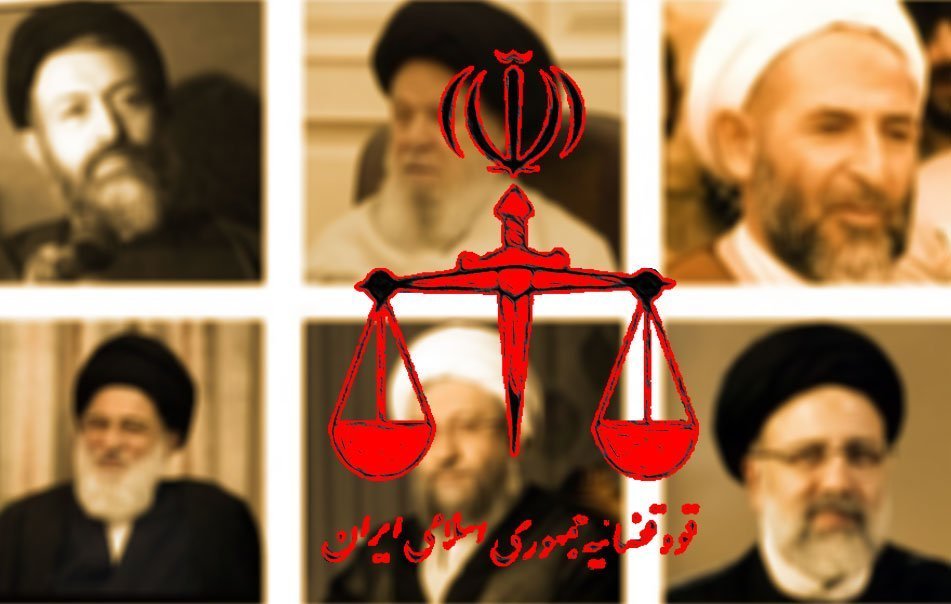
Based on the Iran’s constitution the Judiciary “should be an independent power”, which means no one shall be above the law “ultra vires”, however this is contradictory as based on article 57, the judiciary is under authority of the Supreme Leader and The Supreme leader directly appoints the head of the judiciary (5 year renewable term), who then appoints the Chief Public Prosecutor, head of state chief inspectorate, head of Administrative High Court, and the head of Military Courts (Iranian constitution 1998: article 156, 172, 173, 174). According to article 160 of the Iranian constitution the head of the judiciary recommends candidates for the ‘Minister of Justice’ to the President who then choses one as the Minister of Justice.
There are two basic types of judicial investigations in Iran
Legal: these investigations are mostly around settling civil disputes. The legal investigations do not include cases where an act is a “crime” by law and rather its about complaints and disputes between citizens or citizens and a governmental institution.
Criminal: The criminal investigations, include cases where there has been a “crime” committed which is punishable by law.
Iran’s Court system consist of ‘General courts’ and ‘Special Courts’
The General Court| دادگاه عمومی
The General Courts have jurisdiction over all cases unless the case falls under the jurisdiction of a ‘Special Court’. 1.1. Preliminary Courts | دادگاه بدوی
Civil courts: hears civil disputes which are not within the Dispute Settlement Councils jurisdictions.
‘The Dispute Settlement Council (شورای حل اختلاف)’ follows (1) cases such as properties of minors and those that have incapacities without any beneficiaries. (2) pecuniary disputes of under certain amounts in villages and cities (3) residential tenant evictions, and (4) determining wills or intestacy. All the appeals from The Dispute Settlement Council is heard at the General civil courts.
Second Criminal Courts | دادگاه کیفری (دادگاه کیفری دو) hears all criminal cases other than the ones that fall within jurisdiction of Special criminal Courts. This courts are held by one judge.
‘Criminal Dispute Settlement Council’(شورای حل اختلاف کیفری) hears all the summary offences such offences which could result in less than 3 months of imprisonment. However, this body does not issue prison terms.
Family courts| دادگاه خانواده hear all cases regarding family disputes and criminal investigations including: (1) Marriage (2) divorce (3) dowry (4) Allomony (5) Guardianship (6) Paternity, and (7) capacity
Juvenile Court| دادگاه اطفال و نوجوانان This court is held for those under 18 and should be held by one judge and two social workers.
First Criminal Court or Criminal Court of the province| دادگاه کیفری استان (دادگاه کیفری یک) this court deals with criminal investigations where the prosecutor is responsible for making a case against the accused. Less serious offences are heard at the Criminal court while indictable offences are brought to the Criminal Court of the Province. This court generally has to be held by 3 judges, for crimes with possible capital punishments court session should be held with 5 judges present. This court hears the following cases: (1) Political and Press offenses, (2) criminal complaints against members of the official bodies such as parliament, ministers, judges, governors, etc. (3) general complaints against police, army, and intelligence ministry authorities, (4) crimes with possible imputation sentences, and (5) crimes with possible Capital punishments such as death penalty, stoning, and life in prison.
1.2. Appeal Courts| دادگاه تجدید نظر
Appeal Court of the Province: This court has family, Civil and Criminal branches and hears the appeals from the preliminary courts.
The Supreme Court: This is the highest court in both criminal and legal investigations. This court has supervision powers over all other courts and is responsible for assuring that all procedures and trials are uniform across cases. The supreme court has both Criminal and General branches and hears the appeals of Criminal Court of The Province and the Revolutionary courts. The jurisdiction of the supreme court also includes resolving disagreements between courts in judgement or interpretations of the law. * The head of the Supreme court serves a 5-year term and is nominated by the head of judiciary
2. Special Courts| دادگاههای ویژه The special Courts have been established to have jurisdiction over specific cases such as clergies, militaries and Revolutionary.
Revolutionary Courts| دادگاه انقلاب
The revolutionary courts started their work, days after the 1979 revolution with multiple executions carried out before their procedure was written. It was on June 17, 1979 the first codes of procedure for the Revolutionary Courts were established. The first article of this code indicates that the leader of the Islamic Revolution has ordered establishment of office of the revolutionary Public Prosecutor and required numbers of Revolutionary Courts at administrative centers in every province.
On July 4, 1979 the Revolutionary council accepted the bill and the revolutionary courts jurisdictions was set to investigating counter-revolutionary crimes.
The revolutionary courts today are at the capital of each province and any region that the Head of Judiciary orders. They are under direct supervision of the Head of Judicial Distrit.
Revolutionary court hear the following cases: (1) crimes against national security, (2) Insulting the Supreme Leader or the Islamic Revolution Leader, (3) Conspiracy against the Islamic Republic, Armed Terrorism, destruction of institutions in order to undermine the government, (4) spying, (5) Drug Crimes, (6)embezzlement, non-sharia Activities, corruption, etc.
There are also some financial frauds that fall under the jurisdiction of the Revolutionary Courts such as smuggling artifacts, plotting to disturb national exports, disruption of monetary currency, etc.
Military Courts| دادگاه نظامی This court hears cases where the defendant is part of a security or armed force such as Army, Police, Gendarmery, or IRGC. According to article 172 of the constitution, the Military Court shall hear Crimes of Military forces only when they are in relation to Military or Security duties all other cases committed by these individuals should be heard in general and criminal courts.
The Clergy Courts| دادگاه روحانیت This courts hears all cases against Clergies.
Administrative Court| دیوان عدالت ایران This court is the Highest court that hears Administrative dispute. Its jurisdiction includes: (1) complaints of private parties against public administrators i.e. ministers and institutions, (2) cases against regulations, (3) cases of complains of public employees with about their employment, (4) hears appeal of preliminary administrative council.
Related َrticles and Sources:
Lahidji, K. (N.A). The History of the Judiciary in Iran. Legatum institute OPEN PDF
Rahmani, T. & Koohshahi, N. (2016). Introduction to Iran’s Judicial System. Journal of Law, Policy, and globalization (Vol45) OPEN PDF
Daraeizadeh, B. (2010). Legal Commentary: Alook at Criminal Procedure in Iran. Iran Human Rights Documentation Center. OPEN PDF
The Law Enforcement Command of the Islamic Republic of Iran (FARAJA), formerly known as the Law Enforcement Force of the Islamic Republic of Iran (NAJA), is one of the most pivotal institutions responsible for maintaining internal security and public order in Iran. Established in 1991 through the merger of several military and security organizations, FARAJA has played a critical role in combating crime, ensuring public safety, and managing crises. This article provides an in-depth exploration of FARAJA’s history, structure, and operations, from its inception to its current role in Iranian society.
Historical Background and Establishment of FARAJA
Pre-Revolution Security Forces
Before the 1979 Islamic Revolution, Iran’s security and law enforcement responsibilities were divided among three main entities: the Shahrbani (urban police), the Gendarmerie (rural and border police), and the SAVAK (the secret police). The Shahrbani maintained security in urban areas, the Gendarmerie operated in rural and border regions, and SAVAK was primarily responsible for intelligence and counter-espionage.
Post-Revolution Changes
After the Islamic Revolution in 1979, Iran’s security landscape underwent significant restructuring. Revolutionary Committees (Komiteh-ye Enqelab) were established as parallel security entities to maintain revolutionary order and address internal threats. These committees worked alongside the traditional police forces but were often more ideologically driven.
Formation of NAJA (Later FARAJA)
In 1991, under the directive of Supreme Leader Ayatollah Ali Khamenei and with the approval of the Iranian Parliament, the Shahrbani, Gendarmerie, and Revolutionary Committees were merged to form a unified law enforcement body known as the Law Enforcement Force of the Islamic Republic of Iran (NAJA). In 2022, NAJA was rebranded as FARAJA (Law Enforcement Command), reflecting its evolving role in modern Iran.
The primary objective of this merger was to streamline operations, improve coordination among various security agencies, and establish a centralized command to address internal and external threats more effectively.
Responsibilities and Missions of FARAJA
Ensuring Public Order and Safety
One of FARAJA’s core responsibilities is maintaining public order and safety. This includes crime prevention, managing public events, and ensuring traffic safety in urban areas. FARAJA also handles security during national and religious ceremonies, which often attract large crowds.
Combating Organized Crime
FARAJA has been at the forefront of combating organized crime, including drug trafficking, human smuggling, and cybercrime. Specialized units, such as the Anti-Narcotics Police and the Cyber Police (FATA), have been established to tackle these crimes effectively.
Border Security
Through its Border Guard Command, FARAJA ensures the security of Iran’s extensive land and maritime borders. This includes preventing illegal crossings, smuggling, and infiltration by terrorist groups.
Crisis Management
FARAJA plays an active role in disaster response and crisis management. Its coordination with other government agencies during natural disasters, such as earthquakes and floods, demonstrates its capacity to mobilize resources quickly and efficiently.
Structural and Technological Developments
Structural Changes
Over the years, FARAJA has undergone significant structural changes to enhance its operational capabilities. New specialized units, such as the Cyber Police (FATA), the Prevention Police, and the Counter-Terrorism Special Unit, have been introduced to address emerging threats more effectively.
Technological Advancements
FARAJA has adopted advanced technologies to improve its efficiency. These include the deployment of surveillance cameras, smart traffic management systems, and sophisticated tools for combating cybercrime. The integration of modern technologies has significantly improved FARAJA’s operational readiness and its ability to respond to security challenges.
FARAJA’s Role in Key Events
Handling Protests and Civil Unrest
FARAJA has played a prominent role in managing protests and civil unrest. Notable examples include the 1999 student protests, the 2009 Green Movement, and the widespread protests of 2017, 2019, and 2022. FARAJA’s response to these events has often been criticized for its heavy-handed approach, but the organization maintains that such measures are necessary to preserve public order.
Anti-Narcotics Operations
Iran is a major transit route for drugs, particularly opium and heroin, originating from Afghanistan. FARAJA’s Anti-Narcotics Police have conducted numerous operations to intercept drug shipments and dismantle trafficking networks. These efforts have resulted in the seizure of large quantities of narcotics and the arrest of traffickers.
Criticisms and Challenges
Human Rights Concerns
FARAJA has faced criticism from human rights organizations for its handling of protests and alleged use of excessive force. Reports of mistreatment of detainees and suppression of dissent have been highlighted by international watchdogs.
Internal Challenges
FARAJA faces several internal challenges, including corruption within its ranks, resource limitations, and the growing complexity of modern crimes such as cybercrime and financial fraud. Addressing these challenges requires ongoing reform and investment in training and technology.
Conclusion
Since its establishment, the Law Enforcement Command of the Islamic Republic of Iran (FARAJA) has played a vital role in maintaining internal security and public order. Its evolution reflects the broader changes in Iranian society and governance. Despite facing criticism and numerous challenges, FARAJA remains a cornerstone of Iran’s security infrastructure.
Understanding FARAJA’s history and operations provides valuable insights into the dynamics of law enforcement in Iran and its role in addressing both traditional and emerging security threats.
References
Abdi, Amir. History of Security Institutions in Iran. Contemporary Insight Publications, 2006.
Abrahamian, Ervand. Iran Between Two Revolutions. New York: Princeton University Press, 1982.
Law Enforcement Studies Center. Structural Transformations in Iran’s Law Enforcement. FARAJA Publications, 2005.
Research Center for Law Enforcement Studies. The Role of FARAJA in Crisis Management. FARAJA Publications, 2011.
Heidari, Mohsen. The Role of Technology in Enhancing Law Enforcement Efficiency. Security and Development Quarterly, 2019.
Strategic Studies Center of FARAJA. Analysis of Law Enforcement’s Role in Managing Civil Unrest. FARAJA Publications, 2020.
United Nations Office on Drugs and Crime (UNODC). Annual Report on Iran’s Anti-Narcotics Efforts, 2021.
Human Rights Watch. Annual Report on Human Rights in Iran, 2022.
Research Center for Law Enforcement Studies. Challenges Facing FARAJA in the Next Decade, 2022.
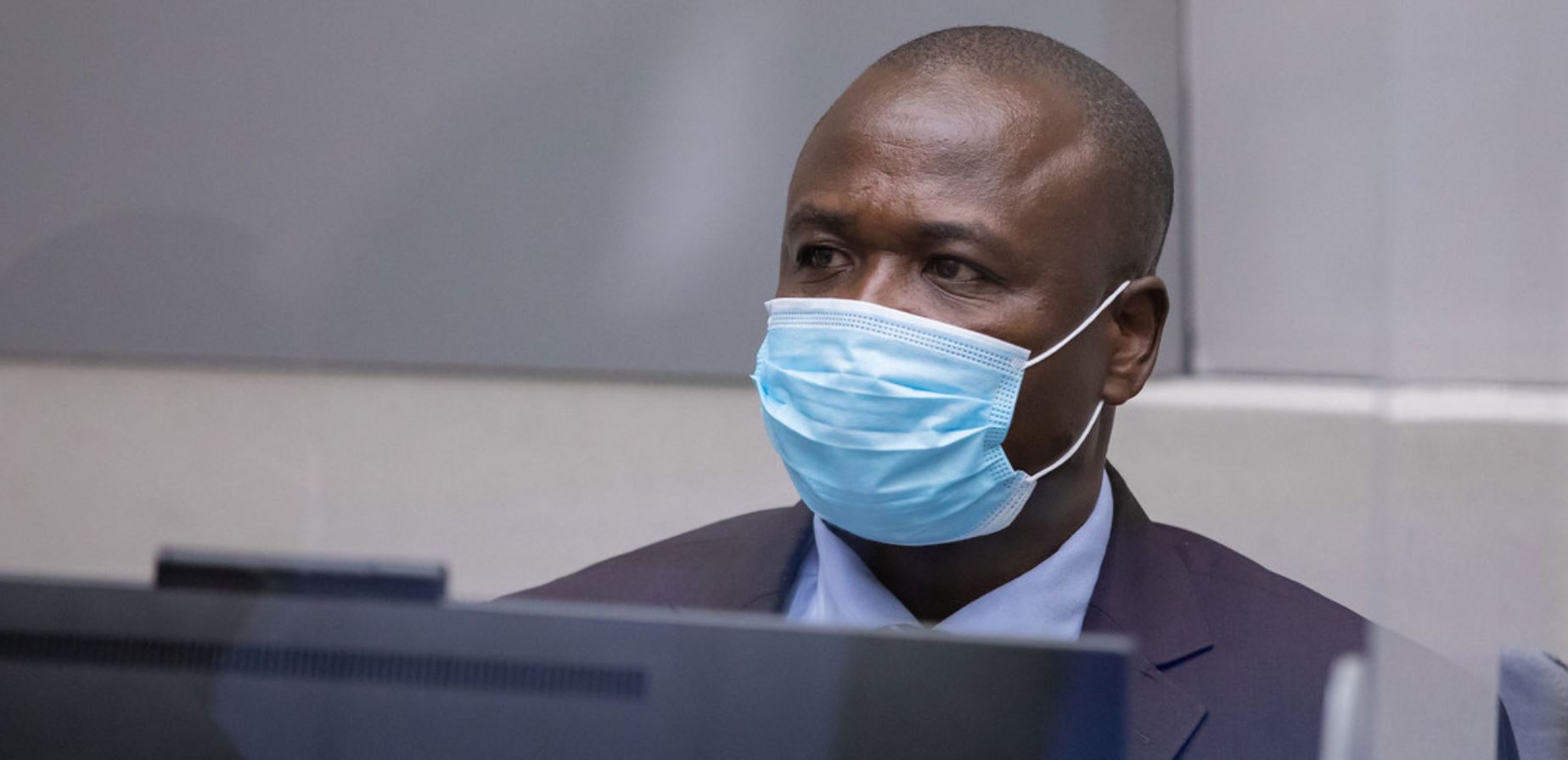
News UN – A former Ugandan warlord whose forces attacked camps for the internally displaced across the country, has been found guilty of war crimes and crimes against humanity at the International Criminal Court, judges ruled on Thursday, a judgement described by the UN chief as a “significant milestone”.
The Court based in The Hague, Netherlands, found that Dominic Ongwen was “fully responsible” for multiple grave violations in northern Uganda in the early 2000s, as part of a longstanding armed insurgency dating back to the 1980s.
As a brigade commander of the Lord’s Resistance Army (LRA), Mr. Ongwen sanctioned the murder of large numbers of civilians, forced marriage, sexual slavery and the recruitment of child soldiers “to participate actively in hostilities”, among other grave crimes.
Attacks against civilians were justified by the reasoning that they were associated with the Government and were therefore the “enemy” of the insurgents, the ICC said in a statement, noting also that LRA soldiers were “under orders to shoot civilians in the chest and head to ensure that they died”.
According to the ICC verdict summary, “in response to the question whether shooting a civilian during the course of an attack would constitute an offence, Witness P-0142, an LRA fighter, stated that ‘nobody would see it as a crime if a civilian is injured or if a civilian is shot at’.”
Civilian targets
Those targeted “in particular” were those who lived in the many government-established camps for internally displaced people (IDP), according to the court, which examined evidence of attacks on four IDP sites: Pajule, on 10 October 2003, Odek (29 April 2004), Lukodi (on or about 19 May 2004) and Abok (8 June 2004).
Although the court noted that Mr. Ongwen suffered greatly after being abducted by the LRA as a nine-year-old child, it noted that he was being put on trial for crimes committed as a “fully responsible adult and as a commander of the LRA in his mid to late twenties”.
It was during the three-year period under review by the court from July 2002 until December 2005 that Mr. Ongwen rose from LRA battalion commander to head of the Sinia Brigade with the rank of brigadier, overseeing several hundred soldiers.
“The Chamber found that Dominic Ongwen is fully responsible for all these crimes,” the Court said. “The Chamber did not find evidence that supported the claim that he suffered from any mental disease or disorder during the period relevant to the charges, or that he committed these crimes under duress or under any threats.”
‘Systematic’ enrollment
Testimony from a LRA soldier identified as “Witness P0307” underscored the systematic practice of enrolling child soldiers: “Each time we came across young people, we would abduct them and take them to the bush. We had to do this as we had to increase our numbers in the bush. So, abducting new recruits was part of routine activities during attacks so that there was no need for any commander to order you to abduct because this was part of the job.”
In total, Mr. Ongwen, who is 45, was found guilty of a total of 61 crimes against humanity and war crimes between 1 July 2002 and 31 December 2005.
He faces up to 30 years in prison, although a life sentence can be handed down in exceptional circumstances. The ICC noted that following sentencing, discussions would begin on reparations for victims.
Over the course of 234 hearings from December 2016 to March 2020, the trial judges heard 109 witnesses and experts for the prosecution and 63 for the defence; representatives of victims called seven witnesses and experts.
An astonishing total of 4,095 victims were also represented in court.
Case a ‘significant milestone’ – UN chief
The Secretary-General António Guterres described the judgement as “a significant milestone in accountability and a step forward in efforts to bring justice to the victims of LRA crimes”.
In a statement issued by his spokesperson he said it also marked the first time that the crime of forced marriage has been considered by the ICC, highlighting the “critical need to eradicate sexual and gender-based violence.”
“The Secretary-General’s thoughts are with the victims of crimes against humanity and war crimes for which Mr. Ongwen has been found guilty”, the statement said.
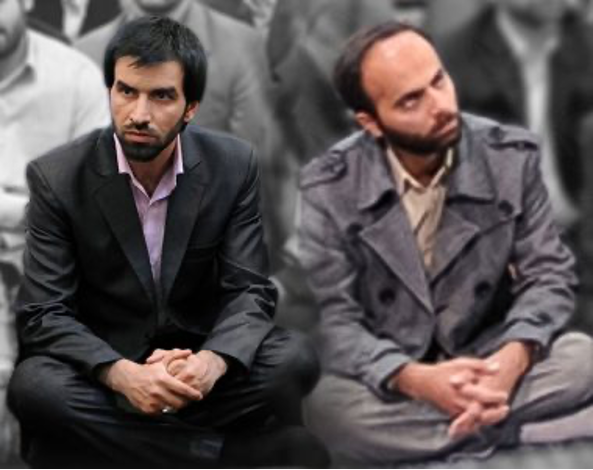
A team of young intelligence forces of the Revolutionary Guards in the internal security sector in the Tehran region
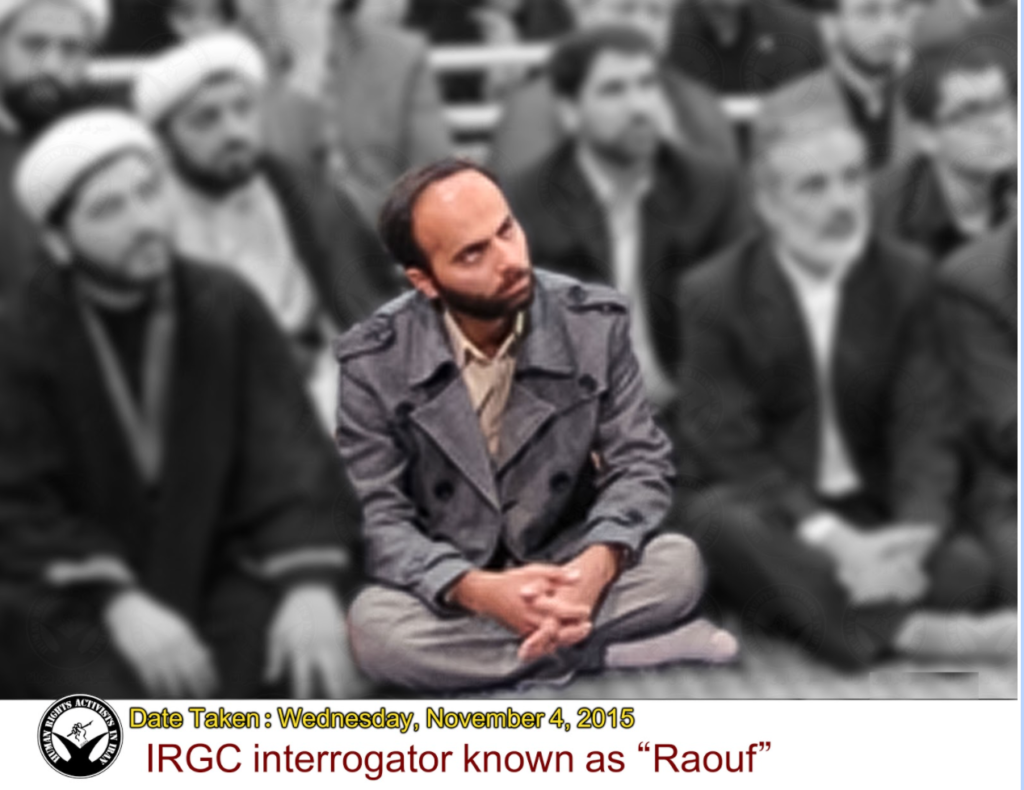
HRANA – Earlier this week, HRANA, the news body of Human Rights Activists in Iran (HRAI), detailed the identification of a man known by a number of names, most notably, Raouf. Raouf is a notorious security force member involved in a number of human rights violations in Iran. Operating in Ward 2A of Evin Prison, which belongs to the IRGC, Raouf is said to have participated in the interrogation and mistreatment of a large number of civil and political activists.
Although his main place of work is believed to be in Ward 2A of Evin Prison, a number of political-civil activists or family members of prisoners have faced interrogations at the hands of Raouf at other locations, such as offices affiliated with the Revolutionary Guards in Tehran.
He is responsible for interrogating a large number of political and civil activists, including Arash Sadeghi, Golrokh Erayi, Mahdieh Golroo, Soheil Arabi, Nastaran Naimi, and Athena Daemi. Most of these people are currently serving long prison sentences.
HRANA has spoken to a number of former political prisoners [whose names could not be mentioned for security reasons] personally interrogated by Raouf to confirm the identity and role of this security agent. Some of their statements are detailed below.
One witness stated, “Raouf slapped me so much during my interrogation that twice I bled after returning to my cell.”
A former political prisoner, speaking anonymously, told HRANA, detailing his interrogation with Raouf, “He hit me so hard that it caused one of my bones to break. He used a leather belt to beat me often for upwards of ten minutes. He did this while he verbally insulted my family and I.”
A human rights activist who served his sentence in Evin Prison told HRANA, “He was present at all stages of my trial in the Revolutionary Court and repeatedly threatened my peers and I with new cases. He continued, “I still remember his face. I still remember how it bothered my wife…”
Mahdieh Golroo, a former student activist, confirmed Raouf’s role in interrogating her throughout her detention, posting a note on her personal page: “I have complained about his recent threats in Sweden by name, phone, and photo – to no avail. It is my duty to expose the interrogators and those who destroy the lives of many with impunity.”
Since the original report was released, HRANA received information that Raouf is a pseudonym for the name Ali Hemmatian. We are not yet able to independently confirm and will continue to investigate further.
The below image displays Raouf sitting in the first row of Ayatollah Khamenei’s speech in 2015.
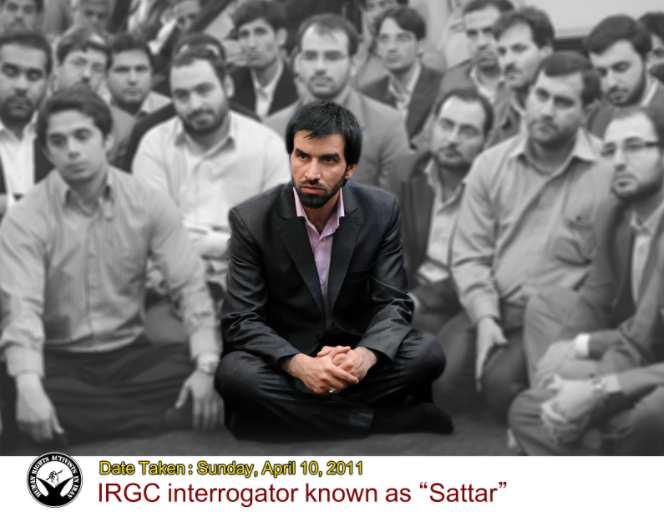
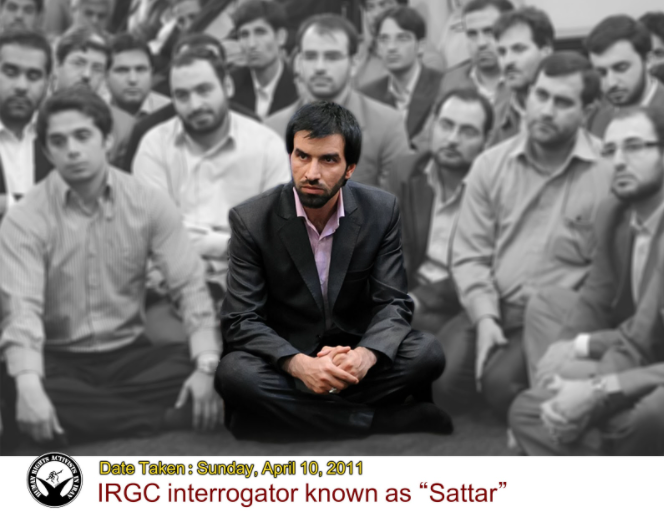
The information about Raouf drew public attention which led to additional witnesses coming forward to identify a number of other security figures within the country. Notably, these witness statements have led to the identification of an IRGC interrogator known as “Sattar.” Sattar is said to have played a role in detaining political prisoners involved in the 2019–20 Iranian protests (also known as Bloody November).
The following image, which shows a meeting of the directors and researchers of the Islamic Revolutionary Documentation Organization with Ayatollah Khamenei on April 11, 2011, shows Sattar in color.
A group of witnesses, all of whom were detained during the November 2019 protests in Tehran, testified that after being arrested, they were taken to unknown locations where they were beaten and interrogated.
One of the victims told HRANA, “From the beginning of our detention [November 2019], we were blindfolded and then taken to an interrogation facility where we were beaten for several days.” When asked about the man in question, the victim continued, “His colleagues called him Sattar; this name was perhaps because of the beard style he wore. However, when I saw him in those days, he had a longer beard and shorter hair than in the 2011 picture [provided above].”
Another witness told HRANA, “While I was closing my business, located on Enghelab Street, I was arrested by plainclothes men (November 2019). From the beginning of my arrest, I was beaten. In addition to myself, two or three other people were arrested and transported in the same vehicle, to an unknown location. After being transported, we were threatened and interrogated. The plainclothes man violently forced us to admit wrongdoing. This went on for two days before ultimately being handed over to the IRGC detention center in Evin Prison.”
A witness, detained at the same time, confirmed these witness statements and also stated, “There were a combination of forces present at the scene of the arrest that day and during the interrogation. Involved were plainclothes forces, Basij forces, and the IRGC. The person in question, Sattar, was in plain clothes, according to the case file and interrogation documents.” He continued, “When we were finally handed over to the IRGC, it was clear Sattar was affiliated with them.”
Sattar, in addition to the above-mentioned unknown places of interrogation, was also seen at the Yad Yaran Basij Resistance Base located on Argentina Street in Tehran.
Following HRANAs request for information, a number of other victims of Sattar’s interrogations contacted the news agency with information, including a court document discovered by HRANA and which named Sattar as “Massoud Safdari.”
A former prisoner who has experience dealing with the security forces detailed Sattar as the person who was present at the time of his televised forced confession. He told HRANA, “I remember his face very well, he was a rude person who, along with his colleagues, managed the video recording by threatening and intimidating me.”
Another witness, whose identity is withheld for security reasons, told HRANA, “I was interrogated at an IRGC intelligence base in Tehran Afsariyeh district known as 1Alef. They recorded my televised confession. Sattar didn’t leave me alone even after they recorded their video. He abused me and harassed my family by threatening them over the phone.”
Some sources also informed HRANA that Sattar, along with a number of other security forces, is living in the district of Shahrak Shahid Mahallati in Tehran.
From the summary of information received and based on the credibility of the sources, it seems that there is a team of young intelligence forces of the Revolutionary Guards in the internal security sector in the Tehran region; their traces can be seen in numerous cases. Sattar (likely Massoud Safdari), Majid Koushki (known as Majid Buffalo), and Massoud Hemmati, known to be on the Raouf team, all likely operating under the leadership of Raouf (likely Ali Hemmatian).
In an effort to complete information about this human rights abuser, HRANA News Agency is calling on victims and those aware of their status to assist in completing these investigations.
This report contains the 2020’s analytical and statistical annual report on human rights in Iran, prepared by the Department of Statistics and Publications of Human Rights Activists (HRA). This statistical analysis report presented by HRAI is the result of the daily efforts of this organization and its dedicated members as part of a daily statistic and census project that started in 2009 by this organization.
This annual report on human rights violations in Iran (2020) is the collection, analysis, and documentation of 4472 reports concerning human rights, gathered from various news sources during 2020 [January 1st to December 20th]. Human Rights Activists News Agency (HRANA) has gathered and reported 42%, official or close to the Iranian government sources 45% and other human rights news agencies 13% of all the reports analyzed in this Annual Report.
The following 45-pages includes statistical overviews and related charts on various sections regarding women’s rights, children’s rights, prisoners’ rights, etc. Based on this report, despite the 4% decrease in human rights violations reports in provinces other than Tehran, compared to the last year’s annual report, there is still a major concern on lack of proper reporting and monitoring of the human rights by the civil society in the smaller cities.
This report is the result of endeavors made by courageous human rights activists in Iran who pay a very high cost for the realization of their humanitarian beliefs. However, for obvious reasons (i.e. existing governmental limitations and ban on the free exchange of information and government preventing the existence of human right organizations in the country), this report by no means is free of errors and cannot alone be a reflection on the actual status of human right in Iran. Having said that, it should be emphasized that this report is considered as one of the most accurate, comprehensive, and authentic reports on the human rights conditions in Iran and it can serve as a very informative source of information for human rights activists and organizations working on Iran, to better understand the challenges and opportunities that they may face.
Monitoring
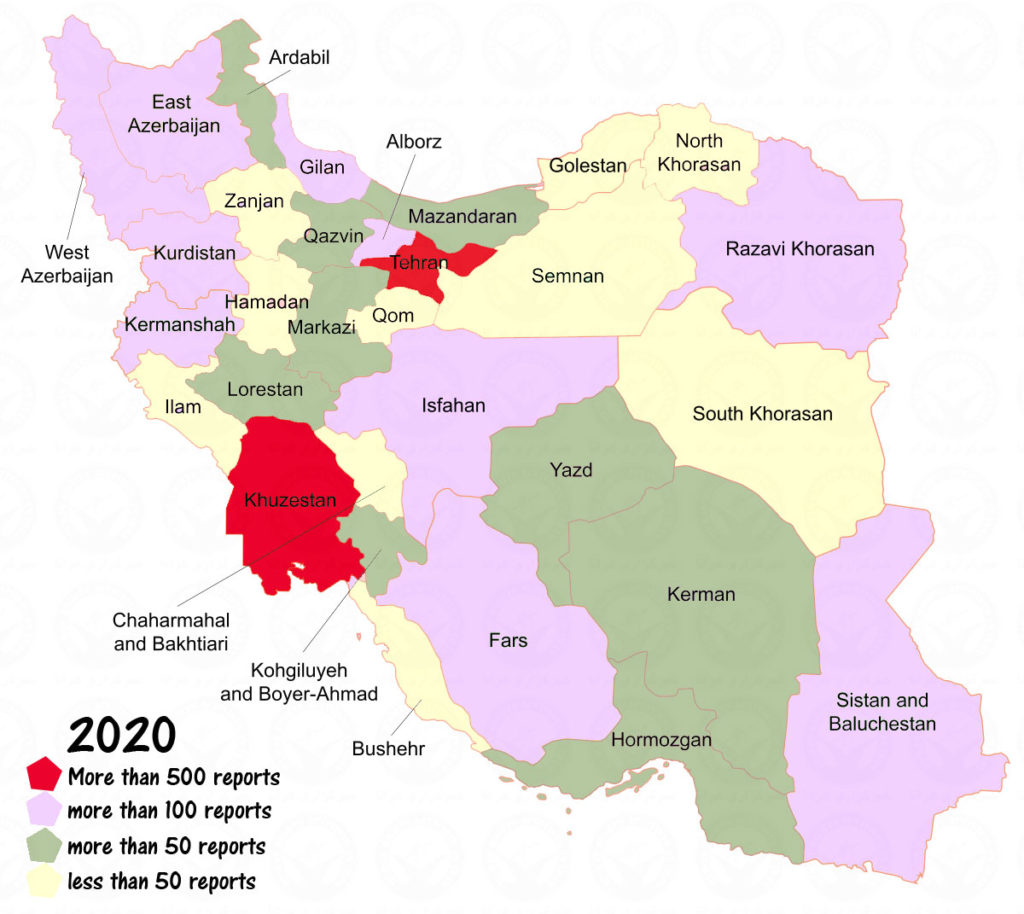
The following map illustrates the number of reports per province made by the human rights organizations and news agencies, this is a direct reflection of the capability of the civil society in each province of the country (2020).
As indicated in the distribution map, there exists a major discrepancy between Tehran, the capital, and other parts of the country in terms of the number of published reports. This is while the census of 2016 reported a population of 13,267,637 in Tehran, compared to a population of 66,658,633 in the rest of the country.
Ethnic Minorities
In the field of national and ethnic minorities’ rights, a total of 234 reports registered by the department of the statistics and publication of Human Rights Activists in Iran (HRAI) in 2020. According to these reports, at least 286 people were arrested, and 39 people were sentenced to a total of 1721 months of prison term. from the total of 1721 months of prison terms issued, 1699 months were imprisonment sentences for 36 individuals, and 22 months were suspended imprisonment sentences for 3 individuals. And a total of 88 individuals were summoned by the security and judicial institutions.
Compared to the previous year there has been a 16.6% decrease in the arrest of ethnic minorities and a35 % decrease in imprisonment sentences.
Religious Minorities
In this category, 136 reports have been registered by the Department of Statistics in 2020. According to these reports, 77 arrests, 49 cases of prevention from economical activities, 126 cases of summon by the judicial and security institutions, and 22 cases of depriving and preventing from education, and 69 cases of police home raids, has taken place. 98 individuals of the religious minorities were sentenced by the judicial institutions to a total of 4351 months of imprisonment. Additionally, the ministry of cultural heritage of Tehran and the Municipality of Tehran demolished the Adventist church of Tehran in the past year.
In the field of religious minorities, the Baha’is constitute the highest of the Human Rights reports on religious minority violations with 45%, Sunnis 26%, Christians 15%, Dervishes 4%, Jews and Yarsans 1%, and others 9%, of the total reports. Note that the reports labeled as “Others” are those that did not belong to a specific group of religious minorities.
The number of citizens arrested in the category of religious minorities has decreased by42 % in 2020 compared to 2019, and the imprisonment sentences issued by the judiciary has increased by28.9 %.
Freedom of Expression
In the category of freedom of thought and expression, in 2020, 883 reports have been registered by the Department of Statistics that included 928 arrested individuals; 287 summonses to the judiciary and security authorities; 4 reports of publication banning; 8 cases of conviction for publications. In 2020, 420 arrestees were sentenced to a total of 22271 months of imprisonment, that includes 386 individuals sentenced to a total 21523 months in prison and 34 individuals received a total of 748 months of suspended prison terms. 34 people to 191 billion and 765 million rials in financial fines, 85 people get 5844 lashes, and 21 cases of deprivation from civil rights have been reported in this category. Additionally, there has been 40 police home raids recorded.
In the field of Freedom of Expression, there has been a decreased of88.8 % in the reports of arrests compared to the previous year. Similarly, sentences issued by the judiciary have increased by46.5 % based on the number of people being tried, and imprisonment sentences were increased by 52.9 % compared to 2019.
Trade Unions and Associations
In the category of the rights of associations and trade unions in 2020, 359 reports have been registered by the Department of Statistics and Publications. This includes 47 members of the trade union were reported being arrested. Also, in this category, 10 individuals have been sentenced to a total of 554 months in prison, 51 cases of summoning to the judicial and security institutions, and 3930 cases of closing the facilities have been reported. In 2020, at least 329 protests and 3 union strikes were held. Most of these protests were related to salary/wage demands from corporations, bad economic conditions, and lack of proper management of corporations. In the category of Trade Unions and Associations, there has been a 31 % decrease in the number of arrests and there has been an 89 % increase in the issue of sentences compared to the previous year.
Academia/ Right to education
In the category of violations of academic rights in 2020, 24 reports have been registered by the Department of Statistics and Publication of Human Rights Activists in Iran. This includes 6 students arrested, 20 students were suspended, and as it was also mentioned in the religious rights section of this report 22 students were prevented from continuing their education because of their religion. In the category of academia and the right to education, there has been a a94 % decrease in the number of arrests. And based on these reports 1 student was sentenced to 60 months in prison.
Right to Life (Death Penalty)
In the category of right to life, in 2020, 241 reports have been registered by the Department of Statistics and Publication of Human Rights Activists Association in Iran. This included 95 death sentences, 236 death sentences were carried out (including 1 execution in public). Based on the announced identifications of some of the individuals executed, 205 were male and 8 were female. In addition, 2 juvenile offenders have also been executed in 2020 who were under the age of 18 at the time of committing the crime. According to these reports, 80% of the executions were based on murder charges. Moreover, 5% charged with rape, another 9% with drug-related charges. 4% were charged with “Waging war against God”, also 1% charged with armed robbery,1% Consumption of alcohol.
The highest number of all death sentences issued are comprised of 80% on murder charges, followed by Drugcharges which make up 9% of the cases.
The province of Alborz ranking first in death sentences in Iranian provinces with 19% of all the death sentences issued, that is due to its two populated and important prisons, followed by Razavi Khorasan province with 12% of all the cases.
The Rajai Shahr prison and Vakil Abad Prison holding the highest number of executions in all prisons in Iran.
According to the statistics, about 0.42% of the executions were carried out in public.
Of those executed in 2020, 3% were female, and 87% were male, while the gender of the other 10% is unknown. These executions reported by independent sources and human rights associations, indicating that 72% of executions are carried out in secret or without any public notice.
In the category of the death penalty, the execution carried out in comparison to 2019 has decreased by4.8 %. The number of execution sentences issued also has decreased by 12%, and the number of public executions has decreased by 92%.
Cultural Rights
In the category of violations of cultural rights in 2020, 21 reports have been registered by the Department of Statistics and Publication of Human Rights Activists Association in Iran. This included reports on 27 arrests and 4 individuals were sentenced to 257 months of imprisonment, from this number 3 individuals were sentenced to 253 months of imprisonment, while 1 person was sentenced to 4 months of suspended prison term. 1 individual was summoned to the judiciary and security organizations. Moreover, 2 licenses were revoked, 1 person was banned from public speaking or performing, and 1 person was banned from working. In this category, arrests have increased by51 % compared to the previous year.
Workers’ Rights
In the category of violations of workers’ rights in 2020, 1318 reports have been registered by the Department of Statistics and Publication of Human Rights Activists Association in Iran. This included 30 arrests. 45 workers activists or workers were sentenced to 183 months in prison, and 42 people received 3108 lashes, and 42 people were summoned to judiciary and security organizations. During 2020, a total of 2011 months of overdue payment of salaries to workers has been reported. 2105 workers were laid off or fired, 2240 cases of unemployment, 18049 lacked work insurance, 3082 workers waiting for work-related decisions. In addition, 1187 people have lost their lives in work-related accidents, and 3259 workers have been injured while at work. On a global scale amongst other counties, Iran ranks 102nd in work safety. Also, in 2020, at least 473 worker protests and 99 workers strike took place. most of these protests were regarding wages. Based on these reports the arrest of workers has increased by56 % compared to 2019.
Children’s Rights
In the category of violations of children’s rights in 2020, a total of 176 reports have been registered by the Department of Statistics, however, it should be mentioned because of secretly in the matter of reporting these incidents there is no accurate statistic in this field. These reports included at least 2205 cases of child abuse, 9 cases of rape and sexual abuse of children, 9 cases of murder of childre, 2 self-immolation, 94 cases of child suicide, and more than 1 million students are deprived of education. Lack of access to devices for virtual education, Child marriages, poverty, cultural context, population density, etc. in Khuzestan province has led to the highest number of deprivations from education in the country. As mentioned in the right to the life section, at least 2 minor offenders have been executed in Iran during 2020. Additionally, 3 teenagers were sentenced to a total of 264 months of imprisonment.
During the nation-wide protests, 19 children and 1 children’s rights activist were arrested.
Women’s Rights
In the category of violations of women’s rights in 2020, a total of 81 reports have been registered by the Department of Statistics. These reports reflected. At least 572 women were physically and sexually abused, 13 cases of honor-killings,6 self-immolation, 4 cases of acid attacks, and 1 cases of summoned women’s rights activists to judiciary and security organs. Based on this report 5 women have been detained for reasons related to women’s rights. At least 2 women’s rights activists were sentenced to 180 months in prison.
Prisoners’ Rights
In the category of violations of prisoners’ rights in 2020, a total of 542 reports have been registered, 53 reports on physical assault of prisoners, 366 reports of deprivation /neglected of medical care, 109 reports of illegal transfer to solitary confinement, 533 attempted hunger strikes, 289 cases of forced transportation or exile, 228 cases of threatening prisoners, 126 cases of banning prisoners of having visitors, 18 cases of torture, 25 case of deaths by diseases,10 arrestees were killed by prison authorities, and 17 prisoners committed suicide, 40 cases of lack of access to lawyers, 1678 reports of prisoners being held in unsuitable circumstances. Also, in this category, there have been 147 cases of keeping prisoners in an unsure state about their sentence and situation.
Security Forces’ Violence and Citizens’ Safety
Death of civilians
This section is dedicated to the killing or injuring of civilians by the police or military institutions. In 2020, a total of 204 people were shot by the military forces; 74 of the victims lost their life including, 36 Kulbar, 5 fuel-Carriers, 33 civilians. 130 people were also injured by the shots of the military forces, including 109 Kulbar, 16 civilian, 5 Fuel-carriers. Addititonally, 9 Kulbers were affected by climate and geographical factors such as freezing and falling from heights, 4 of whom were injured and 5 Kulber lost his life.
Victims of landmines and explosions
The landmines left from the war threaten the lives of civilians of the border cities each year. Iranian government continues manufacture and planting of the anti-personnel mines, and against the international agreements, it believes that the use of these type of landmines is the only effective way in keeping its vast borders safe.
Based on reports, in the past year at least 10 civilians have lost their lives by landmines in the border areas and 14 other civilians have been injured.
Floggings
The International Covenant on civil and Political Rights (ICCPR) has explicitly banned the use of inhuman, or degrading punishments, such as flogging. However, based on the gathered reports in 2020, flogging sentences were carried out for at least 14 accused who were sentenced to a total of 874 floggings. The sentence of 3 of the accused for a total of 222 floggings were carried out in public.
It should be noted that, the judiciary has also issued a total of 23946 flogging sentences in the past year.
Intervention in personal affairs of civilians
In 2020, at least 209 civilians were arrested for attending or hosting personal gatherings and parties. This number is based on 8 official reports of the country.
Additionally, in 2020, at least 180 group of civilians –mostly consist of those who have lost money (exacerbated economically) or those whose civilian rights have been violated– have organize protests for not being able to fulfill their asking and demands. These protests took place in 24 provinces. Tehran, Eastern Azerbaijan, Khuzestan, and Khorasan Razavi were the provinces with most protests.
Sentences
In 2020, the judiciary of the Iranian government, including the initial court and appeal, issued 29841 months of imprisonment. These reports included; 1721 months of imprisonment for the ethnic minorities, 4351 months of imprisonment for religious minorities; 22271 months of imprisonment in the category of freedom of expression, 554 months of imprisonment in the category of Unions, 183 months of imprisonment for workers, 257 months of imprisonment in cultural category, 264 months of imprisonment in children’s rights category, 180 months of imprisonment in women’s rights category, and 60 months of imprisonment for students. These statistics only include the court sentences that indicated detailed information or characteristics of the verdicts.
A total of One hundred and ninety-four billion and seven hundred and forty-six million rials in fines and 9182 lashes has been issued in 2020.
In 2020, the number of convictions of citizens or activists has increased by35 %. Moreover, the convictions of religious minorities increased by 28.9%, ethnic minorities decreased by 35%, and freedom of expression has been increased by 52.9%, unions increased by 89%, in the cultural field increased by 38%, workers decreased by 73%, women’s rights decreased by 80%, and in the students category decreased by 89%.
Arrests
In 2020, the security forces arrested 1426 individuals because of political or civil rights-related activities. The statistical analysis exhibited 47 case of arrest in the trade union category, 286 arrests in the category of ethnic minorities, 77 arrests in the category of religious minorities, 928 arrests in the category of freedom of expression, in the children’s rights category 20 arrests, 6 arrests of students in the category of Academia/right to education, 27 arrests in the field of culture, and 30 arrests in the category of workers’ rights. Moreover, 5 women were prosecuted for their activities, and promotion of their lifestyle; 3 of whom were arrested for modeling, and the other two for participating in sports.
In 2020, the number of arrests decreased by84 %. According to these reports, the number of arrests decreased in ethnic minorities by 16.6%, culture increased by 51%, religion minorities decreased by 42%, unions decreased by 31%, students decreased by 94%, workers’ rights increased by 56%, and in the category of freedom of expression decreased by 88.8%.
This is the brief version and the full report is available for download in PDF format.