Iran faces water bankruptcy; climate change or mismanagement?

By Lina Kruger
International Observatory of Human Rights

Extreme water shortages in Iran have led to protests that started in the southwest Khuzestan province and spread to Aligoodarz in the western Lorestan province. For over a week, Iranian protesters have been demonstrating in some of the country’s hottest regions to call attention to the drought that has been affecting agriculture, livestock, households and has led to regular power blackouts.

Despite the peaceful nature of the protests, Iranian security forces have cracked down on the demonstration, arresting protesters and firing bullets, leading to the death of over 10 people. According to the dissident Human Rights Activists News Agency (HRANA), at least 102 protesters have been arrested across 30 cities over the last 10 days.

The government however denies the violence allegations, blaming the recorded deaths on “suspicious bullets shot by some unknown people who penetrated among peaceful protesters”. However, Amnesty International’s Evidence Lab, part of its Crisis Response Team, states that there is confirmed footage of Iranian security forces using automatic weapons and shotguns on the peaceful protesters in the province of Khuzestan.

Analysis by Amnesty’s weapons experts, gunfire was used to suppress protests in the cities of Izeh, Ahvaz, Kut-e Abdollah, Susangard, and Shoushtar. In addition, NetBlocks, an internet access advocacy group, confirmed that mobile phone and internet service was purposefully disrupted in those regions during the protests. Despite the internet outage, hashtags such as #KhuzestanIsThirsty and #KhuzestanHasNoWater have been trending internationally while calling attention to the deadly protests. Diana Eltahawy, Amnesty’s Deputy Director for the Middle East and North Africa commented: “Iran’s authorities have a harrowing track record of using unlawful lethal force”, going on to say: “Protesters are voicing legitimate economic and political grievances, yet they face a barrage of gunfire, tear gas, and arrests.”

Michelle Bachelet, United Nations High Commissioner for Human Rights, has called on Iran to address its chronic water shortage while also requesting the government put an end to the violence used on protesters. She commented: “The impact of the devastating water crisis on life, health and prosperity of the people of Khuzestan should be the focus of the government’s attention, not the protests carried out by people driven to desperation by years of neglect.”

Saeed Khatibzadeh, Iran’s foreign ministry spokesman, responded by denying the “false accusations and incorrect information” and criticised Bachelet for not considering the steps Iran has taken to “relieve the suffering of the population”.

However, in contrast to the foreign ministry spokesman, president Rouhani stated the people of Iran have a right to protest and this sentiment was also reflected by Iran’s supreme leader, Ayatollah Ali Khamenei, who commented: “The people showed their displeasure … but we cannot really blame the people and their issues must be taken care of.”

The position taken by the two highest ranking individuals in the Iranian power structure is likely influenced by the global outcry at the government’s brutal crackdown on the November 2019 protests in Iran, which saw over 300 men, women and children killed.

The reasons behind Iran’s dangerous water shortage are complicated. All sources of the country’s water, including rivers, reservoirs, and groundwater, are starting to run dry, an issue that has been exacerbated by global warming.

The average temperatures in the middle east have been rising and cities in Iran, Oman, Kuwait, Pakistan, and the United Arab Emirates are expected to hit temperatures of up to 55 degrees Celsius for days at a time by the middle of the century.

Massoumeh Ebtekar, vice president and the head of Iran’s Department of Environment commented on Iran’s water shortage, “Our water usage is twice the world standard, and considering the situation in our country, we have to reduce this level”. Iranians use an average of 66 gallons of water a day, much lower than the 105 gallons of the US, however, Iran does not have the same abundance of fresh water. A 2013 study by the World Resources Institute, identified Iran as being at an extremely high risk of future water scarcity by ranking it as the world’s 24th most water-stressed nation.

Furthermore, Iran is experiencing one of the driest years in five decades with rainfall being down by 85%.

Iran’s attempts to solve its water crisis might actually be exacerbating the problem. Since 1979, 600 dams have been built in Iran and hydroelectric power plants are a large part of its economy.

Yet dams in the hottest regions of the country lose two billion cubic metres of water a month due to evaporation. The falling supply of water has led Iran to use power pumps to extract such large amounts of groundwater that the loss of weight can be detected from space and has impacted the region’s gravitational field, according to NASA.

Kaveh Madani, senior fellow at Yale University and former deputy head of Iran’s Department of Environment has stated that the main reason for the chronic water shortage is poor development management by the government and that because Iran uses “…the water for agriculture, don’t supply enough water to your wetlands, don’t supply enough water to the environment and the ecosystem”, it is essentially “developing unsustainably”.

Iran’s economy is also suffering heavily under the sanctions placed on its oil industry by former US President Donald Trump in 2018. With a youth unemployment rate of 25% and an inflation rate of over 50%, students, workers, and pensioners have been demonstrating Iran’s mismanagement for months. Protesters have been heard chanting slogans such as “death to Khamenei!”.

Furthermore, impacts of the pandemic on Iran are adding to the unrest. With the country’s morale so low, it is no surprise that turnout at June’s presidential election was Iran’s lowest in history.

Solving the country’s water crisis will require Iran to address its shortage directly while taking active steps towards a sustainable solution. Kaveh Madani suggested that for Iran to solve its chronic water shortage, it must first change its development model and “must invest in the industrial and service sector and decrease the pressure on its natural environment if it wants to survive. This means diversifying the economy and making big reforms to the agricultural sector”.

Amnesty has called on Iran to stop using violence to suppress the water protests and has requested that the UN Human Rights Council starts collecting evidence to “facilitate fair and independent criminal proceedings”. Iranians are suffering under the water shortage so instead of punishing its people for protesting, the Iranian government needs to address these issues directly.

Deadly Repression of Khuzestan Protests: Hundreds Arrested; At Least 9 Deaths, Including a Child

By Human Rights Watch

The rising death toll and mass arrests raise grave concerns about the Iranian authorities’ response to recent protests in Khuzestan and other provinces, Human Rights Watch said today.

The authorities should immediately and unconditionally release peaceful protesters, provide information about deaths, and allow an independent international investigation into security agencies’ alleged use of lethal force. All those responsible for abuses should be held to account.

“The Iranian political leaders’ primary response to widespread demands for basic rights has been unchecked repression,” said Tara Sepehri Far, Iran researcher at Human Rights Watch. “Only a transparent investigation into the deaths of protesters, holding security forces accountable for wrongdoing, and a commitment to address long-term grievances can begin to address the local population’s loss of trust in the authorities.”

Since July 15, 2021, Iranians have protested deteriorating living conditions in Khuzestan and several other provinces, including Isfahan, Lorestan, Eastern Azerbaijan, Tehran, and Karaj. As of July 28, human rights groups have verified the identities of at least nine people who were shot dead or died of injuries during the protests, including a 17-year-old boy, in Khuzestan and Lorestan provinces. Iranian government officials have announced the death of three protesters and a police officer during the protests. Videos shared on social media from protests in cities in Khuzestan show security officials shooting firearms and teargas toward protesters.

On July 15, people in dozens of towns and cities in Khuzestan province, which has a large ethnic Arab population, took to the streets for several nights to protest not having clean water for days. Human Rights Activists News Agency (HRANA) identified six victims and at least 171 people arrested during the protests. Unconfirmed reports indicate the number of deaths and arrests may be higher. Amnesty International and Radio Zamaneh news outlet have published the names of three more people who were killed during the protests.

On July 21, Ali Shamkhani, the secretary of Iran’s national security council, wrote on his Twitter account that the authorities have ordered the release of those arrested during the protests in Khuzestan “who have not committed any criminal act.” On July 25, Mizan News, the judiciary’s news agency, reported that Gholamhossein Ejeyi, the head of Iran’s judiciary, had ordered the Khuzestan courts to release those arrested for protesting and a review of those convicted for the November 2019 protests, which began over gasoline prices and transformed into a broader expression of popular discontent with the government’s repression and perceived corruption. Human Rights Watch has extensively documented that Iran’s judiciary regularly uses vaguely defined national security charges to prosecute peaceful dissent and subjects detainees to mistreatment, torture, and unfair trials.

Under the United Nations Basic Principles on the Use of Force and Firearms by Law Enforcement Officials, police may use force only when strictly necessary and to the extent required to achieve a legitimate policing objective. The deliberate use of lethal force is permissible only when it is strictly necessary to protect life, and warnings should be given when possible. The authorities should promptly report and investigate all incidents of law enforcement officials killing or wounding people with firearms through an independent administrative or prosecutorial process.

Over the past four years, Iranian authorities have responded to widespread protests with increasingly excessive and lethal force, mass arrests, and internet shutdowns. In November 2019, in one of most brutal crackdowns, security forces used excessive and unlawful lethal force against massive protests across the country. Amnesty International reported that at least 304 people were killed. Iranian authorities said that 230 people were killed, but have failed to conduct any transparent investigation into serious allegations of unlawful use of force by security officials and instead prosecuted protesters in unfair trials.

Human Rights Watch reiterates its previous calls on the member countries of the United Nations Human Rights Council to establish a UN-led inquiry into alleged serious rights violations during and in the aftermath of the widespread protests.

There are longstanding concerns across Iran, and Khuzestan in particular, over mismanagement of water resources and pollution from oil development. For decades environmental experts have warned that development projects in oil-rich Khuzestan, including the construction of hydroelectric dams, irrigation schemes, and water transfers to neighboring provinces, are causing environmental harm and leading to water shortages affecting a range of people’s rights.

“Crises of government incompetence, repression, and impunity are converging in Iran, harming and immiserating millions of Iranians every day,” Sepehri Far said.

People killed during the protests:

  1. Mostafa Naeemavi, 30, in Shadegan, Khuzestan, on July 16, 2021, according to state affiliated outlets including Fars News.
  2. Ghassem Nasseri (Khozeiri), in Kut-e Abdollah, Khuzestan. Injured on July 16, 2021, and died at the hospital on July 17, according to state affiliated outlets including Fars News.
  3. Hadi Bahmani, 17, in Izeh, Khuzestan, on July 22, 2021, according to HRANA and Radio Zamaneh.
  4. Hamzeh (Farzad) Fereisat, 32, in Ahvaz, Khuzestan, on July 20, 2021, according to HRANA and Radio Zamaneh.
  5. Omid Azarkhosh, in Aligudarz, Lorestan. Injured on July 18, 2021, and died at the hospital on July 21, according to HRANA and state affiliated outlets including Fars News.
  6. Meysam Achrash, in Taleghani town, Khuzestan, on July 22, 2021, according to HRANA.
  7. Isa Baledi, 27, in Taleghani town, on July 21, 2021, according to Amnesty International and Radio Zamaneh.
  8. Mehdi Chanani, in Shoush, Khuzestan, according to Amnesty International.
  9. Hamid Mojadam (Jokari), in Chamran Town, Khuzestan, according to Amnesty International.

COVID-19 weaponised against Iranian political prisoners: daughter of detainee

By Khazan Jangiz
Rudaw

The daughter of a dual German-Iranian national held in Iran says COVID-19 is potentially being weaponised against political prisoners, with her mother’s condition worsening and authorities refusing to grant her medical furlough.

“Unfortunately, we have not yet had any success for getting medical furlough for my mother Nahid Taghavi. This is a game for time on the part of authorities,” Mariam Claren tweeted on Sunday.

“The behavior of authorities [sic] irresponsible. You might think the virus is being used as a weapon against the political prisoners.”

Taghavi’s condition “has worsened” and the prison doctor has confirmed that she is in need of immediate medical treatment outside of prison due to her diabetes, Claren added.

Taghavi, in her 60s, was arrested at her Tehran apartment on October 16 last year.

The Iran-born architect, who has held German citizenship since 2003, had her passport and German identity card confiscated and is being used as a “political bargaining chip,” according to the Germany-based International Society for Human Rights (IGFM).

“Ms. Taghavi was previously transferred to quarantine along with several prisoners with symptoms after receiving a positive COVID test. Despite the widespread prevalence of COVID-19 among inmates in the women’s ward of Evin Prison, Ms. Taghavi has not been approved for medical leave,” the Human Rights Activists News Agency (HRANA), which focuses on human rights violations in Iran, reported last week.

Another prisoner, Narges Adib, who suffers from a number of health issues, is also facing a similar situation.

Taghavi tested positive for COVID-19 last month, along with another prisoner Maryam Samghani, according to HRANA.

Iran has previously denied medical care for prisoners who have contracted the coronavirus, including Kurdish political prisoner Zeinab Jalalian and dual British-Iranian national Anoosheh Ashoori.

In January, Amnesty International called on supporters to send a letter to Ebrahim Raisi, the head of Iran’s judiciary and the current president-elect of Iran, calling to “immediately and unconditionally release Nahid Taghavi as she is a prisoner of conscience detained solely in connection with her peacefully exercising her rights to freedom of expression and association.”

The letter called for “regular access to a lawyer of her choosing and family, as well as to any health care she needs, including medication and transfer to outside facilities for treatment unavailable in prison, and ensure that she is granted access to consular assistance from the German authorities.”

Amnesty at the time warned that “the spread of COVID-19 in Iran’s prisons puts her at heightened risk of severe illness or death due her age and medical conditions.”

Raisi is hardline judge with a record of human rights abuses including a role in 1988 prison massacres. International monitors are concerned that human rights could further erode as he takes office on August 5.

Iran’s detention of dual nationals from various countries in Iran have multiplied since former US president Donald Trump in 2018 unilaterally withdrew the United States from a nuclear deal with Iran and re-imposed harsh sanctions against Tehran.

Campaigners say the act is a policy of hostage-taking aimed at pressuring the West. Iran has conducted several exchanges of foreign prisoners, including researchers, with countries holding Iranian nationals.

82 Executions in Iran between April and July

In July, Iran executed a staggering 38 individuals for crimes related to drugs, murder, and sexual offenses. In the previous three months, an additional 44 individuals faced the same fate. All of these executions took place under the direction of president-elect Ebrahim Raisi, who will assume office on Friday. 

Raisi, who has been colloquially referred to as the “Ayatollah of Massacre” for his role in the extra-judicial executions of political prisoners in 1988, continues to evade accountability for his endless violations of human rights. 

According to Senior Advocacy Coordinator, Skylar Thompson, “The impending Ebrahim Raisi presidency is a frightening illustration of the culture of impunity in the Islamic Republic of Iran; it shows that without international support for a meaningful pathway to accountability, Iranian citizens will continue to suffer at the hands of the regime.” She continued, “As Head of the Judiciary, Raisi presided over the highest number of executions per capita, and in addition has committed some of the most egregious crimes imaginable throughout his career, his impending position as President promises comparable ruthlessness”

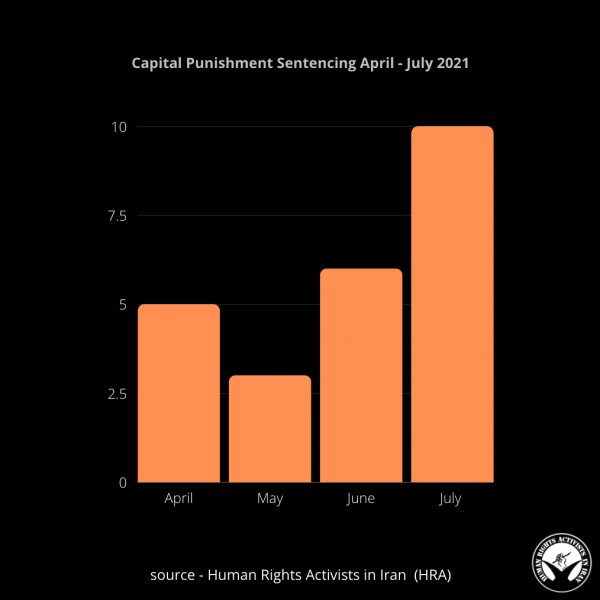
In addition to the staggering number of executions, capital punishment sentencing is also on the rise [See figure 1]. In July alone, a total of 10 people were sentenced to death, compared with 6 in June, 3 in May, and 5 in April.

Capital Punishment Sentencing per month April to July 2021

While the death penalty is not prohibited under international law,  in countries that have not abolished the death penalty, the sentence may only be legally imposed for ‘the most serious crimes’. According to HRC General Comment no. 36 on The Right to Life (GC 36), the phrase “the most serious crime” must be “read restrictively and apply only to crimes of extreme gravity”. 

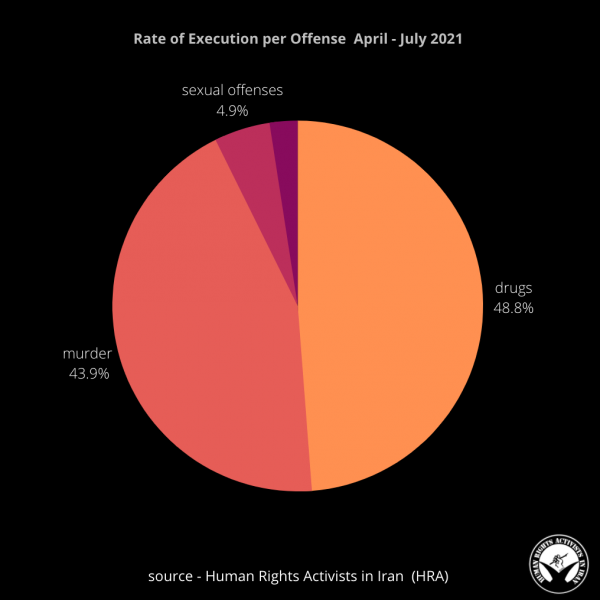
Iran’s judicial system interprets the phrase, to put it lightly, in a way that is less-than-restrictive.  Despite recent legal reforms, drug-related offenses accounted for the highest number of executions between April and July (48.8%).  GC 36 also establishes that “sexual offenses, while serious in nature, must never serve as a basis for the imposition of the death penalty”, but from April to July 2021, 4 individuals were executed in Iran on charges of a sexual offense.

Rate of Execution per offence

One of the 10 executed in July was juvenile offender Baha al-din Ghasemzadeh. Juvenile executions are explicitly prohibited under international law, but they are an enduring practice within Iran’s criminal justice system. In fact, in a recent interview with Agence France-Presse, Secretary of the state-run High Council for Human Rights Majid Tafresh said that the Islamic Republic executes juvenile offenders “three to four times a year”, and claimed this should not be considered a human rights violation. According to HRA’s Spreading Justice Project Manager, Parasto Azizi, “HRAs Spreading Justice team has documented several individuals including judges and prosecutors responsible for imposing the death penalty for crimes falling outside of those internationally recognized as most serious including illegally imposing the death penalty in cases involving juveniles.” 

*In addition to the numbers analyzed in this report, on August 2nd, two juvenile offenders were executed in Urmia Prison on drug-related charges.

The Use of Torture in Iran

The Use of Torture in Iran – Obligations, Violations, and Victim Testimony

The use of torture in Iran is vast, often state-sanctioned, and continually occurs with impunity. While States bear the sole responsibility for protecting the human rights of individuals within their jurisdictions, if they are unable or unwilling to do so, the international community must work towards ensuring that there is accountability for violations on part of the State.

Throughout history, and oftentimes in reaction to a negative international image, Iran has ratified five out of the ten core human rights treaties. In light of the upcoming World Day to Support Torture Victims, the international community must commit to working together to ensure there is justice and accountability for said violations. 

State Obligations 

The Islamic Republic is a State party to the ICCPR, with no reservations or derogations, thus obliging the State to respect all provisions within. Article 7 of the ICCPR expressly prohibits the use of torture, providing that “no one shall be subjected to torture or to cruel, inhuman or degrading treatment or punishment […]”. Article 7 is additionally complemented by positive obligations in Article 10 paragraph 1, which sets forth that “all persons deprived of their liberty shall be treated with humanity and with respect for the inherent dignity of the human person”.

The meaning of Article 7 has been debated and expanded upon throughout the years, most notably in UN Human Rights Committee (HRC) general comment no. 20. 

In addition to international obligations, Article 38 of the Constitution of the Islamic Republic of Iran states, ‘The use of any type of torture for extracting information or confession from a person is not allowed. Forcing a person to testify, take an oath, or confess is not allowed and such statements given under pressure are invalid. Those violating this principle will be punished according to relevant laws.’ 

There is an ever-present culture of impunity in Iran. Closing the accountability gap requires a bold stance from the international community to commit to understanding the widespread use of torture in Iran and utilizing that information to hold human rights violators accountable. The brief analysis that follows aims to demonstrate Iran’s extensive use of torture in every meaning of the term – notwithstanding obligations under the ICCPR and domestic law. The examples given are by no means exhaustive. 

Physical, mental integrity and prolonged solitary confinement 

The prohibition of torture outlined in Article 7 relates not only acts that cause physical pain but also to acts that cause mental suffering to the victim. It is widely recognized that prolonged solitary confinement may amount to torture. In addition, prolonged solitary confinement is proven to cause both mental and physical suffering to the victim.

The use of physical torture in Iranian prisons can be divided into the following 3 categories:

  1. Inflicting physical pain: floggings, use of handcuffs and shackles for prolonged periods of time, the beating of prisoners, hanging prisoners, amputation of body parts, and more. 

It should be noted the above are a mere few examples of physical torture present in Iranian prisons.  Amputations and floggings are provided for under domestic punitive law. 

  1. Deprivations: long periods of time in which prisoners are deprived of food, water, medical and sanitary products, sleep, fresh air, space to move, and/or healthcare. 

There are several examples of prisoners kept in small spaces, denied medical and sanitary products, and healthcare. All of the above are instances that amount to torture. In addition, the denial of medical care is a violation of the right to the highest attainable standard of health. Where the lack of medical treatment leads to avoidable death there is an additional violation of the right to life. 

  1. Exploiting cultural taboos: sexual harassment of both men and women, force-feeding, harassing loved ones, and beating prisoners with items that might be sacred to their religion or culture.  This type of torture is physical, but it also has a deep psychological impact.

The use of psychological torture in Iran is widespread. Psychological torture negatively impacting an individual’s mental health and is aimed at breaking down the victim leading to a negative interpretation of self-worth and altered perspectives. 

Examples of psychological torture common in Iran over the past 4 decades: 

  1. Prolonged solitary confinement: limits all the sensory experiences and leaves the victim fully dependent on the interrogator or prison guard for every basic necessity of life, including food and communication. 

In Iranian prisons often solitary confinement cells have their lights on 24 hours a day, making it extremely difficult for prisoners to count the days or sleep. 

  1. Control of access to information: many prisoners have stated how they were fed wrong information about the outside world while they were in solitary confinement. At times, they are told their friends or family members were also arrested, killed, or testified against them. There have been documented instances of individuals being told that their loved one was seeing someone else or had forgotten about them.  There are also times that individuals are completely cut off from the outside world given no access to newspapers or the like. The latter is in addition to psychological torture, a violation of Nelson Mandela Rules. 
  1. Verbal threats: Individuals are threatened with physical torture such as; the rape of oneself or a family member, killing, or additional false sentencing in the name of societal shame i.e. changing one’s charge to moral corruption. 
  1. Creating shame and disrespect: examples: ethnic individuals forced to speak in Farsi, religious minorities forced to disrespect their own religion, and sexual minorities forced to deny and or insult their sexuality. In addition, female prisoners have documented instances of having been repeatedly told to list the men they have slept with.
  1. Witness suffering: prisoners are forced to hear or witness the suffering of others. This includes: hearing others being beaten, watching executions, or watching others being tortured. 

Interrogation and forced confessions 

The use of statements or confessions obtained through torture is not legally admissible in a trial of the accused. The Human Rights Committee has expressed that forced confessions amount to torture under Article 7 of the ICCPR. These acts are also expressly prohibited in the Iranian Constitution. 

Access to doctors and lawyers 

Under the ICCPR, there should, in all cases, be prompt and regular access to doctors and lawyers. In the case of Iran, once imprisoned, many political prisoners and activists are denied access to both medical care and legal counsel. Instances of denial are well documented in HRANA reports. In addition, particularly in the case of those detained in Evin Prison, the lack of adequate medical care has been documented to lead to avoidable illness and death. There are serious concerns regarding the consequences of the denial of medical care. 

The right to an effective remedy 

Positive obligations onto the State include effective remedies for victims of torture, including compensation. However, victims and families of torture victims are often harassed, intimidated, and bribed. Iranian authorities systematically repress the efforts of those seeking justice for crimes committed against them including for torture. 

Victim testimonies: physical and psychological torture 

Yashar Piri

Yashar Piri, a Turkic ethnic activist from Tabriz city, was beaten during both his arrest and interrogation. His brother, Rouzbeh, wrote in a note that “Basij members in plain clothes arrested Yashar without providing a court order or a judicial officer card“. He continued, claiming that when “Yashar was arrested, he was hit on the head with an electric shocker and then pepper-sprayed in his mouth, his legs were tied with a belt, and after handcuffing him, the beating continued until he was drug to the ground and transferred to an unknown place while unconscious”. Yashar was released 3 days after his arrest, and has been in the hospital since being treated for his injuries obtained in this event.

Mohammad Doji

On November 18 of last year, 19-year-old Mohammad Doji died following severe physical torture in Amirabad Prison in Gogan city. Prisoners who witnessed the incident have stated, “There was a clash in the prison and the guard officer took off his [Mahammad Doji’s] clothes to punish Mohammad. He tied his hands and feet while he was naked and hung him from the ceiling of the prison in the cold. They beat and beat him until he was unconscious, they poured cold water on him, and all this was done in front of our eyes as to teach us a lesson. Unfortunately, this morning he could not stand the torture anymore.

Hamid Rastbala

In August 2020, Hamid Rastbala, a Sunni Prisoner held in Vakil Abad Prison of Mashhad, wrote in a letter about the torture that he and other Sunni prisoners faced. He details torture aimed at forced confessions below. 

Parts of this letter reads: 

They recklessly call the Sunnis the military enemies of the Islamic Republic. We were tortured in solitary confinement for almost ten months to obtain false confessions. Many of us Sunni political prisoners were greeted with severe floggings and severe shocks (electrical shocks by shockers). Some of us were even sexually abused by spraying pepper spray on our genitals and anus. 

They threatened to arrest, torture, assassinate and rape our families. Many of us suffered severe mental health concerns, and in order to halt the torture and pressure, we accepted any accusation that was leveled against us.

We even admitted and repeated these accusations in front of the video camera so that they would not harm our families. This is human rights and human dignity in the Islamic Republic.

Mohammad Alijani

Mohammad Alijani was arrested during the nationwide protests of November 2019 in Islamshar. He is currently being held at Greater Tehran Prison and is facing charges of Muharebah. In July 2020, Alijani wrote a letter about the physical and mental torture he faced. 

Parts of his letter reads: 

I, Mohammad Alijani, Reza’s son, was arrested by the security and intelligence police during the protests in November 2019. I was severely tortured physically and mentally.

I was made to confess to charges such as disturbing public order by participating in the riots and destroying public property of the Basij base, insulting the leadership, by force, and under physical and psychological torture. 

I am the breadwinner of my home and my absence from home has caused problems such as falling rent and family problems to pay for the house. My family and I suffer greatly from this.

Abolfazl Karimi 

Abolfazl Karimi was a juvenile at the time of arrest during the November 2019 protests. On March 16, 2020, Karimi wrote a heartfelt letter about his conditions and the torture he faced in Evin Prison.

Below is an excerpt from the letter:

I suffered a lot in ward 2A of Evin prison and was unaware of my mother’s pain [who had recently gone under surgery]. Because they did not allow me to contact my family and kept me in solitary confinement for 50 days. During interrogations, I was threatened with the arrest of my mother and father. I was also beaten with a shocker by the Akbarabad Revolutionary Guard’s intelligence; they claimed that I had killed one of the officers. Officers broke my head and pulled my toenails. Even now, all my toenails are falling out. They broke one of my teeth by kicking my face and during the interrogation in Branch 1 of Baharestan, they forcibly accused me of the crime. My request to everyone is to please not say that the IRGC intelligence does not hurt anyone. The IRGC’s intelligence is crueler than Shimr (Shimr is referred to as who is said to have killed Hossein (one of Shia 12 Imams) in the battle of Karbala).

The Afkari brothers

The Afkari brothers, arrested in relation to nationwide protests of August 2018, are said to have been made to confess against each other under severe torture. Even after one of them, Navid Afkari, was executed, the others continued to be tortured and kept in solitary confinement.

Their parents wrote a letter to the Judge Supervisor of the prison. An excerpt follows: 

Mr. Hashemi, Judge Supervisor of Adelabad Prison of Shiraz; My children Navid, Vahid, and Habib Afkari were beaten and transferred to solitary confinement on 3 and 5 September 2020. For this reason, they demanded that their complaint be investigated, and the family also demanded that the beating and torture of their sons by Ali Khadem al-Husseini, a prison guard, be investigated. We demanded a forensic doctor go to the prison and record the injuries inflicted on my children, which were 17 in the case of Navid and about 15 in the case of Vahid and Habib.

However, 47 days later, no action has been taken and the office of Mr. Rezaei Dana, the director of Adelabad Prison, claims that the complaints were registered by Mr. Rezaei Dana.  However, the reviewing authority does not give us the date of registration of the complaint and the letter number.

Niloufar Bayani 

Niloufar Bayani, an environmental activist who worked as an expert at the Parsian Wildlife Institute, was arrested along with eight other environmental activists in early 2018. The arrests took place in a coordinated operation by the IRGC’s intelligence on charges related to “espionage”.

There are multiple reports that these individuals were physically and psychologically tortured. During the interrogation carried out by IRGC intelligence interrogators, Niloufar Bayani was abused and harassed. She was made to be completely naked and endured sexual assaults including inappropriate touching. She was threatened with rape and was severely beaten by officers using cables and hoses. 

Bayani wrote a letter describing her detention conditions stating she was kept in solitary confinement for 8 months and was interrogated on a daily basis from 8 to 12 hours a day.

An excerpt of her letter follows: 

“I was blindfolded, while being interrogated I was made to stand, spin or squat and stand again, I was threatened with the arrest and torture of my 70-year-old mother and father. They threatened me to be physically tortured by showing me images and descriptions of torture devices. And I heard hours about the suffering and pain that torture causes.” 

The above are a mere few recent examples of many more known and unknown cases of physically tortured prisoners across the country. It should be noted that many cases of physical torture are never revealed and there can be no correct statistic given in this regard. These few cases were chosen to show that physical torture is being used widely for various reasons being punitive, making examples for others, extracting false confessions, and more. The examples also provide insight into the widespread use of torture not limited to one institution, rather country-wide. The featured cases also aim to highlight that the victims of torture can be anyone including juvenile offenders, women, ethnic minorities, religious minorities, and more. 

Accountability

The frequent use of acts amounting to torture illustrates the deep level of impunty enjoyed in Iran. Closing the accountability gap requires a bold stance from the international community to commit to understanding the widespread use of torture and utilizing that information to hold human rights violators accountable. 

Torturer Violator Spotlight

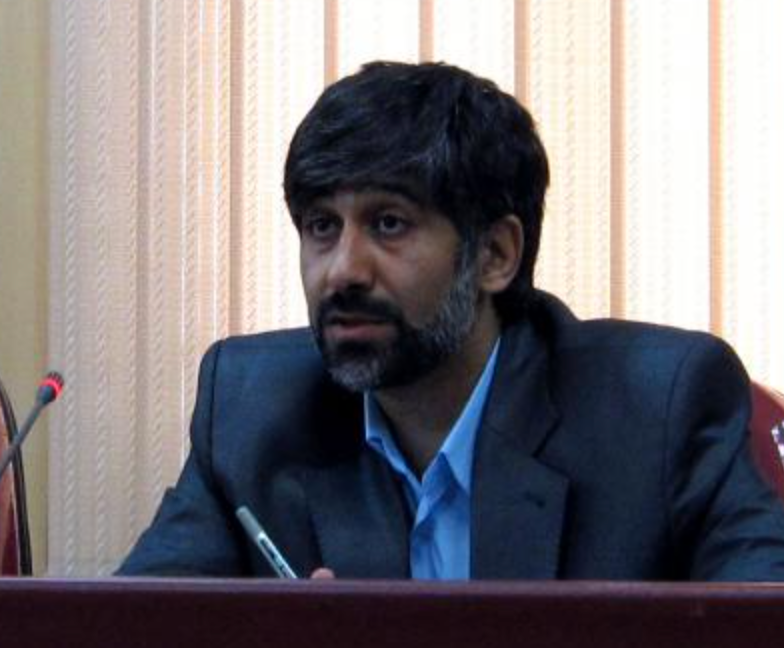
Sohrab Soleimani: director general of Prisons of Tehran Province

Sohrab Soleimani

Sohrab Soleimani has been directly involved in and responsible for countless violations of fundamental human rights as the director-general of prisons in Tehran Province. These violations have included harassment, torture, and pressure on prisoners, especially in political and ideological prisons. There are many reported incidents of brutality against prisoners at the hand of Sohrab Soleimani. Imprisoned journalist Issa Saharkhiz suffered from frequent seizures while held in solitary confinement and protested the lack of medical care for political prisoners under Saleimani’s directorship. Article 10 of the ICCPR, as noted above, mandates that “all persons deprived of their liberty shall be treated with humanity and with respect for the inherent dignity of the human person”. In addition to the countless violations of both Article 7 and 10 related to torture, Soleimani is responsible for widespread violations of the non-derogable right to life. Soleimani and all of those acting under his control should be held accountable. Read more about Soleimani’s violations here. 

Bahram Reshteh Ahmadi: Deputy Prosecutor for Security and the HEad of Evin SEcurity Court

Bahram Reshteh Ahmadi 

As the Deputy Prosecutor for Security and the Head of the Evin Security Court, Bahram Reshteh Ahmadi has played a key role in violating the rights of defendants and political prisoners, as well as in detaining political, civil, and human rights activists. Ahmadi has additionally been directly involved in the harassment of political prisoners through the denial of access to legal counsel, a right expressly guaranteed under the ICCPR. Read more about Ahmadi’s violations here. 

Hamid Mohammadi: Warden of Evin Prison

Hamid Mohammadi

Since June 2020, Hamid Mohammadi has been the warden of Evin Prison. As warden, Mahammadi carries the ultimate responsibility for the life and wellbeing of prisoners held there. Mohammadi is responsible for the cruel, inhumane, and often degrading treatment in Evin Prison in the form of torture, beatings, interrogation, and solitary confinement. He also bears responsibility for inmates’ frequent deprivation of health and medical care, which has led, in several cases, to avoidable physical and mental suffering and even death. Under Mohammadi, political prisoners and journalists such as Nasrullah Lashani, Keyvan Samimi Behbahani, Majid Asadi, and Golrokh Iraee have experienced harsh interrogations, prolonged solitary confinement, and lack of access to medical care, family, or lawyers. 

 Read more about Mohammadi’s violations here. 

Additional Iranian human rights violators complicit in acts of torture can be found at www.spreadingjustice.org using the searchable tag ‘torture’ and include among others: 

Seyed-Kamal Hadianfar, Seyed Ebrahim Raisol-Sadati, Mohammad-Hassan Sadeghi Moghaddam, Mohammad Mohammadi Reyshahri, Ali Fallahian, Mohammad Mahdi Haj-Mohammadi, Ali Sheikhloo, Heydar Moslehi, Ruhollah Rezaei Dana, Hassan Karami, Saeed Jalili, Seyed-Mahmoud Alavi, Ali Larijani, Gholam-Hossein Esmaeili, Hamid-Reza Baharvand, Mostafa Nazari, Mohsen Rezaee, Mohammad-Bagher Ghalibaf, Esmaeil Fallah, Morteza Bahmani, Mohammad Shahriari, Sadegh Jafari Chegeni

Iranian officials continue to violate the rights of LGBTQ+ community

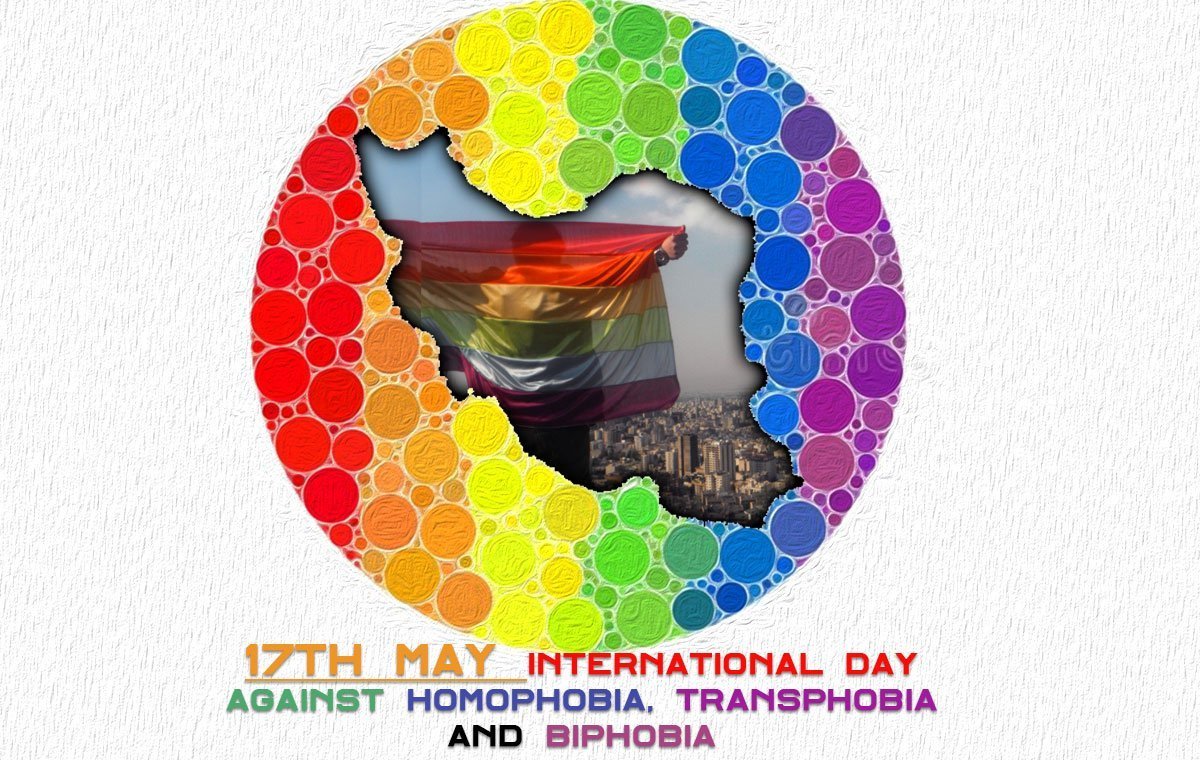
May 17, International Day Against Homophobia, Transphobia and Biphobia

Beginning in 2004, the 17th of May has been recognized as “The International Day Against Homophobia, Transphobia, and Biphobia”. This day was created on the anniversary of removing homosexuality from the list of mental disorders by the World Health Organization (WHO), and the aim is to raise awareness on human rights violations committed against the LGBTQ+ community around the globe. However, Iranian legislation, continues to penalize same-sex consensual relations, by floggings, imprisonment, or the death penalty. As a result, transgender persons are subjected to daily discrimination and rights violations, i.e., pressure to undergo sex reassignment surgery only being able to change their official identity and documents after doing so. This report by Human Rights Activists in Iran’s News Agency (HRANA), gives a brief overview of the LGBTQ+ rights in Iran, highlights cases of LGBTQ+ rights violations that have taken place between 17 May 2020 to 17 May 2021 in Iran, and lastly it highlights a list of serious human rights violators who have violated the rights of LGBTQ+ community in Iran.

It should be noted that unfortunately due to cultural sensitivity and legislative discrimination around LGBTQ+ cases in Iran, many of the violations in this regard are not reported all and the actual cases may be a lot more than the reported cases.

Instances of reported Structural and Social Violence Against LGBTQ+:
cases from 17 may 2020 to 17 may 2021

Iran does not recognize homosexuality, and Iranian penal code makes sexual acts between two same sex individuals punishable by law, in cases even punishable by death penalty. Under this penal code kissing between two men or two women is punishable by 60 lashes, and if two men are find naked together ( if not blood related) can be punished by 99 lashes, dissemination of materials regarding LGBTQ+ literature are considered “immoral” and “corrupt” and can receive the highest form of punishment. Iran is one of the few countries in the world who allows execution for same sex conduct. Transgender identity is only recognized through state supported sex reassignment surgery. In cases homosexual individuals are pressured to go through sex reassignment surgery to be able to avoid legal and social pressure.

In May 2020, HRANA published a report on human rights violations against transgender prisoners who are held in a separate ward in Evin prison. This ward, ward 240 hall 1, is comprised of a common hall on the ground floor of the building called “Amoozeshgah”. There have been reports of physical and verbal violence against prisoners in this ward based solely on their gender identity.

Mohsen Lorestani, an Iranian pop singer, was arrested at his mother’s home on March 3rd, 2019, and was later prosecuted by the state’s attorney. His second court session was held in branch 28 of the Tehran Revolutionary Court, led by Judge Moghise. Mr. Lorestani was charged with “Corruption on earth”, his lawyer explained that this charge was based on the creation and administration of an Instagram group for transgender persons.

According to his Lawyer, Mr. Hosseini, the main accused persons in the case are military personnel, hence, his client’s charges suggest the possibility of transgender “Parastoo (Swallow)” being involved. “Parastoo” meaning Swallow Bird is a term used to refer to individuals who work with security and intelligence organs to trap their targets through romantic and sexual affiliation. This lawyer referred to the claim of “infiltration of security personnel including the highest-level political figures” by the military. Mr. Hosseini said that considering the high degree of control of the activities of the accused military persons by the security departments of military organs, the security aspect of the case is of particular importance, and it’s unreasonable to relate Mr. Lorestani with such a network. Mr. Lorestany was temporary released on 11 May 2020, on a 3 billion Toman Bail.

In June 2020, HRANA reported the summons and interrogation of several LGBTQ+ community members by the security organs after showing up on a highly visited Instagram. Several homosexual and transgender persons have faced persecution from the government because of their public presence in cyberspace where they talked about their sexual identity or orientation.

Based on HRANA’s sources, two individuals (identities protected by HRANA) in the northwestern provinces of Iran, were summoned and threatened by security organs after showing up on Instagram. “Maryam”, a transgender woman living in Iran, has spoken to HRANA about being summoned by the Morality Police of her city and being pressured to spy on her transgender friends and acquaintances to reveal information about their gatherings.

Although the National Statistics Center has never measured or published statistics on the unemployment of the transgender community, unemployment and job loss is a common concern among the transgender community living in Iran. Some transgender persons lose job opportunities because of their sexual identity and or refusal to undergo the suggested sex reassignment surgery. Several transgender persons try to hide their sexual identity from employers and colleagues even after sex reassignment surgery for job security.

In February 2020, HRANA reported on a transgender Iranian citizen deprived of employment due to the common Iranian perception that considers transgender persons “sick”. An example of such action involves a woman living in Tehran, “Delbar Ameri-Far”, who was prevented from continuing her work and renewing her license as an expert with the Iran Food and Drugs Administration (FDA). Ameri-Far was told that she could try again to get her license if she could provide sufficient documentation on her “continued treatment”. The letter from the Iranian FDA stated, “Your license renewal request will only be processed upon provision of medical documents certifying ongoing treatment and proof of your full health.”

The Iranian Public Conscription Organizations’ ongoing classification of transgender status as a disorder is while in 2019, the WHO, in their latest guidelines (ICD-11) classified transgender status under sexual health. Identifying as transgender is irrelevant to one’s mental health and according to many transgender rights activists, classifying it as a disorder leads to, among much more, social stigmatization.

Alireza Fazeli-Monfared young Homosexual person from Ahvaz was murdered on 4 May 2021 by a few men that is said to have been related to him. According to reports published on social media and LGBTQ+ rights activists his Murder has been related to expressing his sexual identity.

On 14 May 2021, Amnesty International on their social media channels, mentioned that despite ten days passing from the murder, those involved in the murder of the young 20 year were not arrested, and demanded that Iran look at his case with equal justice; they asked Iran to respect the human dignity of all sexual and gender Minorities in Iran.

According to the Iranian Penal code, same-sex consensual sexual relations are considered illegal, and if proved, are punishable by lashing, imprisonment, or the death penalty. Moreover, while not all transgender persons opt for sex reassignment surgery, under the current legislation their sexual identity is only recognized and validated after the surgery, i.e., changing names on official documentation. While there is still a gap in legislation on this topic, in 2013 a chapter of the Family Protection Act was dedicated to the transition process of transgender persons. Roohollah Khomeini, Supreme Leader at the time, authorized “sex change” surgery in a Fatwa in 1982.

While there is no international human rights mechanism that specifically addresses discrimination and violence against the LGBTQ+ community, discrimination based on sexual orientation is violation of Iran’s international human rights obligations, namely the ICCPR and ICESCR. Article 26 of the ICCPR states that the law must guarantee non-discrimination for persons “on any ground such as race, colour, sex, language, religion, political or other opinion, national or social origin, property, birth or other status .”

Additionally, the ICESCR at article 2(2) requires the state must guarantee that all individuals enjoy the rights in the ICESCR “without discrimination of any kind as to race, colour, sex, language, religion, political or other opinion, national or social origin, property, birth or other status”.

Individuals and institutions profiled in Spreading Justice complicit in violating the rights of the LGBTQ+ community

Javad Momeni

Affiliation: State prisons and security and corrective measures organization

As the Executive Deputy of Evin Prison, Javad Momeni has been directly involved in gross violations of and persecution of LGBTQ+ in this prison. According to published reports, he personally harassed and insulted transgender prisoners in Ward 240, known as the Transgender Ward, which holds transgender prisoners. According to an eyewitness, “the prison guards were constantly insulting us. They said you are a disgrace or corrupt. In addition, they put a lot of psychological pressure on us. “For example, one day a prison guard showed me a piece of paper to harass me and claimed that I was going to be executed.”

Hossein Taeb

Affiliation: Intelligence Organization of the Islamic Revolutionary Guard Corps

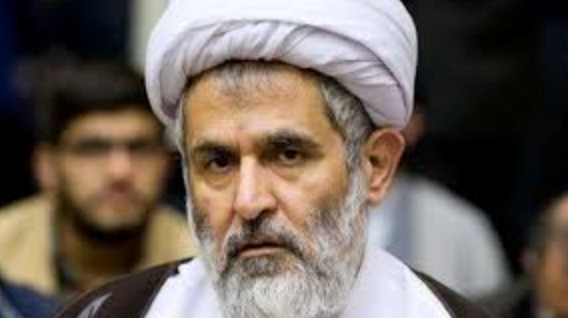
The Revolutionary Guards’ intelligence service has been suppressing, detaining, harassing, and violating the rights of LGBTQ+ community and their rights activists, and Hussein Tayeb, as the organization’s commander, is responsible for these actions.
For example, in October 2013, IRGC intelligence agents raided a birthday party in Kermanshah and arrested several dozen people on charges of what was called “homosexuality.” According to a report published by HRANA, the news organ of the Iranian Association of Human Rights Activists, “the host of the party and the owner of the birthday party, nicknamed” Shervin “, was detained and tortured the most. They threw a rope into his cell and scared him. After his release, he was under pressure for a long time and was summoned until he finally committed suicide and ended his life. “Another person was under pressure for years to spy and was repeatedly contacted by IRGC intelligence.”

Seyed Ebrahim Raisi

Affiliation: Judiciary of the Islamic Republic of Iran

As one of teh most nuterious judges who has been within the judiciaary of iran for more than 40 years in various roles, Ebrahim Raisi has played role in the violation of the rights of LGBTQ+ community.

Hossein Amirili

Affiliation: Deputy Chief of FATA Police

Hossein Amiri was appointed as the Deputy Chief of FATA Police on June 26, 2019, by the Commander in Chief of the Police Force of the Islamic Republic of Iran. Since then, he, along with FATA Police Chief Vahid Majid, has been responsible for all human rights violations commited by this organ, including the restrition of expresison of sexual identity and LGBTQ+ litretature.

Vahid Majid

Affiliation: Iranian Cyber Police with the abbreviated name of FATA Police

Vahid Majid as the Commander in Chief of the Iranian Cyber Police, or FATA Police, is responsible for restricting the freedom of expression in cyberspace, including the restrition of expresison of sexual identity and LGBTQ+ litretature.

Mahammad Moghiseh

Affiliation: Supreme Court of the Islamic Republic

As the judge of Branch 28 of the Revolutionary Court of Tehran, Moghiseh is responsible for widespread rights violations related to sexual minorities.

In November 2019, Mohammad Moghiseh sentenced Rezvaneh Mohammadi, an LGBTQ+ rights activist to five years in prison for allegedly “normalizing homosexual relations” along with the charges of “Assembly and collusion against the national security with the intention of overthrowing the regime” through “collecting information and pictures regarding the mass graves of the executed prisoners of 1988”, and “decriminalizing homosexuality”, “normalization of illegal activities of sodomy”, “removing disgrace from homosexuals”, “making homosexual activity acceptable”, “trying to make the authorities of the Islamic Republic of Iran answer for violating the right of homosexual people and lack of recognition of homosexuality”

Mousa Ghazanfar-Abadi

Affiliation: Islamic Consultative Assembly

Mousa Ghazanfar-Abadi, as the then head of the Tehran Revolutionary Courts, is responsible for violating the rights of LGBTQ+ people and prosecuting their rights activists.
In this regard, Branch 28 of the Revolutionary Court of Tehran in November 2009 sentenced Rezvaneh Mohammadi, a LGBT rights activist, to 5 years in prison for charges of  “gathering and colluding with the intention of acting against the security of the country with the aim of overthrowing the regime”, “through collecting of information and pictures of  mass graves of those executed in mass executions of 1988”, “decriminalization of homosexuality”, “normalization of illegitimate sodomy”, “decriminalization of homosexual acts”, “acceptance of homosexuality”, “efforts to hold the authorities of the Islamic Republic accountable for human rights violations and non-recognition Homosexuality”

Mahammad-Ali Jafari

Islamic Revolutionary Guard Corps (IRGC)

As commander of the Islamic Revolutionary Guards Corp (IRGC), Jafari has been directly involved in widespread human rights violations by the Revolutionary Guards, including violations of the rights of sexual and religious minorities, torture of opponents of the Islamic Republic, violations of women’s rights, violations of the right to life, and the severe suppression of social freedoms in Iran.

In October 2013 IRGC-IO’s agents attacked a birthday party in Kermanshah and arrested a few dozen people for “homosexuality”. According to HRANA, “the host of the birthday party, nicknamed as Shervin, was held in prison and tortured more than the others. Agents put hang rope in his cell and threatened him. After release he was under a lot of pressure and was summoned until he committed suicide.

HALALZADEHA POPULAR MOVEMENT (hate group) 

The Halalzadeha Popular Movement is responsible for discrimination and violence against the LGBTQ+ community – including forming gatherings against sexual minorities. in one of the gatherings of this group they march over the rainbow flag and pass over it by their motorcycles to show their hatred.

FERGHE NEWS

Ferghe News actively publishes discriminatory articles targeting LGBTQ+ individuals.


For further inquiries please contact Skylar Thompson, Senior Advocacy Coordinator Human Rights Activists in Iran (HRA) at [email protected]

Interview with HRA’s executive director, Keyvan Rafiee regarding ‘Spreading Justice database’

On the occasion of the International Day for the Right to the Truth Concerning Gross Human Rights Violations and for the Dignity of Victims, and alongside the adoption of the resolution on the situation of human rights in the Islamic Republic of Iran at the 46th session of the Human Rights Council, HRA launched Spreading Justice, a database of human rights violators in Iran. In this database documents and reports regarding the role of each violator is aggregated under each profile to highlight their role in the ongoing gross human rights violations in Iran.

Watch the latest interview of HRA’s executive director, Keyvan Rafiee, with Iran International television to learn more about this database of human rights violators in Iran.

Iranian Labor rights activists and workers face ongoing rights violations

On the occasion of International Workers’ Day, or May Day, Human Rights Activists in Iran (HRA) highlights the ongoing denial of the full enjoyment of workers’ rights in Iran; namely workplace discrimination, child labour, violations of the right to form and join labor unions and the suppression of the right to peaceful assembly and association often resulting in unfair trials, arbitrary detention, and torture at the hands of Iranian officials. The following article provides a brief overview of the situation of labour rights in Iran as well as identifies several individuals known to be responsible for violating the rights of Iranian workers’ and labour rights activists. The noted violations are in stark contrast to Iran’s International human rights obligations (including ratified ILO Conventions, CRC, ICCPR, and ICESCR) and therefore should not go unpunished.

The Situation of Labour Rights in Iran

The Right to Form and Join Labour Unions

In the past year, a total of 593 workers’ protests and 738 trade union protests have reached the media and or civil society organizations.

Among the most important labor events in Iran over the past year the following workers’ protests can be mentioned; Haft Tappeh sugarcane workers, Kut-e Abdollah Municipality, Heavy Equipment Production Company (HEPCO) in Arak, railway technical lines and buildings, and the union protests of teachers, retirees and social security pensioners.

Over the past 12 months, various cities in Iran have witnessed various forms of protest movements by Iranian workers. A wide range of workers have taken to the streets due to non-receipt of their monthly salaries and disregard for their insurance claims, and some of these workers have gone on strike and protested for up to 30 months of wage arrears. Thus, 114 labor strikes and 3 union strikes have taken place.

The level of cohesive demand of different sections of the working class has been unprecedented in the past year. Repression and sabotage and non-recognition of the rights of trade unions and independent labor organizations, arrest and imprisonment of several labor activists, as well as the denial of the right to protest were among the reasons for the dispersal and disorder of some labor rallies and protests.

Many workers have been summoned, arrested or convicted on charges such as holding a peaceful rally on International Workers ‘Day, protesting against low wages, signing statements in support of trade unions, posting photos of workers’ demonstrations on the Internet or receiving invitations to attend world trade union meetings.

At least 37 workers and labor activists have been arrested in the past 12 months. Among the most important of these arrests are the arrests of four Haft Tappeh workers’ activists, five Kut-e Abdollah Municipality workers, six participants in a rally in support of the Haft Tappeh workers, and tens of nurses and teachers.

Additionally, 46 labor activists were sentenced to 636 months in prison and 3,108 floggings, 51 people were summoned to judicial and security authorities, 1,331 were fired or suspended from work, 4,224 were unemployed, 28,493 uninsured workers and 4,224 uncertain of their work situations.

Also, in the field of unions and syndicates, a total of 47 arrests of union activists, 30 months’ imprisonment for 2 union activists, 50 summonses to judicial-security authorities and 132 cases of closure of places have been reported.

Both the ICCPR (Article 22) and ICESCR (Article 8), to which Iran is a State party, guarantee the right to form and join labor unions. However, under Iranian law, there exists no express right to form labor unions that are independent of the State. Claiming ‘security concerns’, workers may only be represented by a select group of State sanctioned bodies. Nonetheless, groups like the Haft Tappeh Sugar Cane Workers’ Syndicate and others continue to form and gather to protest widespread violations of labour rights. The Haft Tappeh Workers’ Syndicate is a union responsible for the organization of several protests regarding violations of workers’ rights – notably, withheld wages, unfulfilled promises, and the arbitrary detention and torture of many of their members.

The violations against the Haft Tappeh Workers’ and others are not only in contrast to the core human rights treaties to which Iran is a State party but also ILO Conventions. As a founding member of the International Labor Organisation (ILO), the Islamic Republic of Iran was one of the first countries in the sub region to join the organization. Iran has ratified 13 ILO conventions including five of the eight so-called core conventions. These conventions are legally binding upon signature.

In addition to poor working conditions labor rights activists are increasingly peacefully protesting discriminatory practices in the workplace, minimum wages set below poverty lines as well as increasingly low pensions, only deepening the economic hardship felt across the country.

Discrimination in Iranian Law

Iran’s national legislation remains discriminatory as a matter of law. Although the Iranian Constitution includes protection for labour rights, all legislation must be in line with Islamic principles (Article 4). This interpretation of the law allows for women and religious and ethnic minorities to face increased discrimination in the workplace based in Islamic principles. Likely in part due to these practices, the World Economic Forum’s 2020 Global Gender Report placed Iran at number 147 out of 153 for economic participation and opportunity. 

Child Labour

The number of Working Children in Iran is between 3 to 7 million, while this figure is estimated at 20,000 for Tehran, yet considering that most working children do not have proper identifications; it is not possible to provide a more accurate statistics regarding the actual number of working children in Iran.

National legislation prohibits children under the age of fifteen to work. However, in practice, child labour remains present at an alarming rate. Iran’s obligations under the Convention on the Rights of the Child prohibit child labour in any form. In addition, the UN Committee on the Rights of the Child has expressed grave concern at the alarming number of children employed in hazardous conditions. Iran should ensure full compliance with international child labor standards, including in the CRC and relevant ILO Conventions.

Women in the Workplace

Prohibition of child labor and the provision of free education for children, the establishment of the highest level of safety standards in the workplace, the elimination of discriminatory laws for migrant women and workers are other demands of the working community.

Despite the fact that Iranian women workers are described as the cheapest labor force in the country, the employment situation of women is more precarious than men, and at the same time as noted above they have far less legal protections, salaries and benefits.

Female workers have less bargaining power than their male counterparts. At the same time, production and industrial units are less inclined to employ married women, and in some cases employ single women with a commitment not to marry or become pregnant.

The situation of working women in small workshops is much worse. Half of the workers in the kilns are women who work in onerous conditions.

Spreading Justice: Labour Rights Violators- at a glance

Omid Asadbeigi, Morteza Bahmani, Sadegh Jafari Chegeni, and Mustafa Nazari, all profiled in Spreading Justice are responsible for countless violations against Haft Tappeh workers, labor rights activists supporting them, and journalists documenting the unrest.

  • Omid Asadbeigi, Owner and Managing Director of the Haft Tappeh Sugar Cane Agro-Industry Co (hereinafter Haft Tappeh), is known to have arbitrarily withheld wages of his employees in addition to colluding with law enforcement agencies and the judiciary of the Islamic Republic of Iran to intimidate and exploit workers. These actions are in stark contrast to obligations under the 13 ratified International Labour Organization Conventions to which Iran is a signatory. Significantly, amongst the Conventions ratified by Iran are: The Employment Policy Convention, 1964 (No. 122) and the Protection of Wages Convention, 1949 (No. 95). The ILO Conventions are legally binding upon signature. According to the legal review conducted by HRAs Spreading Justice Legal Consultant, Brian Currin, “It is evident that Asadbeigi does not only fail to comply with the most basic obligation of an employer, namely the payment of wages, but in addition he colludes with law enforcement agencies and the judiciary of the Islamic Republic to intimidate and exploit workers.”
  • The Shush Security Police have been responsible for the unlawful arrests and detention of workers and have forcefully suppressed workers’ right to protest and strike. Morteza Bahmani is the head of the Shush Security Police and is responsible for and directly involved in the aggravated assault and torture of workers at Haft Tappeh as well as labor rights activists considered to be their supporters. As stated by SJ Legal Consultant, Brian Currin, “Morteza Bahmani’s actions are the antithesis of what is expected of a State that is a founding member of the ILO and should be condemned by the international community that embraces the practices, ethos and values of the ILO.”
  • As the chief of the Shush Judiciary, Sadegh Jafari Chegeni has committed countless human rights violations, particularly workers’ rights violations. According to the workers of Haft Tappeh, Sadegh Jafari Chegeni was one of the main perpetrators of the repression of protesting Haft Tappeh workers. In addition, evidence of his involvement in the economic corruption involving the CEO of Haft Tappeh (Omid Asadbeigi noted above) has also been publicly mentioned by Haft Tappeh workers.
  • As the prosecutor of Shousha, Mostafa Nazari has been directly involved in and responsible for widespread human rights violations, especially the rights of workers, as well as the right to freedom of peaceful assembly and association. According to numerous reports, he was one of the main perpetrators of the crackdown on the protesting workers of Haft Tappeh as well as their unfair judicial treatment.

*It is of note that the violators highlighted in this report are merely a select few. For more information on the violators within, please view the profiles in their entirety by clicking on the individual names.

A statistical glance at the situation of Iranian Workers 2020-2021

In Iran, Labor Day comes at a time when the privatization of state-owned factories and companies continues without regard to the long-term interests of workers.

According to Human Rights Activists in Iran’s (HRA) statistics department, a review of labor reports published in the last 12 months (April 30, 2020 to April 27, 2021), indicates at least 9,367 workers were killed or injured in work accidents.

Injuries

At least 7577 workers were injured at work in the past 12 months. In 12 official reports or comments at the national and provincial levels, officials reported that 7073 people were injured.  In addition to the official reports, Civil and labor rights activists reported another 504 cases of injuries at work.

Deaths

At least 1790 workers lost their lives in work accidents in the past 12 months; Officials and relevant agencies reported the deaths of 1,545 workers in 9 official reports, while independent organizations reported 245 deaths of workers that were not mentioned by official reports and authorities.

Actual numbers might be a lot higher

It should be noted, even though statistics above are many, the reality might be much harsher due to lack of transparency of the responsible institutions, many of work incidents are not reported and thus do not make it to the media.

To better understand this issue, “Iran announced that 15,997 people lost their lives in work-related accidents in the last 10 years (2008-2018), 15,767 were men and 230 were women.” This means that an average of 1,600 people has lost their lives each year in work-related accidents over this decade.

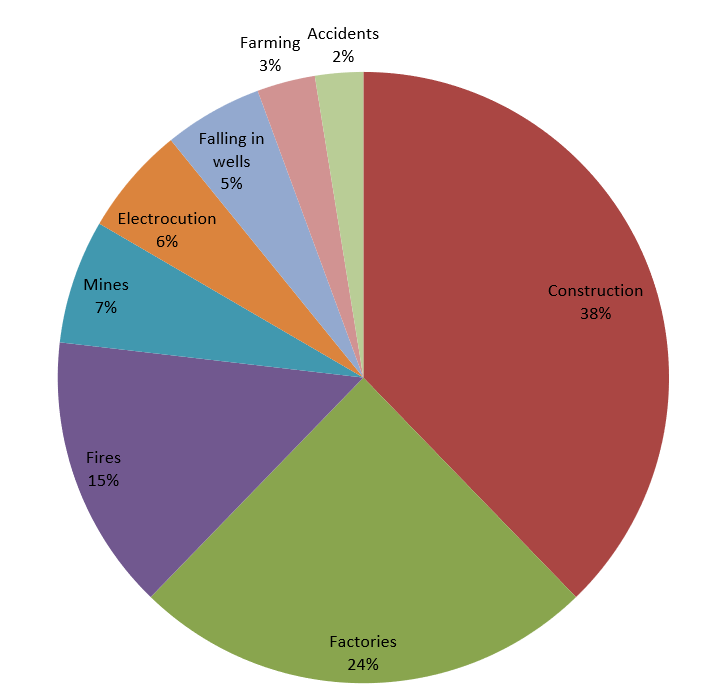
According to these statistics, the main cause of death in work accidents is falling from a height. In the last ten years, that is about 41.5% of total casualties at work accidents. Iran ranks 102nd in the world in terms of occupational safety.

Occupational Accident Classification Chart

HRA’s Statistic Department: Occupational Accident Classification Chart (May 2, 2020 to April 27, 2021)

Wage Arrears

According to statistics compiled by HRA’s statistic Department, at least 34,318 workers have more than 2,313 months of wage arrears.

However, it should be noted that among the published reports on wage arrears, a large number of reports did not mention the number of workers awaiting wage arrears, which is one of the important factors in the impossibility of providing accurate statistics of workers claiming arrears.

Poverty line and low wages

On Sunday March 14, 2021, the Supreme Labor Council implemented a 39% increase in the minimum wage, that is the minimum monthly salaries were increased from 1 million and 912 thousand Tomans to 2 million and 650 thousand Tomans.

Although the Iranian government has refused to officially announce the poverty line, economic activists believe that the minimum wage is still well below the poverty line even after this increase.

Also, the members of the Supreme Labor Council increased the workers ‘food rations to 450,000 Tomans and the workers’ housing allowance to 600,000 Tomans. It should be noted that housing allowance is not implemented yet and to be implemented must be approved by the Council of Ministers and then be included in the next year’s payroll of workers. These figures are being ratified while the head of the labor faction of the 11th parliament has previously stated that even if the minimum wage rises by 100 percent, workers purchasing power will not return to normal.

In addition, the increase of workers’ salaries by a small amount to 2 million and 650 thousand Tomans has been approved while recently the head of the Supreme Association of Trade Unions, referring to the announcement of the Central bank that poverty line is at 10 million Tomans, said: “Last year the poverty line was 6 million Tomans, which has increased by 4 million Tomans this year.”

On the other hand, Faramarz Tofighi, the workers’ representative in the wage determination committee, had previously said: the acceptable cost of essentials (food, etc) is 6 million and 895 thousand Tomans. This is while in the final agreement, the minimum wage for the year 1400 (Jalali Calendar) is set at only 2 million 656 thousand Tomans, and this is about 3 million Tomans less than what the workers representatives indicated as cost of essentials.

In addition, Ali Asgarian, Deputy of Public Participation of the Relief Foundation, announced: According to the monitoring of the monthly observation center, which defines food poverty line by 1800 sampling points, now the food poverty line is 670 thousand Tomans per person and if the family consider three people with the minimum wage, many working families are below the poverty line or at the food poverty line. He added that about 20 million people in the country need support; “Currently 6.5 million people are covered by the Relief Foundation and there are about 7 million other people who have similar conditions but are not covered by this organization. There are also another 14 million people in need in the country who are not receiving any assistance.”

The minimum wage set by the Supreme Labor Council, according to many experts and labor activists, is much lower than the real inflation rate in the country and lower than the value of the household consumption basket. This is another reason for the continuation of the protests of the working community of the country.

Obligations

Violations against labor rights activists and workers alike are in stark contrast to Iran’s international human rights obligations namely, the Convention on the Rights of the Child (CRC), the International Covenant on Civil and Political Rights (ICCPR), the Convention on Economic Social and Cultural Rights (CESCR), and relevant ILO Conventions. Iran should ensure full implementation of the noted mechanisms and protect the rights of workers’ by removing discriminatory barriers to workplace participation particularly on women and ethnic and religious minorities. In addition, HRA calls on the international community to hold the above and all perpetrators accountable for their actions against Iranian workers’ ending the widespread impunity enjoyed in the Islamic Republic of Iran.


For further inquiries please contact Skylar Thompson, Senior Advocacy Coordinator Human Rights Activists in Iran (HRA) at [email protected]

Iranian Courts Responsible For Issuing Death Sentences

Iran has one of the highest rates of death sentence in the world and is therefore always condemned by the Human Rights Council and the UN General Assembly. Death sentences in Iran are issued by Criminal Court Number One, the Revolutionary Court, the Military Court, and the Special Court of Clergies.

One means of objecting to the issued verdict is to request an appeal. According to law, appeal judgment is “deciding whether or not the verdict under appeal conforms to the laws of religious jurisprudence and legislation”. For criminal convictions, appeal is a request for change of the verdict issued by the court of first instance. Apart from the cases in which the convict can request a retrial from the Supreme Court, in some cases, it is possible to appeal against the judgment or acquittal in the Supreme Court according to the Code of Criminal Procedure.

Criminal Court Number One

Criminal Court Number One is established in each provincial capital, as discerned by the head of the judiciary in the jurisdiction of the cities. In areas where this court does not exist, cases are heard in the closest Criminal Court Number One within the jurisdiction of that province.

This court is composed of one presiding judge and two counselors (three judges), but it can officially convene when two members are present. In Criminal Court Number One and in all cases where the trial is held before several judges, the majority vote of all members shall matter and the opinions of the minority must be reasonably included in the case.

With the enactment of the new law on criminal procedure, the provincial criminal courts were removed from the judiciary and transformed to criminal court number one according to Note 3 of Article 296. In addition to investigating the crimes set forth in Article 302, the criminal court number one located in the provincial capitals also investigates political and press offenses in accordance with Article 305. As per Article 308 of the same law, the court also hears the charges of ministers’ advisors, the highest officials of governmental organizations, chairs of public companies and institutions, non-governmental public institutions, directors general, governors, directors of institutions, government departments and public non-governmental institutions within provinces and cities, university chancellors, chairs of higher education centers, and mayors of provincial capitals and districts.

It should be noted that if any crime occurs in any province, the relevant province will investigate the attributed charges. Another condition set for such a case is that the investigation of these charges should not be within the competence of other authorities according to certain laws.

Investigation of crimes within the jurisdiction of the Criminal Court Number One

According to Article 302 of the Code of Criminal Procedure, the following crimes are within the jurisdiction of Criminal Court Number One:

1. Crimes punishable by death: These are the crimes that are punishable by Qisas (blood vengeance), execution and stoning.

2. Crimes punishable by life imprisonment: This means a punishable theft that has happened for the third time.

3. Crimes punishable by amputation: This means committing theft for the first or second time, which is subject to the determined punishment.

4. Intentional crimes against physical health amounting to half of the full blood money (Diyya) or more.

5. Crimes subject to 1st to 3rd degree discretionary punishment, which are as follows:

Revolutionary Court

Pursuant to Article 303, the following crimes shall be investigated in the Revolutionary Court. A. Crimes against foreign and national security, Moharebeh (waging war against God), corruption on the Earth, insolence, collusion and conspiracy against the Islamic Republic of Iran, armed fight, arson, destruction of property in order to oppose the regime B. Insulting the founder of the Islamic Republic of Iran and the Supreme Leader C. All crimes related to narcotics, psychoactive drugs, their ingredients, and the trafficking of weapons, ammunition and controlled substances. D. Other cases that are under the jurisdiction of this court according to certain laws.

As per Article 297, the Revolutionary Court shall convene in the presence of a presiding judge and two counselors in order to try the crimes mentioned earlier in paragraphs (A), (B), (C) and (D) of Article 302 of the Code of Criminal Procedure. To investigate other crimes, a court will convene in the presence of a substitute president or judge or by a counselor.

Article 5 – The required number of revolutionary courts shall be established in the capital of each province and in districts determined by the head of the judiciary. These courts shall be established under the supervision and administrative management of the jurisdiction and shall investigate the following crimes:

1. All crimes against foreign and national security, Moharebeh (waging war against God) or corruption on the Earth

2- Insulting the status of Ruhollah Khomeini, the founder of the Islamic Republic of Iran and Ali Khamenei, the supreme leader of the Islamic Republic of Iran.

3- Conspiracy against the Islamic Republic of Iran, armed fight, terror and destruction of organizations in order to oppose the regime

4- Espionage for foreigners.

5 – All crimes related to trafficking and drugs.

6- Disputes related to Article 49 of the Constitution.

By the virtue of Article 19 of the Law on the Establishment of Public and Revolutionary Courts, the following verdicts can be appealed. The appellate court can overrule the verdict or reinvestigate the case if it finds the verdict erroneous or believes that the court of first instance was incompetent.

A) Verdicts: 1- Execution and stoning. 2 – Hudud (Islamic Punishments), Qisas (blood vengeance or retaliation for body organs). 3- Forfeiture and confiscation of property. 4 – Diyya (financial compensation) over 1/5 of full financial compensation amount. 5 – If the maximum legal punishment for the crime amounts to more than 6 months of imprisonment, flogging or a fine over one million Rials. 6- A verdict that demands more than one million Rials. 7- A verdict that is not valid according to the confession heard in court. 8- A verdict that does not conform to the opinion of one or more experts whose opinion has been accepted in writing by the parties. 9- The verdict concerning the derivatives of the dispute if the verdict of the main dispute can be appealed. 10 – Judgment on marriage, divorce, termination of marriage and marriage portion. 11- Judgment on lineage, will, executor appointment, endowment, endowment of 1/3 of properties, entailment and guardianship. 12- Verdict on incapacity and emancipation of a minor.

B) The following judgments of the verdict of the main dispute can be appealed: 1- The decision to annul the petition or reject the petition, issued by the court. 2- Termination of the lawsuit or not hearing the lawsuit. 3- When charges are about to be dropped. 4- The decision on the incompetence of one of the parties to the lawsuit.

Contradiction between the competence of the Revolutionary Court and the Criminal Court Number One

When there is a conflict between the competence of Revolutionary Court and the Criminal Court Number One, the Revolutionary Court shall investigate the matter. However, cases that fall within the competence of the Criminal Court Number One do not negate the jurisdiction of the Revolutionary Court.

For instance investigating the crime of corruption on the Earth lies with the Revolutionary Court. According to Article 286 of the Islamic Penal Code, the punishment for corruption on earth is the death penalty, which leads to eradications of ones’ life. According to Article 302 of the Code of Criminal Procedure, a crime whose punishment leads to death is within the jurisdiction of the Criminal Court Number One. Therefore, the question that arises is that which of the two above-mentioned authorities (Revolutionary Court or Criminal Court Number) will be in charge of investigating the crime of corruption on earth, the punishment of which is eradication of life? The answer is that the competent authority in this case is the Revolutionary Court.

Military court

One judicial entity that is separate from the armed forces is a special judicial authority called the Judicial Organization of the Armed Forces. This organ investigates the crimes of military forces. The Judicial Organization of the Armed Forces of the Islamic Republic of Iran is a part of Iranian Judiciary. It is the only specialized judicial authority set in the Constitution of the Islamic Republic of Iran, and it is established in the provincial capitals of the country. According to Article 172 of the Constitution, military tribunals are established in accordance with the law to investigate crimes pertinent to certain military or disciplinary duties of members of the army, gendarmerie, police (law enforcement forces) and the Islamic Revolutionary Guard Corps. However, for their general crimes or crimes they commit as judicial agents, they are tried in public courts.

At the time being, the competence of the Judicial Organization of the Armed Forces is based on the resolutions passed by the Islamic Consultative Assembly, the Expediency Council, and the certain permissions issued by the Supreme Leader of the Islamic Republic, Ali Khamenei. The jurisdiction of this organization concerns the certain crimes committed by military and law enforcement forces and members of the Armed Forces, crimes discovered during the investigation of military crimes, the crimes of Iranian prisoners and non-Iranian prisoners inside Iran, and crimes related to the duties of the personnel of the Ministry of Intelligence.

 The investigations have two phases in the Judicial Organization of the Armed Forces. Therefore, reports or complaint are submitted by the relevant authorities or ordinary people, and a relevant case is first opem in the military court and the preliminary investigation is conducted by an investigator or assistant prosecutor under the supervision of the provincial military prosecutor. If there are sufficient reasons to commit the crime, the case is submitted to the military court after the indictment is issued (drawn up the prosecutor). After referring the case to the court branches, the mentioned court issues an appropriate verdict after holding the trial. The verdicts issued by the military courts can be appealed against in higher judicial authorities and the Supreme Court of the country due to the importance of the crime, pursuant to Law on Appeal Courts enacted in 1993.

By the virtue of Note 2 of Article 307, the charges of military and law enforcement officers (the subject of Article 307), which are within the jurisdiction of the Judicial Organization of the Armed Forces, may be investigated by military courts number 1 and 2 in Tehran. It should be noted that the general crimes of military and law enforcement personnel enjoying the rank of brigadier general or higher, or the holders of the rank of second brigadier general working alongside army generals or brigadier generals are within the jurisdiction of Tehran criminal courts. Crimes committed by officials who are not mentioned in Article 307 and its notes are investigated by the Judicial Organization of the Armed Forces. The new Code of Criminal Procedure does not include the establishment of a special legal body to investigate the crimes of the armed forces and the military personnel. These crimes are dealt with in accordance with the relevant laws.

Military courts are divided into military court one and two. Pursuant to Article 3 of the Penal Law on the Armed Forces of the Islamic Republic of Iran, crimes punishable by 10 years or more of imprisonment or death sentence are heard in the Military Court One, and less serious crimes are punished by the Military Court Two.

Military Court One consists of a substitute prosecutor or a presiding judge and a counselor. The right to vote belongs solely to the substitute prosecutor or a presiding judge.

Note – In Military Court One, the substitute prosecutor or a presiding judge could be a civilian or a military force. The counselor is chosen from military jurists and is obliged to carefully study and review the case before court decision, and to state his views in writing.

According to Article 5 of the Code of Judicial Procedure of the Armed Forces of the Islamic Republic of Iran, the opinions of Military Court One leading to the death penalty or ten years imprisonment (or more) shall be reviewed by the Supreme Court, whether or not the convict or the prosecutor objects to the verdict, with due observation of the provisions of Articles 287 and 288 of the Law on Amendment of Articles of Criminal Procedure.

Note: Whenever a crime is within the jurisdiction of Military Court One on the basis of its legal punishment, and when after the end of the trial, it is found that its punishment is less than death sentence or ten years of imprisonment, Military Court One will proceed to issue a verdict on it.

Special Court of Clergies

Special Court of Clergies has certain structures including the prosecutor’s office and the court of law. This court is entirely independent of Iranian Judiciary with its distinct rules of procedure, prosecution, crime detection, verdicts, investigations and even budget. The taken measures to investigate the crimes are also different in this court. The courts of appeal are composed of one presiding judge and two counselors.

Since its establishment, this court has always been criticized. For instance, if the Special Court of Clergies claims to be a subpart of the judiciary, why doesn’t it allow defendants to choose a lawyer? While according to Article 35 of the Constitution of the Islamic Republic of Iran, defendants have the right to choose a lawyer for themselves in all courts.

Investigation procedure in Special Court of Clergies: Complaints are first filed in the court of the relevant province before the provincial prosecutor. Then, the prosecutor orders that the complaint be referred to one of the branches of the assistant prosecutor’s office and referred to the prosecutor again for an indictment. After the indictment is issued, the case is referred to the court of first instance, which is located in the same court. After the issuance of the initial verdict, if one of the parties requests an appeal, a special clerical appeal court will convene. The appeal court exists only in Tehran. The decision of the court of appeal is final and only the plaintiff can request a retrial. All steps are done confidentially, and all notifications and votes are communicated in person.

According to the regulations, Special Court of Clergies has jurisdiction to investigate the following charges:

A. All crimes of clergies

B. All acts against the dignity of clergies

C. All local disputes that are against public security if one party to the dispute is a clergy.

D. All cases assigned by Ali Khamenei, the leader of the Islamic Republic of Iran.

If the court of first instance makes a mistake in issuing the verdict and that mistake is significant and fundamental, then the judge of the appellate court for clergies will overrule the verdict and return the case to the office of Special Court of Clergies to be considered by another branch.

When utilizing the information provided in this report please reference Spreading Justice.
Application of The Death Penalty In Iran

Capital punishment is a state-sanctioned killing to deprive one of the right to life. It is vis a vis murder. Capital punishment might be administered by the natural persons. Capital punishment should not be carried out without court’s verdict, before following full judiciary due process, including formal criminal hearing procedure, and observing the rights of the accused. In the absence of observing hearing and court procedures and process, or the denial of the rights of the suspect (the accused), if the government sanctions death penalty and executes the sentence, this action is called “arbitrary” or “extrajudicial.” The difference between arbitrary execution and murder is that in the first situation, the government by taking advantage of its superiority, hegemony, and authorities vested in it, conspicuously deprives one of the right to life. While in the latter, the person or persons surreptitiously and secretly perpetrate the killing.

Capital punishment, in the laws of the Islamic Republic of Iran, is emanated from the Quran, Sunnah, Islamic laws and Shi’a jurisprudence resources. The death penalty falls under two types of punishments: a) hudud; b) ta’zir. In the case of hadd (singular of hudud, i.e., mandatory punishment–trans.), its quality and quantity are specified by God in the Quran. The judiciary officials and justices have no authorities to change it. Contrary to hadd, there are not any pre-mandated punishments in the case of ta’zir. The punishment is at the discretion and within the authorities of the Islamic government. For instance, death sentences on cases related to the armed conflict falls under hadd. While the death sentences related to drug trafficking falls under ta’zir.

The first time that capital punishment was included in the penal code was on Dey 23, 1304 after it was ratified. The amendment of which (Article 170) as the highest punishment on murder cases on Khordad 7, 1352. After the 57 revolution, the Majlis (the Islamic Consultative Assembly–trans.) ratified the Islamic penal code in 1362. It was to be implemented tentatively with a five-year probation period. Later in Mordad 1370, the same law including general provisions, hudud, qisas (lit: retaliation in kind–trans.), diyat (compensation paid to the heirs of a victim [blood money and ransom] –trans.) was passed by the judicial and legal commission of the Majlis. However, the final bill was ratified by the Expediency Discernment Council because there was a disagreement between Majlis representatives and the Guardian Council concerning this bill (the final ratification of any bill before enforcing it is by the Guardian Council. In case of an unresolved disagreement between Majlis and the Guardian Council, the Expediency Discernment Council arbitrates—trans.). In 1375, the laws of ta’zir and other deterrent punishments were added to the Islamic penal code. Its implementation was extended for another ten years. In Tir, 1383, the newspapers informed that drafting “the law for founding a national institution to defend the rights of citizens” has started. This draft included 8 chapters and 109 articles. According to Article 5 of this law, the death penalty was restricted to very exclusive cases of crimes in compliance with the irrevocable international rules of law.

Finally, to pass an inclusive and comprehensive law, in 1386, the judiciary branch prepared the Islamic penal code bill including the provisions, hudud, qisas, and diyat. The branch sent it to the government for approval. After government passed it, the bill was headed to the Majlis in Azar 1386. After many years of deliberations, the Majlis passed the bill forwarding it to the Guardian Council for final ratification in 1391. The Guardian Council sent it back to the Majlis with some comments to be addressed. Finally, in Dey 1392, the spokesperson for the Guardian Council informed of the final ratification of the law. The implicit elimination of stoning punishment and the obligation of the courts to issue a substitute punishment for the execution of juveniles under 18 years old were among the most important changes in the new law.

Iran wins one of the world highest records for the most executions. Therefore, the state is continuously condemned by the UN human rights Council and the General Assembly. A remarkable number of capital punishments are related to drug trafficking cases. These punishments are not derived from hadd. In 1396, to alleviate international pressures because of the high number of executions, the judiciary branch of the Islamic Republic of Iran decided to eliminate death penalty for the suspects of drug trafficking. Then, the Majlis, by amending the law of combatting drug trafficking, eliminated death penalty for the suspects of this crime other than for the kingpins of the drug bands and when there is an armed drug trafficking.

Crimes with Capital Punishment

According to the Islamic penal code, death penalty is issued in cases as follows: murder (Article 290), extramarital sex (Article 224 and Provision 3 of Article 132), sodomy (Article 234), intercrural sex (Provision of Article 236), repeating crimes which bear hadd more than three times (Article 136), sab al-Nabi (Article 262 [type of blasphemy, i.e., abusing and insulting the Prophet Mohammad–trans.]), theft after the fourth arrest (a paragraph of Article 278), muharebeh (Article 282 [hirab-lit: unlawful warfare or piracy but fig: waging war against God–trans.]), spreading corruption on earth (Article 286), and baghy (Article 287 [lit: trespass, but fig: riot or rebellion against the Imam or the Islamic ruler/government—trans.]).

Within Iran’s law, death penalty is sometimes issued using the very same term and sometimes under the term qisas. The implementation of both qisas and death penalty might technically be the same. But the biggest difference between the two lies in the very fact that in the case of qisas, the punishment for murder cases is forgivable, whereas the punishment for muharebeh, i.e., waging war against God is unforgiveable. For instance, if someone kills someone, and murder is proved in the court, he is sentenced to qisas. Qisas is of three types: the choice of which lies within the authority of the victim’s family and survivals. The first choice is to forgive the murderer and grant pardon; the second choice is to accept blood money (diya) from the murderer; the third choice is to deprive the murderer of the right to life (execution).

From the perspective of the criminal law and in the Islamic penal code, capital punishment is of three types:

1. Qisas Death Penalty: This type of punishment is carried out when there is a murder. It has specific features. The presence of the private plaintiff in this type of sentencing removes it from the realm of the international laws. The permission of the Supreme Leader and other factors are very influential in this type of punishment.

2. Hadd (mandatory) Death Penalty: Considering the definition of hadd by the Islamic jurists, one can define death penalty based on hadd as follows: It is a death penalty mandated by God and the Prophet Mohammad. One cannot reduce it to less than death. Death penalty based on hadd falls into the following categories:

A. Sexual Crimes including zena (extramarital sex and/or unlawful sexual intercourse): adultery, incest, rape, or sex of non-Muslims with a Muslim woman, and sodomy.
B. Crimes against Religion and Societal Security: It includes muharebeh, i.e., waging war against God and the Islamic state, and apostacy.
C. Repetition of Crimes: Such as repeating adultery for the fourth time which follows a death sentence.

3. Ta’zir (discretionary punishment) Death Penalty: It is a death penalty decided by the judge and/or a ruler. Majority of the Shi’a jurists believe that the principle is that ta’zir is beneath hadd. But under one of the following three circumstances: the expediency of the individual and the society, spreading corruption on earth, and forbidding the evil, discretionary (ta’zir) death penalty is permitted.

Crimes That Result in Death Penalty in Iran

Muharebeh and Baghy

In accordance with Article 186 of the Islamic penal code, “any organized group or association that perpetrates an armed resurrection, as long as the union remains existing; whereas all the advocates and followers are aware of the stance of the group or association or organization; and as long as they adhere to the goals and purposes of the group, that group is considered muhareb (person/s who wages war against God or the Islamic state) even if they are not part of the armed branch of the group.” As it is clearly specified in the article, all armed members of the group regardless of their status in the group; even if they did not perpetrate any armed activities are charged with muharebeh (waging war against God and the Islamic state). However, in 1392, with the amendment of this article in accordance with chapter 4, Article 130 of the Islamic penal code, the definition of muharebeh, and spreading corruption on earth extended and included the leader of any organized criminal band as well. The punishment for muhareb, or a person who spreads corruption on earth is capital punishment. In accordance with Article 279 of the Islamic penal code passed in 1392, muharebeh means drawing weapon, the punishment of which is death. However, if drawing weapon does not harm the security, it does not fit within the definition of muharebeh. In accordance with Article 282, there are 4 types of punishments for muhareb (perpetrator of such war): a) death penalty; b) crucifixion; c) amputation of the right hand and left foot; d) exile.

The bandits (highway thieves), burglars and smugglers who use weapon are considered muhareb. Hence, the same punishments are awaiting them. In accordance with Provision 1 of Article 114, muhareb’s repentance revokes execution if he whose punishment is execution repents before detention. In Article 287, baghy is defined as armed rebellion against the Islamic Republic of Iran. Its punishment is death sentence.

Baghy and Spreading Corruption on Earth

Article 286 of the Islamic penal code reads as follows: He who perpetrates crime against human body; crimes against domestic and/or foreign security of state; spreading lies; disrupting the economic order of the state; incineration and vandalism; spreading toxic, poisonous and dangerous germs, and materials; establishing or helping to launch brothel houses. Whereas these actions result in severe disruption in the public order of the state; insecurity and/or sustaining a major casualty and damage to one’s body, or private and public properties; or spreading moral corruption or prostitution in a wide range. The perpetrator of these actions is considered perpetrator of corruption on earth. Hence, he is sentenced to capital punishment.

Provision – Whenever the court citing available evidence and documents does not reach to the conclusion there was an intention to cause a widespread disruption in the public order; flaring insecurity; causing major damage and harm; and/or spreading moral corruption or prostitution; whenever the court does not infer that the perpetrator was aware of the impact of his actions; whenever the crime does not fall under another penal code; the perpetrator (taken into account the impact and the volume of the harm resulting from the crime), is sentenced to fifth-degree or six-degree discretionary punishment (ta’zir).

Article 287 of the Islamic penal code is as follows: Any group that perpetrates an armed resurrection against the Islamic Republic of Iran is considered baghy, i.e., an outlaw (one who exits the infallible Imam or his righteous representative–trans.). In the case of using arms, the members are sentenced to death penalty. Article 288 of the Islamic penal code is as follows: Whenever the members of a baghy, i.e., outlaw group are arrested before clashes and before drawing arms; whereas the organization and the union still exists, they are sentenced to the third-degree discretionary punishment (ta’zir). Whereas the union is destroyed, they are sentenced to the fifth-degree discretionary punishment (ta’zir).

Espionage

Article 63 – Anyone who verbally or in written communicates with a citizen of a hostile government; whereas that verbal or written communication does not embrace any of the crimes mentioned in the previous article; whereas this verbal or written communication includes information and interests that harm the military or political affairs of Iran; the perpetrator’s punishment is two to ten years of solitary confinement. Whereas the communication verbally or in written conveys espionage, the perpetrator’s punishment is death.

Sab al-Nabi (a type of blasphemy: abusing and insulting the Prophet Mohammad–trans.)

In chapter 5 of hudud, sab al Nabi is a crime founded by the new law. It is included in Article 262 against those who insult Mohammad (the Prophet of Islam), the prophets, Imams, Zahra (Mohammad’s daughter and Ali’s spouse). The punishment of which is death penalty.

Drug Crimes

After the foundation of the Islamic Republic of Iran (the 57 revolution), capital punishment, as the first law on combatting drugs trafficking, was ratified by the Majlis in 1359. The law addressed the following actions: poppy plantation if the action is repeated; importing and selling opium, heroin, morphine, cocaine, in any amount; keeping; hiding; carrying more than one kilogram of opium; and 5 grams of heroin, morphine and cocaine. In 1396, a step was taken with the intent of reducing the number of death penalties for the suspects of drug crimes. The plan was “adding an article to the law of combatting drug trafficking.” The death penalty, however, remained intact.

In Article 8– the amendment of combatting drug trafficking ratified in 1367– heavy sentences have been enacted for “importing; manufacturing; producing; distributing; exporting; delivering; selling and buying; making it available for sale; keeping; hiding or carrying” “heroin, morphine, cocaine, and other chemical derivatives from morphine and cocaine.” In compliance with the first amendment to Article 1 of combatting drug trafficking passed in 1396, the sentences are as follows:

Capital punishment and confiscation of the assets gained from the crimes related to psychedelic drugs (amphetamine, methamphetamine, … including DSL and crystal meth); whereas the amount is more than 2 kilograms. The confiscation of assets excludes a conventional livelihood for the convict’s family.

Of course, there are 5 contingencies on the execution of death penalty:

1. The accomplice or at least one of the partners in crime was armed during the crime action; or they were carrying a firearm or hunting rifle with the intent to fight against the officers.

2. He is the kingpin and leader of the band.

3. He is a financial supporter and/or a drug investor.

4. In the perpetration of crime, he has used children and teenagers under 18 years old and/or the insane people.

5. He has already been convicted to death penalty, life imprisonment, or more than 15 years in prison for perpetrating crimes related to drugs.

Death penalty is imposed for the maximum limit of 2 kilograms for the psychedelic drugs; of 3 kilograms for morphine and cocaine derivatives; of 50 kilograms for drugs with lower negative impact on the consumers (such as opium, hashish, marijuana, opium milk and opium residue and …).

Disrupting the Economic System of the State

Article 1 of the law is about the punishment of the disrupters of the economic system passed in 1369. The disruption in the state monetary and foreign exchange system; disruption in the distribution of the public staples; disruption in manufacturing system; any action with the intent of checking the cultural heritage or national wealth out of the country; accepting big funds as deposit form natural persons or legal persons under the pretext of mudarabah (profit and loss sharing also called PLS or “participatory” banking with venture capital–trans.); and actions with the similar nature which lead to misappropriation of the public property; or disruption in the economic system; and any organized and purposeful action to disrupt the exports of the country are defined as criminal actions. In accordance with Article 2 of the same law, if the perpetrator commits any of the afore-mentioned actions in Article 1, with the intent of harming the Islamic Republic system; or with the intent of fighting with the system; or with the knowledge that these actions are effective in fighting with the system; whereas his actions are to the extent of spreading corruption on earth, the perpetrators is sentenced to death. Otherwise, he is sentenced to prison between 5-20 years. In accordance with Provision 5, Article 2, none of the assumed punishments in this law are suspensible. Neither death penalty nor financial fines or deprivation and permanent suspension of public services are mitigated or reduced.

Homicide

The illegal killing of a person by another person is murder. Homicide is of two types: murder and manslaughter. 

Article 300 of the Islamic penal code, volume 3 on qisas is as follows: murder bears qisas punishment; hence death penalty. Whereas the victim dies, the execution of death penalty is carried out upon the request of the victim’s survivals. In accordance with Article 310, whereas a Muslim or Dhimmi or Mustaʾmin or Mu’ahid (historical terms for non-Muslims living permanently or temporarily in an Islamic state with legal protection–trans.) kills a non-Muslim, qisas (capital punishment) is not administered. In accordance with Article 91 of the Islamic penal code passed in 1392, capital punishment has been eliminated for the juveniles (under 18 years old). In charges that bear death penalty including murder, discretionary punishment is deliberated for the juveniles. The article says, “In crimes that bears hadd or qisas, whereas a juvenile under 18 years old does not comprehend the nature of the crime or its illegality; or whereas there is a doubt about their mental maturity; their sentence is deliberated based on the case and their age.

The provision of Article 306 is about the commission of crimes against unborn child: whereas there is a live birth; whereas the criminal action against child happened before the victim’s birth to the extent that it causes a birth defect or death after birth; or his birth defect remains; qisas is certain. Whereas the baby is live born and dies as the result of the commission of the crime; the perpetrator shall be sentenced to death penalty by the request of the baby’s survivals.

 Zena/Zina (Extramarital Sex)

Zena literally means the unlawful sexual intimacy with a woman out of wedlock. Technically, it means the sexual intercourse of a man with a woman; whereas the indecent intimacy is inherently haram (forbidden) for him, i.e., it is out of wedlock; an action which is not done by mistake; the woman is not his property (slave). Considering the viewpoints and interpretations of the Islamic jurists and legists, extramarital sex bears death penalty in four cases including “adultery; incest; rape or non-consensual sexual intercourse; and sex of a non-Muslim man with a Muslim woman.”

In volume two of the Islamic penal code, Article 224, extramarital sex lies within hadd punishment; It bears death penalty as in the following cases:

A: Incest.

B: Sex with stepmother that results in the execution of the zani, i.e., the man who initiated the act,

C: Rape or non-consensual sex that results in the execution of the zani, i.e., the man who initiated the act,

D: Sex of a non-Muslim man with a Muslim woman that results in the execution of the zani, i.e., the man who initiated the act.

The provision of Article 224 is as follows: whereas the woman is unconscious, asleep, or drunk; whereas a man does sex with her, without the woman’s consensus; the act is considered rape.

Sodomy and Intercrural Sex

Sodomy means a sexual relationship between two men, regardless of penetration occurs or not. There is a remarkable differentiation between these two situations in the fatwas of the Islamic jurists. In Tahrir al-Wasilah (a book by Ayatollah Khomeini as a commentary on a traditional theological text–trans.), sodomy is defined as the following: “the sexual intimacy of two men– whether via intercourse or other.” Whereas both men are mature; sane; and free, whereas the intimacy does not lead to penetration as in intercrural sex or other forms. Then the hadd (mandatory punishment is 100 lashes for both men, regardless of their marital status.”

Article 234 outlines the punishment for sodomy after defining it in Article 233 of the new Islamic penal code: “Hadd (mandatory punishment) for sodomy is death penalty for the top partner (person who penetrates—trans.); whereas it is a rape; non-consensual; or the man is married. Otherwise, he is sentenced to 100 lashes. The punishment for the bottom partner ([the one upon whom the penetration happens—trans.] regardless of his marital status), is death.”

In accordance with Provision 2 of Article114, whereas extramarital sex and sodomy are enforced, i.e., rape or non-consensual; whereas the perpetrator repents; his sentence—death penalty– is mitigated to the six-degree discretionary punishment in the form of either prison or lashes.

Repeating the Crime

In chapter six of the penal code passed in 1392, there is a clause about repeating the crime: whereas a person perpetrates a crime three times that results in a mandatory punishment, i.e., (hadd); whereas hadd is administered each time that the crime takes place; the sentence for the fourth time will be death, such as homosexuality between women (lesbian–Article 163 of the Islamic penal code). In Tir 1399, in Mashhad, a convict was sentenced to death penalty on the charge of “drinking alcohol for the sixth time.” He was executed on Tir 18, 1399 in the Mashhad central prison.

The Procedure of Administration of Death Penalty

Whereas a lower court sentences the convict to death; the case can be appealed in another court. Whereas the appellate court confirms the lower court’s verdict; the case is sent to the Supreme Court to deliberate on the procedure adopted to implement the hearing process.

Whereas the case is related to murder (qisas); the case is sent to the Supreme Leader for obtaining “permission (estizan).” Currently, the Supreme Leader of Iran is Ayatollah Ali Khamenei. After obtaining the permission, the case is sent to the head of the judiciary branch for the final approval. The judiciary branch is the official administrator of the sentences. Whereas the final approval is obtained; the verdict is sent to the office of administration of sentences.

Whereas the case is contingent on qisas; the victim’s survivals can decide to enforce the verdict or grant pardon to the convict; whereas death penalty is contingent on hadd or ta’zir; the convict can place an appeal of pardon. Whereas pardon is granted by the commission of amnesty and mitigation, the execution of the sentence halts. Otherwise, all the judiciary steps are finalized. The judiciary branch is committed to inform the convict’s lawyer, or in qisas cases the victim’s survivals and the defendant’s lawyer at least 48 hours before the execution of the verdict.

The Supreme Leader, the head of judiciary branch, or in cases that the law has asserted, any judiciary high-ranking officials can request an appeal during any time of the afore-mentioned phases. They can request a retrial and/or a new trial. Until the new trial convenes, the execution of the sentence will be halted.

 Death Penalty: Irreparable and Irrevocable

Human rights advocacy institutions believe because of the nature of death penalty, which is irreparable and irrevocable; especially when there is a doubt on the accused person’s charges, capital punishment should be excluded from the list of the available punishments.

In Ordibehesht 97, in Ardabil a prisoner named Babak Rezaei was executed on the charge of murder during an armed robbery. Two years later after his execution, in Aban 98, another prisoner confessed to murder and the armed robbery in this case. Babak Rezaei had denied the charges during his interrogation and in court hearings. However, he was coerced into a compulsory confession against himself during one of his interrogation sessions.

ent might be administered by the natural persons. Capital punishment should not be carried out without court’s verdict, before following full judiciary due process, including formal criminal hearing procedure, and observing the rights of the accused. In the absence of observing hearing and court procedures and process, or the denial of the rights of the suspect (the accused), if the government sanctions death penalty and executes the sentence, this action is called “arbitrary” or “extrajudicial.” The difference between arbitrary execution and murder is that in the first situation, the government by taking advantage of its superiority, hegemony, and authorities vested in it, conspicuously deprives one of the right to life. While in the latter, the person or persons surreptitiously and secretly perpetrate the killing.

Capital punishment, in the laws of the Islamic Republic of Iran, is emanated from the Quran, Sunnah, Islamic laws and Shi’a jurisprudence resources. The death penalty falls under two types of punishments: a) hudud; b) ta’zir. In the case of hadd (singular of hudud, i.e., mandatory punishment–trans.), its quality and quantity are specified by God in the Quran. The judiciary officials and justices have no authorities to change it. Contrary to hadd, there are not any pre-mandated punishments in the case of ta’zir. The punishment is at the discretion and within the authorities of the Islamic government. For instance, death sentences on cases related to the armed conflict falls under hadd. While the death sentences related to drug trafficking falls under ta’zir.

The first time that capital punishment was included in the penal code was on Dey 23, 1304 after it was ratified. The amendment of which (Article 170) as the highest punishment on murder cases on Khordad 7, 1352. After the 57 revolution, the Majlis (the Islamic Consultative Assembly–trans.) ratified the Islamic penal code in 1362. It was to be implemented tentatively with a five-year probation period. Later in Mordad 1370, the same law including general provisions, hudud, qisas (lit: retaliation in kind–trans.), diyat (compensation paid to the heirs of a victim [blood money and ransom] –trans.) was passed by the judicial and legal commission of the Majlis. However, the final bill was ratified by the Expediency Discernment Council because there was a disagreement between Majlis representatives and the Guardian Council concerning this bill (the final ratification of any bill before enforcing it is by the Guardian Council. In case of an unresolved disagreement between Majlis and the Guardian Council, the Expediency Discernment Council arbitrates—trans.). In 1375, the laws of ta’zir and other deterrent punishments were added to the Islamic penal code. Its implementation was extended for another ten years. In Tir, 1383, the newspapers informed that drafting “the law for founding a national institution to defend the rights of citizens” has started. This draft included 8 chapters and 109 articles. According to Article 5 of this law, the death penalty was restricted to very exclusive cases of crimes in compliance with the irrevocable international rules of law.

Finally, to pass an inclusive and comprehensive law, in 1386, the judiciary branch prepared the Islamic penal code bill including the provisions, hudud, qisas, and diyat. The branch sent it to the government for approval. After government passed it, the bill was headed to the Majlis in Azar 1386. After many years of deliberations, the Majlis passed the bill forwarding it to the Guardian Council for final ratification in 1391. The Guardian Council sent it back to the Majlis with some comments to be addressed. Finally, in Dey 1392, the spokesperson for the Guardian Council informed of the final ratification of the law. The implicit elimination of stoning punishment and the obligation of the courts to issue a substitute punishment for the execution of juveniles under 18 years old were among the most important changes in the new law.

Iran has one of the world highest records for the most executions. Therefore, the state is continuously condemned by the UN human rights Council and the General Assembly. A remarkable number of capital punishments are related to drug trafficking cases. These punishments are not derived from hadd. In 1396, to alleviate international pressures because of the high number of executions, the judiciary branch of the Islamic Republic of Iran decided to eliminate death penalty for the suspects of drug trafficking. Then, the Majlis, by amending the law of combatting drug trafficking, eliminated death penalty for the suspects of this crime other than for the kingpins of the drug bands and when there is an armed drug trafficking.

When utilizing the information provided in this report please reference Spreading Justice.