From Forced Veiling to Forced Confessions

From Forced Veiling to Forced Confessions;
A spike in crackdowns against women in Iran 

In Iran the punishment for being seen in public without a headscarf and what is deemed ‘appropriate’ clothing includes arrest, a prison sentence, flogging or a fine. Such a “use of repressive legislation to criminalize the exercise of freedom of expression and peaceful assembly is incompatible with Iran’s obligations under international human rights law”. Historically, women’s rights activists have been arrested and sentenced to prison for protesting against what has been termed “forced veiling” or “compulsory hijab”. 

Most recently there has been a frightening uptick in crackdowns against women in Iran and  a slew of those women’s rights activists have additionally been coerced into forced confessions televised across Iranian State media after being arrested for protesting against forced veiling; a violation of the freedom from torture, the right to fair trial and due process. 

In July, a video circulated online depicting a woman harassing activist Sepideh Rashno for what she perceived as an “improper hijab”. This is common as the public is encouraged under principles of “enjoining good and forbidding evil” to police their peers on such matters. 

Rashno was later arrested. She was held incommunicado, her whereabouts unknown, until a televised confession aired where signs of physical torture were evident. Prior to the airing of her confession, HRANA reported her transfer due to possible internal bleeding–believed to be a result of physical torture. She continues to be held without access to legal counsel. 

Of those complicit in the surge in crackdowns against women there are many. However, when it comes to the later point on violations connected to coerced forced confessions, Ameneh Sadat Zabihpour-Ahmadi stands out amongst the crowd. A high ranking individual within the IRIB, she is notorious for producing forced confessions; her voice and name as producer can be seen in Rashno’s confession which aired on 31/July/2022. The IRIB is well-known for broadcasting forced confessions and show trials, this fact has been noted by numerous governments around the globe, the United Nations, and a number of human rights organizations. IRIB is a State controlled media organization; the head of the IRIB appointed by the Supreme Leader. Previous heads have been designated under Global Human Rights Sanctions regimes for this very behavior. The current head of the IRIB, Peyman Jebeli is complicit in the violations surrounding the televised forced confession of Rashno and others and as such should be held to account.  

The right not to wear the hijab is a right protected in Articles 19 and 26 of the ICCPR to which Iran is a State party. Iran, and its law enforcement leaders, are bound by the ICCPR and as such should be held accountable. In addition related acts of coerced, televised forced confessions are violations of freedom from torture and the right to fair trial and due process. These acts should be thoroughly and separately investigated. 

A Swedish court has sentenced an Iranian Official to life in prison in a historic trial.

Hamid Noury (Abbasi), 61, was a judicial official in the early years of the inception of Islamic Republic of Iran. He was directly linked to Mass executions of 1988 in Gohardasht prison, and sentenced to life in a historic trial by a Swedish court. 

The Trial is of historic significance, as it is the first time an Islamic Republic’s official is held accountable internationally for atrocities committed locally and the violation of international law. 

Hamid Noury worked as Assistant to the deputy prosecutor in Evin Prisons in Tehran and Gohardasht (Rajai Shahr) Prison in Karaj From 1982 to 1991. At the time of  the mass executions of the summer of 1988, in which thousands of political prisoners and prisoners of conscience were executed by the judiciary of the Islamic Republic, he was one of the effective members of the execution committee in Gohardasht prison during this massacre.

Historic Significance of the Trial for Universal Jurisdiction

Today on Thursday July 14, 2022, in a historic sentence, the final verdict was issued by Judge Tomas Zander in the Swedish court, and Hamid Noury was sentenced to life in prison for “Mass execution and Torture of political prisoners.”

Hamid Noury was arrested on November 9, 2019 during a trip to Sweden at Stockholm Airport on charges of “premeditated murder, crime against international law and war crimes” for direct role in a serious and widespread human rights violation.

Hamid Noury’s trial began in 2021, and over many sessions witnesses have testified to his role in giving death sentences and walking prisoners to their execution sites. 

Hamid Noury’s Trial is remarkable for many reasons. Most importantly, It is the first time an Iranian official is sentenced in a foreign court for violations of International Law. 

Secondly, the crimes took place about 34 years ago and there has been no site access for investigations and NGO’s Private investigations were submitted for the trial, also the trial largely depended on heart wrenching testimonies of witnesses. 

Thirdly, this was an international effort for justice, as witnesses and activists from across the world set foot forward to testify against Noury’s crimes, in multiple trials that took place over a year. In this rare international effort for justice, the court briefly relocated to Albania to accommodate witnesses that could not be present in sweden. 


This Trial is of historic significance not just for Iranians but for everyone seeking international justice, as it brings hope to possible prosecution of other perpetrators that have committed atrocious crimes years ago and who enjoy impunity locally. 

Shutdown impact stories: how internet shutdowns affect women in Iran

Access now, 23 JUNE 2022 
By Skylar Thompson and Felicia Anthonio 

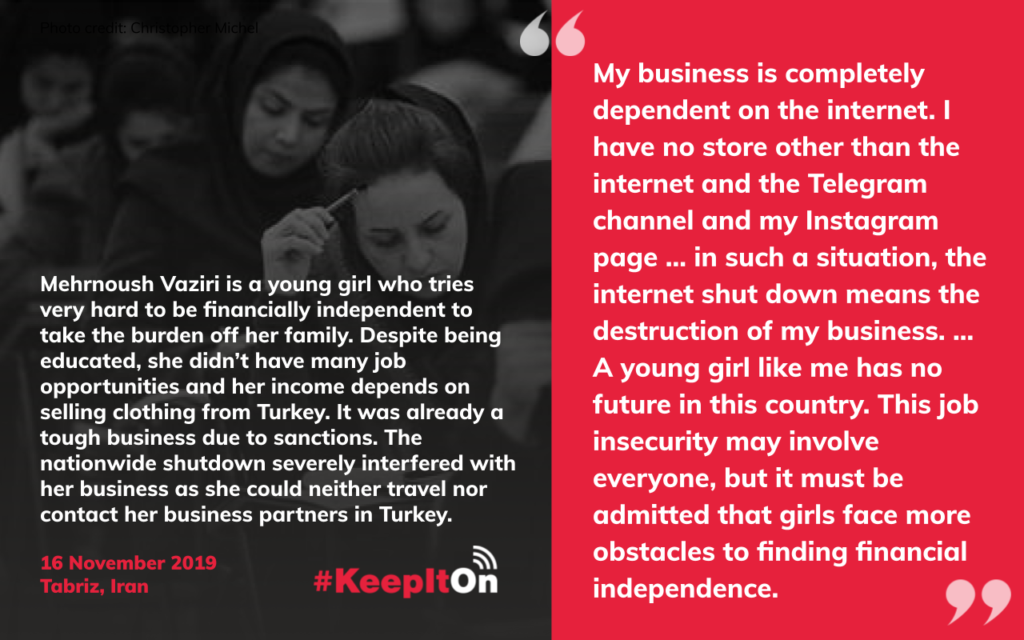
“This job insecurity may involve everyone, but it must be admitted that girls face more obstacles to finding financial independence.”

Women in Iran face an incredible array of legal and social obstacles to gaining financial independence. The worsening economic situation across Iran — owing to a barrage of economic sanctions and domestic corruption and mismanagement, among other things — has only made matters worse. Women are disproportionately affected by the crisis, and some have turned to selling goods online to earn income and support their families. But what happens when the internet goes dark?

As a new report from the United Nations confirms, internet shutdowns, by their very nature, restrict human rights, and there are almost no circumstances under which they can be justified according to international human rights law. Yet Iran’s regime systematically imposes internet shutdowns to silence dissent and simultaneously repress the right to peaceful assembly and association. Often, these shutdowns entail cutting off mobile phone networks, slowing down broadband speeds, or completely cutting internet access across regions or on a national scale, affecting both national and international networks.

Most recently, Iranian authorities imposed nationwide slowdowns or “throttling,” as well as blanket internet blackouts, when Iranians held protests to speak out against the soaring price of bread and other basic necessities. In May 2022, authorities reportedly disrupted internet access for 26 days out of the month. The same thing happened in 2021, as Human Rights Activists in Iran (HRA) documented: authorities responded to dissent and protest over government mismanagement of water by cutting internet access in Khuzestan province, then extending the shutdown across the country.

These and other shutdowns have a devastating impact on the lives of the Iranian people. But what about the effects on women? Below you will find the stories of Samane, Susan, and Mehrnoush, gathered by HRA and Access Now to show how women who use the internet to achieve financial independence in Iran are impacted by the regime’s tightening grip on internet freedom.

Islamic Penal Code of the Islamic Republic of Iran: Book Five

Incorporating all amendments up to January 2012

Adopted by the Legal Affairs Commission of the Islamic Consultative Assembly on Tuesday 30/07/1991

Table of Contents

Book Five- Ta’zir and Deterring Punishments

Chapter One- Crimes against the national and foreign security of the State

Article 498 – Anyone, with any ideology, who establishes or directs a group, society, or branch, inside or outside the country, with any name or title, that constitutes more than two individuals and aims to perturb the security of the country, if not considered as mohareb, shall be sentenced to two to ten years’ imprisonment.

Article 499– Anyone who joins, as a member, any of the groups, societies, or branches aforementioned in article 498, shall be sentenced to three months to five years’ imprisonment, unless it is proved that he had been unaware of its aims.

Article 500– Anyone who engages in any type of propaganda against the Islamic Republic of Iran or in support of opposition groups and associations, shall be sentenced to three months to one year of imprisonment.

Article 501– Anyone who, knowingly and intentionally, provides maps or secrets or documents and decisions regarding the national or international policies of the State to those who are not authorized to have access, or who informs them about their content in a way that constitutes espionage, taking into consideration the circumstances and stages [of the crime], shall be sentenced to one to ten years’ imprisonment.

Article 502– Anyone who commits one of the espionage crimes inside Iran in favor of a foreign State and against another foreign State, if damages the national security [of Iran] shall be sentenced to one to five years’ imprisonment.

Article 503– Anyone who enters [political or military or security] places with the intent to steal or draw maps or gather information about political or military or security secrets, and also those who are arrested while drawing maps or filming or taking pictures from military bastions or prohibited places, shall be sentenced to six months to three years’ imprisonment.

Article 504– Anyone who effectively encourages combatants or those in military forces to rebel, escape, surrender, or disobey military orders, with the intention to overthrow the government or to defeat national forces against the enemy, shall be considered as mohareb; otherwise [if he does not possess the intention] if his acts are effective he shall be sentenced to two to ten years, and if not, to six months to three years’ imprisonment.

Article 505– Anyone who, with the intention to disrupt national security, gathers information through any means under the cover of State authorities or government officials, if they intend to provide them to others shall be sentenced to two to ten years’ imprisonment [if successful], and otherwise to one to five years’ imprisonment [if unsuccessful].

Article 506– If, due to their negligence and disregarding security protocols, government officials who are responsible for classified security and intelligence affairs and have received the required training reveal information to enemies, they shall be sentenced to one to six months’ imprisonment.

Article 507– Anyone who is a member of corrupt groups or among those who act against national security, provided that he is not in a leading position and before being prosecuted, reports the plot and names of those engaged in the conspiracy and corruption to the officials, or cooperates effectively with the officials after he is prosecuted, shall be exempted from punishment; and if he has personally committed another crime, he shall be only sentenced for that crime.

Article 508– Anyone who cooperates by any means with foreign States against the Islamic Republic of Iran, if not considered as mohareb, shall be sentenced to one to ten years’ imprisonment.

Article 509– Anyone who during wartime commits one of the crimes against national and foreign security of the State mentioned in this chapter, shall be sentenced to the highest punishment prescribed for the same crime.

Article 510– Anyone who, with the intent to disrupt national security or aid the enemy, recognizes and hides, or assists in hiding, spies who have a mission to gather information or cause damage to the country, shall be sentenced to six months to three years’ imprisonment.

Note- Anyone who, without spying or hiding spies, identifies and attracts some people by any means and introduces them to enemy States or foreign countries for espionage purposes against the national security [of the Islamic Republic of Iran] shall be sentenced to six months to two years’ imprisonment.

Article 511– Anyone who, with the intent to disrupt national security and disturb public opinion, threatens to plant bombs in an airplane, ship, and/or other public means of transportation, or claims that the aforementioned means of transportation have been rigged with bomb(s), in addition to compensation for damages caused to the government and people, shall be sentenced to six months to two years’ imprisonment.

Article 512– Anyone who, with the intent to disrupt national security, induces or encourages people to war with one another and slaughter each other, regardless of whether or not [such actions] cause murder and ravage, shall be sentenced to one to five years’ imprisonment.

Note- Where it can be proven that the accused repented [for their actions] before being caught by the State, articles (508) and (509) and (512) are not applicable.

Chapter Two- Insulting sacred religious values and criminal attempt on national authorities

Article 513– Anyone who insults the sacred values of Islam or any of the Great Prophets or [twelve] Shi’ite Imams or the Holy Fatima, if considered as Saab ul-nabi [as having committed actions warranting the hadd punishment for insulting the Prophet], shall be executed; otherwise, they shall be sentenced to one to five years’ imprisonment.

Article 514– Anyone who, by any means, insults Imam Khomeini, the founder of the Islamic Republic, and/or the Supreme Leader shall be sentenced to six months to two years’ imprisonment.

Article 515– Anyone who makes an attempt on the lives of the Supreme Leader or the Heads of Powers [of the Executive, Judiciary and Legislature] or the Grand Ayatollahs, if not considered as mohareb, shall be sentenced to three to ten years’ imprisonment.

Chapter Three- Attempt on the lives of foreign diplomatic officials

Article 516– Anyone who makes an attempt on the life of a foreign Head of State, or its Diplomatic Representative, in the jurisdiction of Iran, shall be sentenced to the same punishment mentioned in article (515), subject to the mutual treatment by the same State towards Iran; but, if a lighter punishment is prescribed, the same punishment shall be imposed.

Article 517– Anyone who publically insults a foreign Head of State, or its Diplomatic Representative, who enter the territory of Iran, shall be sentenced to one month imprisonment, subject to the mutual treatment by the same State towards Iran.

Note- The application of the articles of this chapter is subject to the request of the relevant State or its diplomatic representative, or the victim or his guardian. The Prosecution shall be stopped if the complaint is withdrawn.

Chapter Four- Producing and distributing fake coins

Article 518– Anyone who produces, or deliberately imports into the country, or buys or sells any kind of counterfeit domestic or foreign gold or silver coin, such as coins from Iran’s previous governments, or the Lira or other exchangeable currencies, or distributes any fake coins shall be sentenced to one to ten years’ imprisonment.

Article 519– Anyone who, with the intention of deception, detracts from the weight of Iranian or foreign gold or silver coins by any means such as scraping, cutting and the like, or knowingly and deliberately engages in the distribution of such coins, or imports them into the country, shall be sentenced to one to three years’ imprisonment.

Article 520– Anyone who produces any kind of counterfeit domestic or foreign current coins other than gold or silver, or, knowingly and deliberately, imports them into the country, or engages in the distribution of such coins, or buys or sells them, shall be sentenced to one to three years’ imprisonment.

Article 521– When the individuals who commit the crimes mentioned in articles (518) and (519) and (520) inform the authorities before the crime is discovered, or facilitate the arrest of others by their confession while the prosecution is carried out, or effectively aid and guide the government authorities, by proposal of Director of the Judicial District and agreement of the court, or at the discretion of the court, their punishment shall be duly mitigated, and if appropriate they shall be exempted from imprisonment; unless it is proved that they repented [for the crime] prior to their arrest, in which case they shall be exempted from all said punishments.

Article 522– In addition to the punishments mentioned in articles (518) and (519) and (520), the property acquired as a result of the commission of the said offences shall be confiscated.

Chapter Five- Forging and counterfeiting

Article 523– Forging and counterfeiting are defined as producing a writing or document or producing an official or non-official persons’ stamp or signature, scratching or tampering or adding or erasing or generating or crossing out or changing the date in comparison to the actual date or enclosing a writing to another writing or using someone else’s stamp without their permission, and the like, with the intention of deception.

Article 524– Anyone who forges the orders or signature or stamp or handwriting of the Supreme Leader or the Heads of Powers [of the Executive, Judiciary and Legislature] in respect to their official position, or uses [the aforementioned] with knowledge of the forgery and counterfeit, shall be sentenced to three to fifteen years’ imprisonment.

Article 525– Anyone who forges one of the following or uses or imports them into the country while being aware of the forgery and counterfeit, in addition to compensation for damages, shall be sentenced to one to ten years imprisonment.

1- Orders or signature or stamp of the First Deputy of the President of the State, or Ministers, or stamp or signature of the Members of the Guardian Council or Members of Parliament or Council of Experts or Judges or any one of the chairpersons or civil servants and officials in respect to their official position.

2- Seal or stamp or emblem of one of the governmental companies or organizations or departments or Islamic revolutionary bodies.

3- Verdicts of courts or documents or bills issued by the National Treasury.

4- Seal or mark used for determining the purity of Gold and silver.

5- Domestic or foreign currencies or bank bills such as accepted bills of exchange by banks or checks issued by banks and other types of binding bank instruments.

Note- Anyone who, deliberately and without holding the required documents and official domestic and foreign permission, and with the intent to inspire doubts in the quality of products and services, uses the title and emblem of national or international standards shall be sentenced to the maximum punishment prescribed in this article.

Article 526– Anyone who, with the intent to disrupt the banking system or financial or economic situation or to disrupt the political and social system and security [of the country], forges domestic or foreign currencies or bank bills such as accepted bills of exchange by banks or checks issued by banks and other types of binding bank instruments and documents or bills issued by the National Treasury, or imports them into the country or uses them with the knowledge that they are fake, if he is not considered as mofsed or mohareb, shall be sentenced to five to twenty years’ imprisonment.

Article 527– Anyone who forges certificates of studying or graduation or transcripts of universities and higher education organizations inside or outside the country or certificates of evaluation of foreign degrees, or uses them with the knowledge that they are fake, in addition to compensation for damages, shall be sentenced to one to three years’ imprisonment. If the perpetrator is an employee of Ministries or those organizations and institutes that belong to the government or municipalities or Islamic revolutionary bodies, or if by any means takes part in the forgery or in using the fake documents, then he shall be sentenced to the maximum punishment.

Article 528– Anyone who forges the stamp or seal of any non-governmental organizations or public bodies such as municipalities, or uses them with the knowledge that they are fake, in addition to compensation of the damages, shall be sentenced to six months to three years’ imprisonment.

Article 529– Anyone who forges the stamp or seal of any non-governmental company established according to law or enterprise, or uses them with the knowledge that they are fake, in addition to compensation for damages, shall be sentenced to six months to three years’ imprisonment.

Article 530– Anyone who acquires the seal or stamp of the organizations or companies or enterprises referred to in the articles above, and abuses them in a way that damages their rights and interests, or causes their abuse, in addition to compensation for damages, shall be sentenced to two months to two years’ imprisonment.

Article 531– If anyone who has committed one of the crimes referred to in the articles above informs the government [of the crime] before their prosecution and exposes other perpetrators, if any, or cooperates in arresting them after the prosecution is started, their punishment shall be mitigated or they shall exempted from punishment respectively.

Article 532– Any civil servant and government official who, when carrying out their duties, tampers with orders and writings and documents and certificates and books and other types of official writings and documents (for instance if they generate a signature or stamp or make changes in a signature or stamp or to the content or add a word or change people’s names), in addition to disciplinary punishments and compensation of the damages, shall be sentenced to one to five years’ imprisonment or a fine of six to thirty million Rials.

Article 533– If individuals who are not civil servants or government officials, commit any of the crimes referred to in the previous article, in addition to compensation of the damages, they shall be sentenced to six months to three years’ imprisonment or a fine of three to eighteen million Rials.

Article 534– If any civil servant of government departments and judicial bodies and anyone responsible for public services, commits forgery of documents in respect to their duties, including in cases where they change the topic or content of those documents, or tamper with written or oral statements of official authorities or the stamp or wording of the parties or present something void as valid or vice versa or something which is not admitted as admitted, in addition to disciplinary punishments and compensation of the damages, shall be sentenced to one to five years’ imprisonment or a fine of six to thirty million Rials.

Article 535– Anyone who uses the forged documents referred to in articles (532) and (533) and (534) with the knowledge that they are fake, in addition to compensation of the damages, shall be sentenced to six months to three years’ imprisonment or a fine of three to eighteen million Rials.

Article 536– Anyone who forges non-official documents or uses them with the knowledge that they are fake, in addition to compensation of the damages, shall be sentenced to six months to two years’ imprisonment or a fine of three to twelve million Rials.

Article 537– If taking pictures of ID cards or personal identity documents and governmental and public documents and the like, causes confusion with the originals, they shall be marked with a stamp or mark to show that it is a duplicate copy or picture; otherwise, it shall be considered as a forgery and the producers and users of such documents who knowingly and deliberately use them as originals, in addition to compensation of the damages, shall be sentenced to six months to two years’ imprisonment or a fine of three to twelve million Rials.

Article 538– Anyone who, whether personally or through someone else, forges a medical certificate with the intent to acquire exemption from public or military service or in order to submit to the court shall be sentenced to six months to one year’s imprisonment or a fine of three to six million Rials.

Article 539– When a medical doctor issues a false certificate to exempt someone from public or military service or in order to submit to judicial bodies, he shall be sentenced to six months to two years’ imprisonment or a fine of three to twelve million Rials. And when such certificate is used to acquire money, in addition to taking the money back and confiscating the money as a fine, he shall be sentenced to the punishment prescribed for being the recipient of a bribe.

Article 540– In the cases of other false certificates which cause damage to a third party or the National Treasury, the offender shall be sentenced to up to 74 lashes or a fine of two hundred thousand to two million Rials.

Article 541– Anyone other than the main applicant who sits any exams including entrance exams of universities and higher education institutes, teacher’s universities and training colleges, exams for sending students abroad to study, or internal or final exams of the aforementioned organizations or exams of high schools, secondary schools, technical schools, etc, the offender and applicant, in addition to disciplinary punishments, shall be sentenced to a fine of two hundred to one million Rials.

Article 542– The punishment for attempting to forge and counterfeit referred to in this chapter shall be the minimum punishment prescribed for the same crime.

Chapter Six- Removing or breaking a seal and stealing documents from governmental places

Article 543– When a place, or anything, is sealed in accordance with the order of competent officials, and someone knowingly and deliberately breaks or removes the seal, or commits an act that is considered as removing or breaking the seal, he shall be sentenced to three months to two years’ imprisonment.

If the keeper commits the [abovementioned] crime, he shall be sentenced to one to two years’ imprisonment. In case the crime is committed as a result of the keeper’s negligence, he shall be sentenced to one month to six months’ imprisonment or up to 74 lashes.

Article 544– When the writings or documents or booklets or notes that are recorded in official registers or kept in official places or entrusted to officials responsible for keeping them, are, wholly or in part, stolen or damaged or unlawfully destroyed, the bookkeeper and the clerk responsible for recording and keeping the aforementioned documents, as well as other individuals whose negligence resulted in the commission of the crime, shall be sentenced to six months to two years’ imprisonment.

Article 545– The offenders of the crimes mentioned in the above article shall be sentenced to three to six months’ imprisonment; and if the keeper or trustee commits one of the abovementioned crimes he shall be sentenced to three to ten years’ imprisonment.

Article 546– When the offender forcibly removes or breaks the seal or commits an act that is considered as removing or breaking the seal, or steals or destroys the writing or documents, he shall be sentenced to the abovementioned punishments accordingly. This punishment does not interfere with the punishment of [other] crimes resulting from the use of force and severity.

Chapter Seven- Escape of prisoners and concealment of offenders

Article 547– Any prisoner who escapes from a prison or detention center shall be sentenced to 74 lashes or three to six months’ imprisonment; and if he has broken or damaged the prison’s gate, in addition to compensation of the damages, he shall be sentenced to both punishments.

Note- Prisoners who are on furlough in accordance with the regulations of prisons, but, without a reasonable excuse, do not return to the prison at the ordered time, shall be regarded as fugitives and sentenced to the abovementioned punishment.

Article 548– When an accused person or a prisoner escapes as a result of recklessness or negligence of the officer who was responsible for guarding or escorting him, the abovementioned officer shall be sentenced to six months to three years’ imprisonment or a fine of three to eighteen million Rials.

Article 549– When an officer who is responsible for guarding or escorting a prisoner or detainee aids or facilitates or colludes in the escape [of the prisoner], he shall be sentenced according to the following:

A – If the detainee is accused of a crime that is punishable by execution, stoning or crucifixion or if he is a prisoner convicted to these punishments, [the offending official] shall be sentenced to three to ten years’ imprisonment; and if the prisoner is convicted to ten years’ imprisonment or more, or if the detainee is accused of a crime punishable by more than ten years’ imprisonment, he shall be sentenced to one to five years’ imprisonment; and in cases other than the abovementioned, he shall be sentenced to six months to three years’ imprisonment.

B – If the prisoner is convicted to qisas or the detainee is accused of a crime punishable by qisas the individual responsible for his escape is obliged to turn him in, otherwise he shall be imprisoned until [the prisoner] is turned in. If the accused person is tried and acquitted in absentia, or if the homicide is determined as quasi-deliberate or accidental, the individual responsible for escape shall be sentenced to the punishment mentioned in paragraph A; and if the fugitive dies, or if it becomes impossible to turn him in, in cases where [the fugitive] is convicted to qisas, the individual responsible for his escape shall pay the diya to the blood owners of the victim.

C – If the accused or convict person who is escaped is convicted [or accused] of a financial crime or diya, the individual responsible for escape, in addition to the punishment mentioned in paragraph A,  shall pay the relevant diya or debt.

Article 550– Any civil servants or officers who are ordered to arrest an individual and act recklessly and negligently shall be sentenced to a fine of one hundred to five hundred Rials; and if the recklessness and negligence was intended to aid the escape of the prisoner and resulted in his escape, in addition to the aforementioned fine, shall be sentenced to six months to three years’ imprisonment.

Article 551– If the individual responsible for escape is not one of the officers mentioned in article 549, and deliberately aids the escape of persons imprisoned or detained under law, he shall be sentenced according to the following:

A – If the prisoner is sentenced to execution, stoning or crucifixion, the individual responsible for the escape shall be sentenced to one to three years’ imprisonment; and if the prisoner is accused of a crime punishable by execution, stoning or crucifixion, he shall be sentenced to six months to two years’ imprisonment; and in cases other than the abovementioned, he shall be sentenced to three months to one year of imprisonment.

B – If the prisoner is sentenced to qisas, the individual responsible for the escape is obliged to turn him in otherwise he shall be imprisoned until [the prisoner] is turned in. If the fugitive dies, or if it becomes impossible to turn him in, the individual responsible for his escape shall pay the diya to the blood owners of the victim.

Article 552– Anyone who arms a prisoner or detainee with a gun in order to aid [the prisoner’s] escape shall be sentenced to two to five years’ imprisonment.

Article 553– Anyone who hides, or aids the escape of, a fugitive of the law or an accused person whose arrest is ordered shall be sentenced according to the following:

When the fugitive is sentenced to execution, stoning or crucifixion or qisas or amputation of limb, the individual responsible for the escape shall be sentenced to one to three years’ imprisonment; and if the fugitive is sentenced to life imprisonment or accused of a crime punishable by execution or crucifixion, he shall be sentenced to six months to two years’ imprisonment; and in cases other than the abovementioned, he shall be sentenced to one month to one year of imprisonment.

Note- If it is proved in a court of law that the individual responsible for the escape or concealment of the fugitive truly believes in his innocence, he shall be exempted from the punishment.

Article 554– Anyone who becomes aware of a crime and aids the offender to escape from trial and conviction, for instance by harboring him in a place, or concealing the evidence of the crime, or presenting fake evidence in order to acquit the offender, shall be sentenced accordingly to one to three years’ imprisonment.

Note- In the cases mentioned in article 553 and this article, if the offender is amongst the first-degree relatives of the accused person, the punishment shall not exceed half of the prescribed punishment.

Chapter Eight- Impersonation of officials and offices

Article 555– Anyone who, without an official position or permission from the government, interferes with or introduces himself as holding official governmental, military and police offices, shall be sentenced to six months to two years’ imprisonment; and if he has forged a document in order to interfere or introduce himself in the abovementioned offices, he shall additionally be sentenced to the punishment prescribed for forgery.

Article 556– Anyone who, publically and without permission, uses official uniforms of the military or police forces of the Islamic Republic of Iran, or badges or medallions or other state grants, without, or with little, changes that cause confusion, if his act is not subject to a harsher punishment under another law, shall be sentenced to three months to one year’s imprisonment or a fine of one million and five hundred thousand Rials to six million Rials. And if he has taken advantage of his illegal act, he shall be sentenced to both punishments.

Note- Using the abovementioned uniforms and objects in theatrical arts shall not be subject to this article.

Article 557– Anyone who, publically and without permission, uses the official uniforms of foreign officers, or badges or medallions, or other grants of foreign states, in Iran, subject to mutual treatment [by the foreign state], or if the act disrupts the public order, shall be subject to the article above.

Chapter Nine- Destruction of historical and cultural assets

Article 558– Anyone who damages whole or part of any cultural, historical or religious buildings, places and sites which are listed as national heritage, or any decorations, attachments, facilities, objects and instruments and drawings and pictures installed or located in these places which independently hold cultural, historical, or religious features, in addition to compensation of damages, shall be sentenced to one to ten years’ imprisonment.

Article 559– Anyone who steals objects and instruments and also materials and pieces of cultural and historical assets, from museums or galleries, or historical and religious sites and other places protected or supervised by the government, or buys or conceals the aforementioned objects while being aware that they are stolen, if he is not punishable by the hadd punishment for stealing, in addition to its restitution, shall be sentenced to one to five years’ imprisonment.

Article 560– Anyone who, without permission from Iran’s Cultural Heritage Organization, or by violating the regulations adopted by this organization, proceeds to any operation in the bounds of cultural and historical assets mentioned in this article that makes their foundations unsteady, or as a result of such operations the said assets and buildings are damaged or destroyed, in addition to elimination of the operation’s effects and compensation of the damages, shall be sentenced to one to three years’ imprisonment.

Article 561– Any effort to take cultural and historical assets out of the country, even if unsuccessful, shall be considered as trafficking and the offender, in addition to restitution of the assets, shall be sentenced to one to three years’ imprisonment and a fine that is double the value of the assets.

Note- It is the responsibility of the Iran’s Cultural Heritage Organization to determine the cultural and historical nature [of the assets].

Article 562– Any type of excavation and digging with the intent to find historical and cultural assets is prohibited and the offender shall be sentenced to six months to three years’ imprisonment and confiscation of the discovered objects in favor of the Cultural Heritage Organization, and the excavation equipment and tools in favor of the government. If the excavation has taken place in historical sites and places that are listed as national heritage, or in holy shrines or religious places, in addition to confiscation of the discovered objects and the excavation equipment and tools, the offender shall be sentenced to the maximum punishment provided.

Note 1 – Anyone who puts his hands, by chance, on the historical and cultural assets mentioned in this article, and does not surrender them in accordance with the regulations of Cultural Heritage Organization, shall be sentenced to confiscation of the discovered assets.

Note 2 – The purchase and sale of historical and cultural assets that are found during illegal excavations is prohibited, and in addition to confiscation of the aforementioned cultural assets, the buyer and seller shall be sentenced to six months to three years’ imprisonment. If the aforementioned assets, under any title, and whether directly or indirectly, are sold to foreign nationals, the offender shall be sentenced to the maximum punishment provided.

Article 563– Anyone who transgresses historical and cultural lands and hills and sites that are listed as a national heritage and do not have a private owner, shall be sentenced to six months to two years’ imprisonment, provided that the Cultural Heritage Organization had previously indicated and marked the boundaries and limits of these places.

Article 564– Anyone who, without permission of the Cultural Heritage Organization and against its adopted regulations, restores or repairs or reconstructs or extends the buildings or decorations of historical and cultural places which are listed as national heritage, shall be sentenced to six months to two years’ imprisonment and compensation of the damages.

Article 565– Anyone who, in violation of the provisions of the Law of Protection of National Heritage, conveys historical and cultural real-estate that is listed as national heritage, while having knowledge that they are listed, shall be sentenced to three to one year’s imprisonment.

Article 566– Anyone who, without permission of the Cultural Heritage Organization and contrary to what is appropriate for the property, changes the use of religious, cultural and historical buildings, places and sites that are listed as national heritage, in addition to elimination of the offense’s effects and compensation of the damages, shall be sentenced to three months to one year’s imprisonment.

Article 566 bis (added on 16/06/2009)- Anyone who makes counterfeit models of cultural and historical assets, whether Iranian or foreign assets, claiming it as original, or introduces, carries or keeps it, or buys it while being aware that it is fake, with the intent to offer, smuggle or sell the asset, shall be sentenced to ninety one days to six months imprisonment and a fine of equal to half the value of the original asset according to the expert report from Cultural Heritage, Handcrafts, and Tourism Organization.

Note 1 – A “counterfeit model” is an object which is made in the contemporary era, and in terms of drawings, pictures, form, texture, size, and weight is similar to original cultural and historical assets, or is claimed to be the original cultural and historical asset when there is no such original and there is no sign on the asset from the creator or the Cultural Heritage, Handcrafts, and Tourism Organization, that distinguishes it from the original.

Note 2 – If there is no original for the counterfeit object, its value, if any, shall be assessed by the experts of the Cultural Heritage, Handcrafts, and Tourism Organization.

Note 3 – The discovered items referred to in this article shall be confiscated in favor of the Cultural Heritage, Handcrafts, and Tourism Organization. This provision shall be extended to those items that are seized before this law comes to force.

Article 567– With regard to the crimes referred to in this chapter, the Cultural Heritage Organization or other governmental departments shall be regarded as a complainant or private plaintiff.

Article 568– With regard to the crimes referred to in this chapter that are committed by legal entities, any of the directors or officials who have made the orders, shall be sentenced to the prescribed punishments.

Note- Cultural and historical assets obtained from the crimes referred to in this chapter, shall be confiscated under the supervision of the Cultural Heritage Organization; and in all cases where the assets, tools and equipments are ordered to be seized, it shall be seized in favor of the Cultural Heritage Organization.

Article 569– In all the cases in this chapter, if the damaged asset is private property and its owner was unaware that it had been listed as a national heritage, he shall be exempted from the abovementioned punishments.

Chapter Ten- Offenses of government officials and agents

Article 570 (as amended on 1/1/2003)- Any official and agent associated with State agencies and institutions, who unlawfully strips members of the public of their personal freedom or deprives them from their rights provided in the IRI Constitution, shall be sentenced to two months to three years’ imprisonment, in addition to dismissal from the service and prohibition of employment in state offices for one to five years.

Article 571– When the acts that violated the IRI Constitution are carried out as a result of a false signature of a Minister or State agent, the offender, and those who applied it knowingly, shall be sentenced to three to ten years’ imprisonment.

Article 572– When an individual is imprisoned against the law, and he has lodged a complaint against his unlawful imprisonment to the law enforcement or police officers, but they have failed to deal with his complaint and are unable to prove that they have taken the required steps and transferred his complaint to the relevant authorities, they shall be sentenced to permanent dismissal from the same office and shall be prohibited from taking government employment for three to five years.

Article 573– If officials and officers responsible for detention centers and prisons receive anyone as a prisoner without the required warrant issued by competent authorities, they shall be sentenced to two months to two years’ imprisonment.

Article 574– If officials and officers responsible for detention centers and prisons refuse to hand over a prisoner to competent judicial authorities, or refuse to submit their registers to the said authorities, or refuse or prevent the prisoners’ complaints from reaching the relevant authorities, they shall be subject to the previous article; unless they prove that they had been ordered to do so by their superior commander, in which case he who has issued the order shall be sentenced to the aforementioned punishment.

Article 575– When judicial authorities or other relevant officials unlawfully order the arrest or detention or prosecution of someone, they shall be sentenced to permanent dismissal from judicial offices and shall be prohibited from taking government employment for five years.

Article 576– If any official and civil servant and governmental and municipal agent, no matter at which level or office he serves, abuses his authority and refuses to obey written state orders or statutes or decisions or orders of judicial authorities or any other orders issued by lawful officials, he shall be sentenced to dismissal from civil service for one to five years.

Article 577– If civil servants and agents including Governors of Provinces, Governors of Divisions, Governors of Sections, or their deputies, and police officers, unless in arbitration cases, interfere with cases that fall under the authority of judicial officials, and refuse to stop the interference despite the objection of party/parties to the case or the objection of judicial authorities, they shall be sentenced to two months to three years’ imprisonment.

Article 578– Any civil servant or judicial or non-judicial agent who corporally mistreats and abuses an accused person in order to force him to confess, in addition to qisas and diya, shall be sentenced to six months to three years’ imprisonment; and if it is done under someone’s order, only the person who has issued the order shall be sentenced to the aforementioned imprisonment; and if the accused person dies as a result of the abuses, the principal to the murder shall be sentenced to the punishment provided for a murderer, and the person who has issued the order shall be sentenced to the punishment provided for the person who has ordered a murder.

Article 579– If a civil servant punishes a convicted person harsher than what was ordered in the verdict or punishes him to what is not ordered in the verdict, he shall be sentenced to six months to three years’ imprisonment; and if the act is carried out pursuant to someone else’s order, only the person who has issued the order shall be sentenced to the prescribed punishment; and if the act is punishable by qisas or diya the main principal to the crime shall be sentenced accordingly; and if the act consists of other crimes, the principal to the crime and the person who has issued the order shall be sentenced accordingly to the relevant punishment.

Article 580– Any civil servant and judicial or non-judicial official or anyone who holds a state duty enters someone’s house against the law and without the owner’s permission and consent shall be sentenced to one month to one year’s imprisonment, unless he proves that he has acted on his superior’s order and he has had no choice but to obey his orders, in which case the prescribed punishment shall be given to the person who has issued the order; and if he commits or causes any other crimes he shall also be sentenced to the relevant punishment provided for that crime; and if the offense is committed in the night, the principal to the crime and the person who has issued the order shall be sentenced to the maximum punishment provided.

Article 581– Any state official and civil servant who, abusing his authority, uses force to buy someone’s property, or unlawfully take possession of someone’s right, or force an owner of a property to sell it to a third person, in addition to restitution of the property or right or its monetary value, shall be sentenced to one year to three years’ imprisonment or a fine of six to eighteen million Rials.

Article 582– If any state official and civil servant, in cases other than those permitted by law, opens or seizes or destroys or inspects or records or intercepts letter or telegraph or telephone communications of people, or discloses their contents without their owners’ permission, shall be sentenced to one year to three years’ imprisonment or a fine of six to eighteen million Rials.

Article 583– If any state official and civil servant or armed forces or the like, without any order from competent authorities [and] in cases other than those in which the law permits arrest or detention of people, arrests or detains an individual and forcibly conceals him in a place, he shall be sentenced to one year to three years’ imprisonment or a fine of six to eighteen million Rials.

Article 584– Anyone who knowingly prepares a place for committing the crime mentioned in previous article, and therefore aids the principal to the crime, shall be sentenced to three months to one year’s imprisonment or a fine of one million and five hundred to six million Rials.

Article 585– If the principal, or the accessory, to the crime [mentioned in the previous article], releases the detainee or takes required measures to release him, provided that he has not detained him for more than five days, he shall be sentenced to two to six months’ imprisonment instead.

Article 586– When the offender, in order to commit the crime mentioned in article 583, uses false names or titles or impersonates state agents or uses their badge or uniform or shows a fake warrant, in addition to the punishment provided in the same article, shall be sentenced to the punishment provided for forgery or deception.

Article 587– If the perpetrator of the crimes mentioned in the previous articles threatens the detainee or prisoner to death or physically abuses and torture him, in addition to qisas or diya, he shall be sentenced to one to five years’ imprisonment and will be prohibited from taking  public services.

Chapter Eleven- Bribery, Usury and Fraud

Article 588– If any arbitrator and inspector and expert, whether appointed by the court or parties to a legal case, makes a decision or produces a report in favor of either party in return for a bribe, shall be sentenced to six months to two years’ imprisonment or a fine of three to twelve million Rials, and as a punishment for the briber, the amount that was paid shall be confiscated in favor of the government.

Article 589– If judges of courts, due to receiving a bribe, give a harsher punishment than that provided by law,  he shall be sentenced to the same excessive punishment he has given, in addition to the punishment provided for receiving a bribe.

Article 590– If a bribe is not in the form of cash, but is [in the form of] goods or property conveyed, whether directly or indirectly, to judicial or administrative civil servants, free of charge or quite cheaper than the usual price, or prima facie at its usual price but in fact sold for much cheaper, or if  goods or property is bought from civil servants, directly or indirectly, at a quite higher price, the said civil servants shall be considered as bribee and the other party as briber.

Article 591– When it is proved that a briber had to pay a bribe to preserve his legal rights, he shall be exempted from criminal prosecution and the money or property he has paid shall be returned to him.

Article 592– Anyone who, knowingly and deliberately, and whether directly or indirectly, pays money or a property or a bill of payment or delivery of a property, in order to carry out or refrain from carrying out what is a duty of the officials mentioned in article 3 of the law of Aggravating [the punishments of] Bribery, Embezzlement, and Fraud adopted on 6/12/1997 by the Expediency Discernment Council, he shall be considered as a briber, and, in addition to confiscation of the bribed money or property, he shall be sentenced to six months to three years’ imprisonment or up to 74 lashes.

Note- If the briber has been moztar [i.e. desperate and left with no other option] or reports the bribery or lodges a complaint, he shall be exempted from the imprisonment sentence and the bribed money shall be restituted to him.

Article 593– Anyone who, knowingly and deliberately, facilitates the commission of bribery including through negotiation, persuasion, transferring the money or property or bill of payment, shall be sentenced to the punishment provided for the briber.

Article 594– The punishment for attempted bribery shall be the minimum punishment provided in each case.

Article 595– Any type of agreement between two or more people under any title such as sale, borrow, settlement, etc that conveys a property or goods in return of a property of the same type and amount and with an extra condition, or receives money more than the amount paid, shall be regarded as usury and is a crime. The offenders including usurer, the individual who has paid the usury, and the broker between them, in addition to restitution of the extra money to the owner, shall be sentenced to six months to three years’ imprisonment and up to 74 lashes and also a fine equal to the value of the aforementioned money or property.

Note 1- If the owner of the property [subject to usury] is unknown, it shall be regarded as property without a known owner and shall be given to the vali-ye Faqih (i.e. Supreme Leader).

Note 2- When it is proved that the person who has paid the usury has been moztar [i.e. desperate and left with no other option] to pay the extra money or property, he shall be exempted from the punishment provided in this article.

Note 3- When the abovementioned contract is concluded between a father and his son or a husband and his wife, or if a Muslim receives usury from a Kafir [non-believer], it shall not fall under this article.

Article 596– Anyone who, abusing the weakness and desires or personal needs of incapacitated persons, obtains a writing or document whether commercial or non-commercial including, a bill of exchange, promissory note, check, draft, receipt, settlement receipt against his benefit, or any documents that binds him or clears the receiver, or someone else, from obligations, in addition to compensation of the damages, shall be sentenced to six month to two years’ imprisonment and a fine of one million to ten million Rials; and if the offender is the natural guardian of the [incapacitated] person, or the executor of [his natural guardian’s] will, or appointed as his guardian by court, then, in addition to compensation of the damages, he shall be sentenced to three to seven years’ imprisonment.

Chapter Twelve- Refusing to carry out legal duties

Article 597– Any judicial authority to whom a complaint or petition is referred according to the law, but, despite the fact that he is legally obliged to deal with the complaint, on the basis of any justification even silence or brevity or contradictory nature of the law, fails to accept or deal with the case, or postpones the issuance of the verdict against the law, or acts contrary to the explicit provision of law, on the first occasion shall be sentenced to six months to one year imprisonment and on the [second] occurrence will be permanently dismissed from judicial office; and in any case shall be also sentenced to compensation of damages.

Chapter Thirteen- Offenses of civil servants against government

Article 598– Any civil servant and employee of a governmental department and organization or council or municipality and company or organization or revolutionary body and also foundation and organization that is supervised by vali-ye faqih [i.e. Supreme Leader] and the Supreme Audit Court and organizations that are financed by the government or holders of judicial rank and basically all the members and staff of the three branches of power and also armed forces and public servants, whether official or unofficial, who abuses any fund or credit or drafts or shares or other monetary instruments or other property that belongs to the abovementioned organizations or other persons that are entrusted to them on the basis of their duty, without any intention to transfer their ownership to himself or a third person, shall be regarded as an unlawful possessor and, in addition to compensation of the damages and payment of the payable rent, shall be sentenced to up to 74 lashes; and if he has benefitted [from the offense], in addition to the aforementioned punishment, he shall be sentenced to a fine equal to the amount of benefit. It is also the same case when [anybody], due to his negligence or failure, causes damage to public funds or consumes it for the purposes that no budget is provided by law, or for a different purpose [other than stipulated by law] or in excess of the allocated budget.

Article 599– Anyone who is responsible for the conclusion of contracts or constructing anything or ordering or supervising its construction for any one of the departments and organizations referred to in article 598, and who takes advantage of it for himself or someone else through a deception regarding the amount or features or excessive price or any deception in the construction, in addition to compensation of the damages, shall be sentenced to six months to five years’ imprisonment.

Article 600– Any civil servant or employee or agent who is responsible for the assessment, determination and collection of any fee in favor of the government, violates the law and collects or orders to collect a fee more than that required by law, shall be sentenced to two months to one year’s imprisonment. The punishment provided in this article is also applicable to officials and employees of municipalities; and in any case what is received in contravention of the law shall be returned to the right owner.

Article 601– Any civil servant that on the basis of their duty employs or hires people or transports some materials and charges the government’s account for whole or part of their salaries or fees, but fails to pay the fees, shall be sentenced to temporary suspension from three months to three years; and the same punishment is applicable in the case of civil servants that employed some people as unpaid labors but charged the government’s account and took their salaries for themselves; and in any case the received salary shall be returned to the right owner.

Article 602– Any civil servant that on the basis of their duties has been entitled to employ some people and charges the government’s account more than the number he has actually employed, or if he includes his personal servants among the civil servants and pays their salary from the government’s account, he shall be sentenced to 74 lashes and restitution of the amount he has charged the government’s account.

Article 603– If any civil servant and employee and individual who is in managerial positions in the Ministries and departments and organizations referred to in article 598, whether directly or indirectly, takes any advantage for himself or someone else through any contract or agreement or any other arrangements with other people or their representatives or branches, under any title such as commission, fee, brokerage or bonus, whether inside or outside the country, or if without any mission from his respective organization buys or constructs anything on its behalf, or takes any benefit for himself or someone else when paying the fees that he is responsible for their payment or when settling an account, shall be sentenced to restitution of twice as much as the benefit gained from this act; and if his act causes any change in the amount or quality of the subject of the contract or any increase in its price, he shall be sentenced to six months to five years’ imprisonment or a fine of three to thirty million Rials.

Article 604– Any civil servant, whether judicial or administrative, who destroys or conceals documents and papers that are entrusted to them or given to them on the basis of their duties, or hands them over to an unauthorized person, in addition to compensation of the damages, shall be sentenced to three months to one year’s imprisonment.

Article 605– Any servant of the departments and organizations referred to in article 598, who, intentionally and unlawfully, makes an statement or action against one of the parties shall be sentenced to up to three months’ imprisonment or a fine up to one million and five hundred thousand Rials and compensation of the damages.

Article 606– Any chairperson or director or authority of the organizations referred to in article 598 who becomes aware of a bribery or embezzlement or illegal possession or fraud or the crimes mentioned in articles 599 and 603, in the organizations under their supervision, and fails to report the offense to competent judicial or administrative bodies, in addition to imprisonment for six months to two years, shall be sentenced to temporary suspension for six months to two years.

Chapter Fourteen- Defying state agents

Article 607– Any form of attack or resistance carried out knowingly against state agents while they are performing their duties shall be regarded as defiance and is punishable according to the following:

1- If the defiant shows his gun in order to threaten, six months to two years’ imprisonment

2- If the defiant touches and holds his gun, one to three years’ imprisonment

3- In all other cases three months to one year of imprisonment.

Note- If the defiant, while defying, commits any other crime, he shall be sentenced to the punishment provided for both crimes.

Chapter Fifteen- Insulting other individuals

Article 609– Anyone who insults any of the Heads of three powers [of the Executive, Judiciary and Legislature]  or Vice-Presidents or Ministers or Members of Parliament or Members of the Council of Experts [for Leadership] or Members of the Guardian Council or judges or Members of the Audit Court or civil servants of Ministries and governmental organizations and companies and municipalities while they are performing their duties, or [if the (offender) insults them] in connection with their duties, shall be sentenced to 74 lashes or a fine of fifty thousand to one million Rials.

Chapter Sixteen- Conspiracy and collusion to commit a crime

Article 610– When two or more individuals collude and conspire to commit crimes against the national or foreign security of the country or prepare the facilities to commit the aforementioned crimes, unless they are regarded as mohareb, shall be sentenced to two to five years’ imprisonment.

Article 611– When two or more individuals collude and conspire to commit crimes against people’s honor or lives, and they have prepared the requirements [of the crime] but do not succeed against their will, they shall be sentenced to six months to three years.

Chapter Seventeen- Crimes against people and children

Article 612– Anyone who commits a murder and where there is no complainant, or there is a complainant but he has forgiven and withdrawn his application for qisas, or if qisas is not executed for any reason, if his act disrupts the public order and safety of the society or it is thought that it emboldens the offender or others [to commit murder again], the court shall sentence the offender to three to ten years’ imprisonment.

Note- In this case, an accessory to the crime shall be sentenced to one to five years’ imprisonment.

Article 613– When anyone attempts a murder but does not succeed against his will, he shall be sentenced to six months to three years’ ta’zir imprisonment.

Article 614– Anyone who commits an assault and battery against someone else that results in damaging or breaking or disabling a victim’s limb or causes him a permanent illness or defect or loss of a sense or ability or loss of mind, in cases where qisas is not possible, if his act disrupts public order and the safety of the society or it is thought that it emboldens the offender or others [to commit assault again], he shall be sentenced to two to five years’ imprisonment; and if the victim applies for it, shall be sentenced to diya as well.

Note- If the injury does not result in the abovementioned defects, and the means of committing the assault is a gun or knife or the like, the offender shall be sentenced to three months to one year of imprisonment.

Article 615– When a group of people fight with each other, each participant in the fight shall be sentenced according to the following:

1- If the fight results in murder, one to three years’ imprisonment.

2- If it results in loss of a limb, six months to three years’ imprisonment.

3- If it results in assault and battery, three months to one year of imprisonment.

Note 1- If a person’s act is considered to be self-defense, then this article shall not be applicable.

Note 2- The abovementioned punishments do not interfere with qisas or diya provisions.

Article 616– If a manslaughter is committed as a result of negligence or recklessness of the offender or caused by an act for which the offender lacks the required skills, or because of disregard for the regulations, the offender shall be sentenced to one to three years’ imprisonment and also payment of diya in cases in which the uliya-ye dam [owners of blood money] apply for, unless it is a case of absolute negligence.

Article 617– Anyone who resorts to a knife or any other weapon to flaunt his strength or to disturb or blackmail or threaten people or in scuffles with someone, if not regarded as mohareb, shall be sentenced to six months to two years’ imprisonment and up to 74 lashes.

Article 618– Anyone who disrupts the order and public peace or prevents people from their business by crying out and creating a row and outrageous behavior or by assaulting other people shall be sentenced to three months to one year of imprisonment and up to 74 lashes.

Article 619– Anyone who assaults or disturbs children or women in public places or roads, or insults them with outrageous language and behaviors, shall be sentenced to two to six months’ imprisonment and up to 74 lashes.

Article 620– When the crimes referred to in articles 616 and 617 and 618 are committed by a group of people and as a result of a previous collusion, each one of the offenders shall be sentenced to the maximum punishment provided.

Article 621– Anyone who, whether personally or through someone else, forcefully or by resorting to threat or deception or any other means, abducts or conceals someone in order to blackmail or take revenge or for any reason, shall be sentenced to five to fifteen years’ imprisonment. If the victim is less than fifteen years old or if the abduction is carried out with a vehicle or if the victim is physically or sexually abused, the offender shall be sentenced to the maximum punishment provided; and if he has committed any other crimes he shall be sentenced to the relevant punishments as well.

Note- Attempted abduction is punishable by three to five years’ imprisonment.

Article 622– Anyone who, knowingly and deliberately, batters or abuses a pregnant woman and causes her to miscarriage, in addition to payment of diya or qisas, shall be sentenced to one to three years’ imprisonment.

Article 623– Anyone who causes the miscarriage of a pregnant woman by giving her drugs or other means shall be sentenced to six months to one year of imprisonment, and if knowingly and deliberately guides a pregnant woman to use drugs or other means to abort her baby shall be sentenced to three to six months’ imprisonment, unless it is proved that it was necessary to save the mother’s life; in any case the diya shall be paid according to the relevant provisions.

Article 624– If a doctor or midwife or pharmacist or those who act as doctor or midwife or surgeon or pharmacist provide the tools for abortion or perform the abortion, they shall be sentenced to two to five years’ imprisonment, and the diya shall be paid according to the relevant provisions.

Article 625– Murder and assault and battery, if committed in self-defense and in order to save the perpetrator’s or someone else’s life or honor or property, then the perpetrator shall not be punished subject to the following conditions and provided that the defense is proportionate to the danger that threatened the perpetrator.

Note- In the case of defending someone else’s property, this article is applicable [only] if the defender is responsible to protect the property or if the owner of the property calls for help.

Article 626– When an act is considered as a crime against life or honor or property, even though committed by state agents, then any form of defense shall be permitted to save the life or honor or property.

Article 627– Defense is [permitted] in the following cases:

A – The fear for life or dignity or honor or property must be based on reasonable grounds.

B – The defense is proportionate to the attack.

C – There is no way to resort to state forces or an easier way to escape.

Article 628– Resisting police forces or other law enforcement officers while they are performing their duties shall not be considered as a defense; however, if they go beyond their authority, and according to the circumstances there is a fear that their acts will cause death or injury or assault to [someone’s] honor or property, then defending against them is permitted as well.

Article 629– In the following cases, murder is not punishable provided that the defense is possible only by murdering [the attacker]:

A – Defending against a murder or severe assault and battery or severe abuse or defending the defender’s and his family members’ honor.

B – Defending against someone who wants to rape someone else.

C – Defending against someone who wants to abduct someone or steal his property.

Article 630– When a man sees her wife committing zina with another man, provided that he is certain that his wife is willing [to have sex], he can kill both of them in the same position; however if he knows that his wife acts under coercion, he may only kill the man [i.e. her rapist]. The same rule applies to assault and battery.

Article 631– Anyone who abducts or conceals a newborn baby or replaces him with another baby or declares him to be another woman’s baby instead of his real mother, shall be sentenced to six months to three years’ imprisonment; and if it is proved that the baby was dead the offender shall be sentenced to a fine of one hundred thousand to five hundred thousand Rials.

Article 632– If anyone fails to hand over a baby that had been given to him when he is asked to do so by persons who have the right to demand the baby, he shall be sentenced to three to six months’ imprisonment or a fine of one million and five hundred thousand to three million Rials.

Article 633– Anyone who, whether personally or at someone else’s order, abandons a baby or an individual who is unable to defend himself in a deserted place shall be sentenced to six months to two years’ imprisonment or a fine of three million to twelve million Rials; and if he abandons him in a residential area, he shall be sentenced to up to half of the abovementioned punishment; and if the act causes injury or death, the offender, in addition to the abovementioned punishment, shall also be sentenced to qisas or diya.

Article 634– Anyone who, without legal permission, exhumes a grave shall be sentenced to three months and one day to one year of imprisonment and if he commits any other crimes in addition to exhumation, he shall be sentenced to the punishment provided for that crime as well.

Article 635– Anyone who, violating the regulations provided for burial of the dead, buries a corpse or facilitates its burial or conceals it, shall be sentenced to a fine of one hundred to one million Rials.

Article 636– Anyone who, while being aware of the murder, conceals the corpse of a murdered person, or buries it before reporting it to the officials responsible for the investigation of crimes, shall be sentenced to three months and one day to one year of imprisonment.

Chapter Eighteen- Crimes against public prudency and morality

Article 637– When a man and a woman who are not married to each other, commit indecent acts other than zina, such as kissing or sleeping next to one another, they shall be sentenced to up to ninety-nine lashes; and if the act is committed by force only the one who has used force shall be punished as ta’zir.

Article 638– Anyone in public places and roads who openly commits a harām (sinful) act, in addition to the punishment provided for the act, shall be sentenced to two months’ imprisonment or up to 74 lashes; and if they commit an act that is not punishable but violates public prudency, they shall only be sentenced to ten days to two months’ imprisonment or up to 74 lashes.

Note- Women, who appear in public places and roads without wearing an Islamic hijab, shall be sentenced to ten days to two months’ imprisonment or a fine of fifty thousand to five hundred Rials.

Article 639– The following individuals shall be sentenced to one year to ten years’ imprisonment and in respect to paragraph (A), in addition to the punishment provided, the relevant place shall be closed temporarily at the discretion of the court.

A – Anyone who establishes or directs a place of immorality or prostitution.

B – Anyone facilitates or encourages people to immorality or prostitution.

Note- If the abovementioned act is regarded as qavadi (procuring), in addition to the punishment provided above, [the offender] shall be sentenced to the hadd punishment for qavadi (procuring).

Article 640– The following individuals shall be sentenced to three months to one year of imprisonment and a fine of one million and five hundred Rials to six million Rials and up to 74 lashes or to one or two of the above punishments.

1 – Anyone who, for distribution and business purposes, displays and shows to the public, or produces or keeps any writing or design, gravure, painting, picture, newspapers, advertisements, signs, film, cinema movie, or basically anything, that violates public prudency and morality.

2 – Anyone who, whether personally or through someone else, for the abovementioned purposes, imports or exports the aforementioned objects, or by any means deals or acts as a broker to the [abovementioned] business or any other businesses, or benefits from renting the said objects.

3 – Anyone who, by any means, advertises to encourage dealing and promoting the abovementioned objects, or introduces people who commit the abovementioned illegal acts, or the place the said objects can be obtained.

Note 1- This article is not applicable in the case of objects that are obtained or bought or sold or used in accordance to the Shari’a rules and for scientific or any other permitted reasonable purposes.

Note 2- The object mentioned in this article shall be seized and their contents shall be removed and then shall be submitted to the relevant state organ to be used properly.

Article 641– When anyone disturbs other people through the telephone or other telecommunication devices, in addition to enforcement of special regulations of the Telecommunication Company, shall be sentenced to one to six months’ imprisonment.

Chapter Nineteen- Crimes against family rights and responsibilities

Article 642– Anyone who fails to pay his wife’s nafaqa (maintenance), while he has the financial ability, subject to the wife’s tamkin (obedience), or fails to pay other members of his family that he is legally responsible to pay their nafaqa, shall be sentenced by court to three months and one day to five months’ imprisonment.

Article 643– Anyone who knowingly concludes a marriage contract between a man and a married woman, or a woman who is in her edda period [a period during which a separated or widowed woman is prohibited from remarrying], shall be sentenced to six months to three years’ imprisonment or a fine from three million to eighteen million Rials and up to 74 lashes. And if he is a director of a Marriage and Divorce Register Office or a Notary Public, he shall be permanently prohibited from directing the said offices.

Article 644– Those who knowingly commit one of the following acts shall be sentenced to six months to two years’ imprisonment or a fine of three to twelve million Rials:

1 – Any woman who is married, or during her edda period, with a man, and marries another man but no sexual relations happen.

2 – Anyone who marries a married woman or a woman who is in her edda period, but no sexual relations happen.

Article 645– In order to protect the institution of family, the registration of the marriage contract, a divorce, and revocation of the divorce is mandatory. Any man who concludes a permanent marriage, or divorces, or revokes a divorce without registering in a Register Office, shall be sentenced to up to one year of ta’zir imprisonment.

Article 646– Marriage before puberty without the permission of the guardian is forbidden. If a man violates Article 1041 of the Civil Code, and its note, and marries a girl before she reaches the age of puberty, he shall be sentenced to six months to two years’ ta’zir imprisonment.

Article 647– If before the marriage, any one of the parties to a marriage deceives the other party with unreal claims such as higher education, financial ability, social status, career or special position, being single, etc, and the marriage contract is concluded on the basis of any such claims, the offender shall be sentenced to six months to two years’ ta’zir imprisonment.

Chapter Twenty- Perjury and revealing secrets

Article 648– Doctors and surgeons and midwives and pharmacists and all persons who, due to their profession or career, are trusted with secrets, if they reveal people’s secrets in cases other than those permitted by law, shall be sentenced to three months and one day to one year of imprisonment or a fine of one million and five hundred thousand to six million Rials.

Article 649– Anyone who takes an oath but perjures in a civil or criminal case lodged against him shall be sentenced six months to two years’ imprisonment.

Article 650– Anyone who perjures before the court shall be sentenced to three months and one day to two years’ imprisonment or to a fine of one million and five hundred thousand to twelve million Rials.

Note- The punishment provided in this article is in addition to the punishment for perjury under hudud and qisas and diya provisions.

Chapter Twenty One- Theft and stealing other people’s property

Article 651– When a theft does not meet the requirements for hadd punishment but satisfies all the following five conditions, the offender shall be sentenced to five to twenty years’ imprisonment and up to 74 lashes.

1-The theft is committed during the night.

2-The thieves are two or more individuals.

3-One or more of the thieves carry a visible or hidden weapon.

Note (added on 12/11/2008)- The weapon referred to in this paragraph includes the following:

(1)   All sorts of firearms such as guns and grenades.

(2)   All sorts of cold weapons such as machete, sword, knife, and brass knuckles.

(3)   All sorts of military cold weapons including trench knives that are common in the armed forces of the Islamic Republic of Iran or the like and bayonets attachable on the rifle.

(4)   All sorts of hunting guns including popguns, special guns for anesthetizing animals, and special guns for hunting aquatic animals.

4-If the thief/thieves have climbed a wall or broken into a protected place or used a master key or impersonated civil servants or used their uniforms or titles, or if they committed the theft in a residential place or its attachments.

5-If [the thief/thieves] have threatened or harmed someone during the theft.

Article 652– If the theft is committed with harming someone, or if the thief is armed, he shall be sentenced to three months to ten years’ imprisonment and up to 74 lashes; and if someone is injured, in addition to the punishment for injury, he shall be sentenced to the maximum punishment provided in this article.

Article 653– Anyone who, by any means, commits banditry in the roads and ways, unless he is regarded as mohareb, shall be sentenced to three to fifteen years’ imprisonment and up to 74 lashes.

Article 654-When a theft is committed during the night and the thieves are two or more persons and at least one of them carries a visible or hidden weapon, unless the one who carries the weapon is regarded as mohareb, the offender(s) shall be sentenced to five to fifteen years’ imprisonment and up to 74 lashes.

Article 655– An attempted theft in the cases mentioned in the previous articles is punishable by up to five years’ imprisonment and up to 74 lashes.

Article 656– If a theft does not meet the requirements for the hadd punishment and satisfies the following conditions, the offender shall be sentenced to six months to three years’ imprisonment and up to 74 lashes:

1-The theft is committed in a residential place or its attachments or in public places such as a mosque or public baths etc.

2-The theft is committed in a place that is protected by trees and bushes or hedges or fences and the thief breaks into the protected place.

3-The theft is committed during the night.

4-The thieves are two or more persons.

5-The thief is an employee and has stolen his employer’s property, or stolen someone else’s property in his employer’s house or someone’s house that he had gone there together with the employer or he is an apprentice or worker, or in his usual place of work such as home, shop, workshop, factory, and warehouse.

6-When directors of a hotel and guesthouse and caravansary and basically all persons who due to their job have access to some properties, steal whole or part of that property.

Article 657– Anyone who steals someone’s property through pick-pocketing or purse-snatching and the like shall be sentenced to one to five years’ imprisonment and up to 74 lashes.

Article 658– If the theft is committed in areas stricken by flood or earthquake or war or fire or in a place of a car-crash, provided that it is not punishable by hadd, the offender shall be sentenced to one to five years’ imprisonment and up to 74 lashes.

Article 659– Anyone who steals tools and parts of facilities that are being used by the public and are built or installed at the government’s cost or a joint funding by the government and private sector or by non-governmental or charity organizations, such as water and electricity and gas facilities, shall be sentenced to one to five years’ imprisonment; and if the offender is among the employees of the relevant organizations he shall be sentenced to the maximum punishment provided.

Article 660 (amended on 12/11/2008)- Anyone who, without paying the subscription fee for water and sewage and electricity and gas and telephone, illegally uses water and electricity and telephone and gas and sewage systems, in addition to compensation of the damages, shall be sentenced to a fine equal or twice as much as the damages. If the offender is among the employees of the said organizations he shall be sentenced to the maximum punishment provided.

Article 661– In other cases where the theft does not meet the requirements mentioned in the above articles, the offender can be punished from three months and one day to two years’ imprisonment and up to 74 lashes.

Article 662– Anyone who, knowingly and in spite of reliable circumstantial evidence that implies a property is stolen, obtains or conceals or accepts or deals the property, shall be sentenced to six months to three years’ imprisonment and up to 74 lashes. If the offender deals stolen properties as his career, he shall be sentenced to the maximum punishment provided in this article.

Article 663– Anyone who, knowingly and without permission, takes possession or uses objects and properties seized by competent authorities, and whose act breaches the seizure, even though he is the owner of the property, shall be sentenced to three months to one year of imprisonment.

Article 664– Anyone who, knowingly and deliberately, in order to commit a crime, makes or changes a key or makes or obtains any tools to commit a crime, shall be sentenced to three months to one year of imprisonment and up to 74 lashes.

Article 665– Anyone who steals someone else’s property but his act is not regarded as theft, shall be sentenced to six months to one year of imprisonment; and if his act causes any harm to the victim shall be sentenced to the relevant punishment as well.

Article 666– If an offender repeats the commission of theft, his punishment shall be the maximum punishment provided by law.

Note- If an offender repeats the commission of theft, and if he has three previous final convictions, the court cannot mitigate his punishment under the provisions of mitigating circumstances.

Article 667– In all cases of theft and stealing properties referred to in this chapter, the court, in addition to imposing the punishment provided, shall sentence the offender or thief to restore the stolen property, and if the property is not available to provide its equivalent or pay its value and also to compensate the damages.

Chapter Twenty Two- Threatening and coercing

Article 668– Anyone uses force or coerces or threatens someone else to make him provide a writing or document or signature or stamp, or takes from him a document or writing which, is entrusted, or belongs, to him, shall be sentenced to three months to two years’ imprisonment and up to 74 lashes.

Article 669– Anyone who by any means threatens someone else to death or damage to his body or honor or property or to reveal a secret against him or his relatives, whether or not he demands money or any action, shall be sentenced up to 74 lashes or to two months to two years’ imprisonment.

Chapter Twenty Three- Bankruptcy

Article 670– Those who are convicted of fraudulent bankruptcy shall be sentenced to one to five years’ imprisonment.

Article 671– Culpable bankruptcy is punishable by six to two years’ imprisonment.

Article 672– When a liquidator, while dealing with a case of bankruptcy, colludes between the creditors and bankrupt tradesman, whether directly or indirectly and whether through a contract or any other means, he shall be sentenced to six months to three years’ imprisonment or a fine of three to eighteen million Rials.

Chapter Twenty Four- Breach of trust

Article 673– Anyone who abuses a blank document which is previously signed or stamped and entrusted to him or that he has obtained by any means, shall be sentenced to one to three years’ imprisonment.

Article 674– When goods or real-estate or documents such as a bill of exchange, check, receipt, etc are entrusted to someone under a rent contract or deposit or mortgage or proxy or any paid or unpaid work, and the said items were supposed to be returned, or used for a specific purpose, and the person entrusted with those items uses or destroys or loses them to the detriment of their owners or possessors, he shall be sentenced to six months to three years’ imprisonment.

Chapter Twenty Five- Arson and destruction of property and animals

Article 675– Anyone who deliberately sets fire to a building or house or ship or airplane or factory or warehouse and basically any residential place, or jungle or heap or any type of farming products or trees or farms or gardens belong to someone else, shall be sentenced to two to five years’ imprisonment.

Note 1- If the abovementioned acts are committed with the intent to oppose the Islamic State, it is punishable by the punishment provided for mohareb.

Note 2- Attempted crimes mentioned above are punishable by six months to two years’ imprisonment.

Article 676– Anyone who sets fire to someone else’s movable belongings shall be sentenced to six months to three years’ imprisonment.

Article 677– Anyone who destroys or damages or ruins someone else’s movable belongings or real estate shall be sentenced to six months to three years’ imprisonment.

Article 678– When the crimes mentioned in articles 676 and 677 are committed by using explosives, the offender shall be sentenced to two to five years’ imprisonment.

Article 679– Anyone who deliberately and unnecessarily kills or poisons or wastes or impairs someone else’s halal-meat animal [animals whose meat is permitted to be consumed under Islamic Shari’a], or other [protected] animals that are illegal to hunt, shall be sentenced to ninety one days to six months’ imprisonment or a fine of one million and five hundred thousand to three million Rials.

Article 680– Anyone who without permission and against the law hunts or traps protected wild animals and species shall be sentenced to three months to three years’ imprisonment or a fine of one and a half million to eighteen million Rials.

Article 681– Anyone who, knowingly, burns or destroys any governmental books and deeds and documents shall be sentenced to two to ten years’ imprisonment.

Article 682– Anyone who, knowingly, burns or destroys any non-governmental or commercial documents or bills which causes damage to a third party, shall be sentenced to three months to two years’ imprisonment.

Article 683– Any kind of looting or destruction of goods and properties or crops that is committed by using force by a group of more than three individuals, if the offenders are not considered as mohareb, shall be punishable by two to five years’ imprisonment.

Article 684– Anyone who pastures [his animals] in someone else’s crops, or destroys someone’s vineyard or orchard or palm garden, or cuts or harvests someone else’s crops, or steals or stops the allocated water and causes its waste, or breaks down someone else’s mill, shall be sentenced to six months to three years’ imprisonment and up to 74 lashes.

Article 685– Anyone who, without permission and by any means, destroys or cuts a palm tree shall be sentenced to three to six months’ imprisonment or a fine of one million and five hundred thousand to three million Rials, or both the punishments.

Article 686– Anyone who, knowingly and deliberately and against the Development of Green Spaces Act, cuts or destroys any type of trees mentioned in article one of the said Act, in addition to compensation of the damages, shall be sentenced to six months to three years’ imprisonment or a fine of three million to eighteen million Rials.

Article 687– Anyone who destroys or sets fire to or breaks down or damages tools and facilities used by the public such as water and sewage, electricity, oil, gas, post, telegraph, and telephone networks, and frequency and microwave (telecommunication), and radio and TV centers, and also their related facilities such as dams, channels, pipes, power stations and power and communication lines (air or underground or fiber-optic cables) and the generators and distribution machines which are built by public funding or joint governmental and private funding or by private sector for public use, and also traffic signs and other signs installed to save people’s lives or to ensure safety of the abovementioned facilities or roads, provided that he does not have any intent to disrupt public order and security, shall be sentenced to three months to ten years’ imprisonment.

Note 1- If the abovementioned acts are committed with the intent to disrupt public order and security and to oppose the Islamic State, the offender shall be sentenced to the punishment provided for mohareb.

Note 2- Attempting to commit the abovementioned crimes shall be punishable by one to three years’ imprisonment.

Article 688– Any act that is regarded as a threat to public health, such as polluting drinking waters or distributing polluted drinking waters, insanitary removal of human and animal wastes, throwing poisonous materials into rivers, [throwing] garbage in the streets, the illegal slaughter of animals, the illegal use of raw sewage or drained water of sewage refineries for agricultural purposes, is forbidden and the offenders, unless punishable by more severe punishments under special laws, shall be sentenced to up to one year of imprisonment.

Note 1- It is the responsibility of the ‘Ministry of Health, Treatment and Medical Education’, ‘Department of Environment Protection’, and the ‘Department of Veterinary Medicine’, whichever is concerned, to determine whether or not an act is a threat to public health, or is environmental pollution or the illegal slaughter of animals and removal of animal waste, and further to file a suit.

Note 2- Environmental pollution is defined as distributing or mixing external materials into water or air or soil or land to the extent that changes its physical, chemical, or biological quality and damages the lives of people or other animals and plants.

Article 689– In all the cases mentioned in this chapter, when arson or destruction and other acts result in death or loss of limb or wound or injury to a person, the offender, in addition to the punishments provided, shall be sentenced accordingly to qisas or diya, and in all the cases, to provide compensation for the damages.

Chapter Twenty Six- Violating and trespassing other people’s houses and estates

Article 690– Anyone who, in order to possess or claim to be the right holder, creates scenes and resorts to deceptive measures such as digging the foundations, building walls, changing or removing the borders between land, terracing, digging a canal, drilling a well, planting trees, etc to create evidence for his possession in farming lands (whether already planted or in rotation cultivation), jungles and nationalized meadows, mountains, gardens, tree nurseries, water supplies, springs, natural streams, national parks, agricultural and stockbreeding facilities and farms, wastelands and uncultivated lands and other lands and estates which belong to the government or the companies which belong to the government or municipalities or [Department of] Endowments, and also lands and estates which are endowed for public or private use, or if, without permission of the Department of Environmental Protection or other relevant bodies, resorts to an operation that destroys the environment and natural resources, or  commits any violation or unlawful possession or disruption of rights in the abovementioned cases, shall be sentenced to one month to one year of imprisonment. The court is obliged to order the elimination of the unlawful possession or disruption, or restoration of the previous status.

Note 1- The abovementioned crimes shall be heard out of set order and the judicial authority shall prepare minutes and order the suspension of the offender’s operation until the final decision is made.

Note 2- When the accused persons are three or more individuals and there is strong circumstantial evidence that proves their commission of the crime, an arrest order shall be issued; the claimant can apply for dispossession [of the offender(s)] and demolition of the building and trees and removal of the traces of the violation.

Article 691– Anyone who forcibly enters an estate which is possessed by someone else, whether or not it is walled or fenced, or even if it was not forcible at the beginning but despite the possessor’s warning [the offender] has stayed by using force, in addition to elimination of his violation, shall be sentenced to one to six months’ imprisonment. When the offenders are two or more individuals and at least one of them carries a weapon, they shall be sentenced to one to three years’ imprisonment.

Article 692– Anyone who forcibly possesses someone else’s estate, in addition to removal of the violation, shall be sentenced to three months to one year of imprisonment.

Article 693– If anyone, according to a final judgment, is convicted to eviction or removal of disturbance from a real estate, but after the judgment is enforced, repossesses, or makes disturbance for, the same property again, in addition to removal of the violation, shall be sentenced to six months to two years’ imprisonment.

Article 694– Anyone who forcibly or by resorting to threat enters someone else’s house shall be sentenced to six months to three years’ imprisonment and if the offenders are two or more individuals and at least one of them carries a weapon they shall be sentenced to one to six years’ imprisonment.

Article 695– If the crimes mentioned in articles 692 and 693 are committed during the night the offender shall be sentenced to the maximum punishment provided.

Article 696– In all cases where the offender, in addition to the criminal punishment, is convicted to restoration of the same property or its value or paying the diya and damages caused by the crime, but fails to execute the judgment, at the request of the applicant, the court shall enforce the judgment against the convict through selling his belongings except for exempted items set by law, or to detain the convicted person until he pays the debts.

Note- If the convicted person claims destitution, he shall remain in detention until the confirming decision on his destitution or payment by installments is made.

Chapter Twenty Seven- Libel and Insult and Dishonoring

Article 697– Anyone who, through printed or written papers or by publishing in a newspaper or by giving a speech in events or by any other means, attributes something to a person which is a crime under law and fails to prove that those documents are true, in cases other than those punishable by hadd, shall be sentenced to one month to one year of imprisonment and up to 74 lashes or one of them.

Article 698– Anyone who, with the intent to cause damage to someone or to disrupt the opinion of the authorities or the public by [sending] a letter or complaint or correspondence or petitions or reports or distribution of printed or written papers, whether signed or without a signature, lies or falsely attributes some acts to an individual or a legal person or officials, whether explicitly or implicitly or whether directly or indirectly, and whether or not it causes material or spiritual damages, in addition to restitution of the prestige [of the victim] if possible, shall be sentenced to two months to two years’ imprisonment or up to 74 lashes.

Article 699– Anyone who, knowingly and deliberately, with the intent to accuse an individual, without his knowledge, manipulates or conceals the tools and means of a crime or any object for which its possession can be prosecuted, in his home or workplace or pocket or belongings, or claims that such items belong to him, and as a result of this the said individual is prosecuted, after the prosecution is terminated or he is declared innocent, the offender shall be sentenced to six months to three years or up to 74 lashes.

Article 700– Anyone who satirizes an individual, whether in poetry or prose and whether verbal or written, or publishes a satire, shall be sentenced to one to six months’ imprisonment.

Chapter Twenty Eight- Public consumption of alcoholic beverages and gambling and tramping

Article 701– Anyone who, publically and without acting secretly, consumes alcoholic beverages in public places and roads and events, in addition to the hadd punishment for consumption of alcoholic beverages, shall be sentenced to two to six months’ ta’zir imprisonment.

Article 702– Anyone who produces or buys or sells or proposes to sell or carries or keeps alcoholic beverages or provides to a third person, shall be sentenced to six months to one year of imprisonment and up to 74 lashes and a fine five times as much as the usual (commercial) value of the aforementioned object.

Article 703– Importing alcoholic beverages into the country shall be considered as smuggling and the importer, regardless of the amount [of the beverages], shall be sentenced to six months to five years’ imprisonment and up to 74 lashes and a fine ten times as much as the usual (commercial) value of the aforementioned object. This crime can be tried in the General Courts.

Note 1- In respect to articles 702 and 703, when the discovered alcoholic beverages are more than twenty liters, the vehicle used for its transport, if its owner is aware of the matter, shall be confiscated in favor of the government; otherwise the offender shall be sentenced [to a fine] equal to the value of the vehicle. Tools and equipments used for producing or facilitating the crimes mentioned in the said articles, as well as the money gained through the transactions, shall be confiscated in favor of the government.

Note 2- When civil servants or employees of governmental companies or companies or institutes dependant to government, councils, municipalities or Islamic revolutionary bodies, and basically all the three powers and also members of armed forces and public service officials, commit, or participate, or aid and abet in the crimes mentioned in articles 702 and 703, in addition to the punishments provided, they shall be sentenced to one to five years’ temporary suspension from civil service.

Note 3- The court, under no circumstances, shall suspend the execution of the punishment provided in articles 702 and 703.

Article 704– Anyone who has set up a place for the consumption of alcoholic beverages or invites people to that place shall be sentenced to three months to two years’ imprisonment and 74 lashes or a fine of one million and five hundred thousand to twelve million Rials or both the punishments; and if they commit both of the abovementioned crimes they shall be sentenced to the maximum punishment provided.

Article 705– Gambling by any means is forbidden and the offenders shall be sentenced to one to six months’ imprisonment or up to 74 lashes; and if they commit gambling publically, they shall be sentenced to both the punishments.

Article 706– Anyone who buys or carries or keeps gambling tools shall be sentenced to one to three months’ imprisonment or a fine of five hundred thousand to one million and five hundred thousand Rials.

Article 707– Anyone who makes or sells or offers to sell or imports or provides to someone else shall be sentenced to three months to one year of imprisonment and one million and a fine of five hundred thousand to six million Rials.

Article 708– Anyone who sets up a gambling house or invites people to that place shall be sentenced to six months to two years’ imprisonment or a fine of three million to twelve million Rials.

Article 709– All the tools and cash that belong to gambling shall be, respectively, destroyed or confiscated as a fine.

Article 710– Individuals who accept to serve in the gambling houses or places prepared for the consumption of alcoholic beverages mentioned in articles 701 and 705, or by any means assists the directors of such places, shall be considered as an accessory to the crime and their punishment is [equal to] the punishment provided for the principal to the crime; however, the court, considering the circumstances and the extent of his acts, may mitigate his punishment.

Article 711– When a law enforcement officers and other competent officials are aware of the places mentioned in articles 704 and 705 and 708 or persons mentioned in article 710 but fail to report the issue to relevant authorities or they produce false reports, if they are not subject to a harsher punishment under another law, they shall be sentenced to three to six months of imprisonment or up to 74 lashes.

Article 712– Anyone who has chosen beggary or swindling as his occupation and earns his living out of it shall be sentenced to one to three months’ imprisonment; and if he commits the abovementioned acts while he has no financial need, in addition to the punishments provided, all the properties gained though beggary and swindling shall be confiscated.

Article 713– Anyone who uses a child or an incompetent person for a beggaring purpose or appoints some people for this purpose, shall be sentenced to two years and restitution of all properties gained through this way.

Chapter Twenty Nine- Traffic Crimes

Article 714– When negligence or recklessness or violation of state regulations or the lack of driving skills of a driver of land or marine or air vehicles or operator of a motorized vehicle causes a manslaughter, the offender shall be sentenced to six months to three years’ imprisonment, and also payment of diya, if requested by blood owners.

Article 715– When any one of the grounds mentioned in article 714 causes untreatable physical or mental illness or loss of a sense or disability of a limb that is crucial in human life, or the permanent disfiguration of a limb or face, or miscarriage, the offender shall be sentenced to two months to one year of imprisonment, and the payment of diya, if requested by blood owners.

Article 716– When any one of the grounds mentioned in article 714 causes a bodily injury that permanently impairs a sense or makes a limb defective, or if it destroys a part of the affected limb without causing disability of that limb, or causes a premature delivery by a pregnant woman, the offender shall be sentenced to two months to six months’ imprisonment, and payment of diya, if requested by the victim.

Article 717– When any one of the grounds mentioned in article 714 causes bodily injury, the offender shall be sentenced to one to five months’ imprisonment, and payment of diya, if requested by the victim.

Article 718– In the abovementioned articles, when a driver or operator of a motorized vehicle, at the time of commission of the crime, was drunk or lacked the [required driving] license or exceeded the speed limit, or used the motorized vehicle despite mechanical defects and malfunction which is effective in causing the accident, or ignores the special lines allocated for pedestrians, or drives through forbidden pathways, shall be sentenced to more than two-thirds of the maximum punishment provided in the above article. The court, in addition to the abovementioned punishment, may ban the offender from driving or operating motorized vehicles for one to five years.

Note- In execution of the punishments provided in articles 714 and 718 of this Code, paragraph 1 of article 3 of the Law of Clearance of some of the Government’s Incomes and its Spending in Specific Cases adopted by the IRI Parliament on 19/03/1995 is not applicable.

Article 719– When an injured person [in a car crash] needs urgent help and the driver, while being capable of taking the injured person to a medical center or calling for help from police forces, or in order to escape from prosecution leaves the scene and abandons the injured person, he shall be sentenced to more than two-thirds of the punishment provided in articles 714 and 715 and 716. The court is not allowed to mitigate the punishment under this article.

Note 1- The driver is allowed to move the vehicle from the accident scene to perform the duties mentioned in this article, [only] if there is no other way to help the injured person.

Note 2- In all the above mentioned cases, when the driver takes the injured person to a place for treatment and rest, or informs the relevant officials about the incident, or if by any means facilitates the injured person’s treatment and rest and relief, the court shall consider mitigating his punishment.

Article 720– Anyone who manipulates the numbers and specifications of plates of land or marine or farming motorized vehicles, or attaches another motorized vehicle’s plate to it, or attaches a false plate, or uses such vehicles while being aware of the false or manipulated plate, and also anybody who, without permission from the traffic police, changes the chassis or motor or plate numbers of motorized vehicles or motor or chassis plates which are carved or installed by the manufacturer company, or changes its original form, shall be sentenced to six months to one year of imprisonment.

Article 721– Anyone who wants to junk a motorized vehicle must first report the issue and the place the car is parked to the local traffic police office. The traffic police must issue the permission within one week and if for some reason they disagree with junking [the vehicle], inform the applicant about its decision within the same period. If the traffic police do not declare their decision in the said period, junking the vehicle is permitted after the deadline is expired. Violation of this article shall be punishable by two months to one year of imprisonment.

Article 722– If a motorized vehicle or its plate is stolen or lost, the possessor of the vehicle, whether or not he is the owner of the vehicle, as soon as he becomes aware, shall report the issue to the nearest police station. Violation of this article shall be punishable by five hundred thousand to one million Rials.

Article 723– Anyone who, without an official driving license, drives or operates a motorized vehicle that requires a special license, and also anyone who is banned by a court decision from driving a motorized vehicle, drives the aforementioned vehicles, in the first instance shall be sentenced to up to two months’ ta’zir imprisonment or a fine of up to one million Rials or both the punishments, and in the case of recurrence shall be sentenced to two to six months’ imprisonment.

Article 724– Any driver of a vehicle that deliberately manipulates the speed-recorder equipment of the vehicle so that the equipment shows a lower speed than the actual speed, or drives the vehicle while being aware that the said equipment is manipulated, in the first instance shall be sentenced to ten days to two months’ imprisonment or a fine of fifty thousand to five hundred thousand Rials or both the punishments, and in the case of recurrence shall be sentenced to six months to two to six months’ imprisonment.

Article 725– If any government official who is responsible for the assessment of driving skills and issuance of driving licenses, issues a driving license for an incompetent applicant, they shall be sentenced to six months to one year of ta’zir imprisonment and five years’ prohibition from civil service and the aforementioned license shall be revoked.

Article 726– An accessory to a ta’zir crime shall be punished with the minimum punishment provided for the same crime.

Article 727– The crimes mentioned in articles 558, 559, 560, 561, 562, 563, 564, 565, 566, later part of article 596, 608, 622, 633, 642, 648, 668, 669, 676, 677, 679, 682, 684, 685, 690, 692, 694, 697, 699, and 700 shall not be prosecuted unless by complaint of a private complainant and if the private complainant forgives [waives his complaint] the court may mitigate the punishment of the offender, or according to the Shari’a provisions abandon the prosecution.

Article 728– Considering the characteristics of a crime and the offender and the number of instances in which the crime was committed, when delivering the judgment and if required, the court may apply the rules regarding mitigation or the suspension of punishment and supplementary and substitute punishments such as the temporary deprivation of public services.

Source: Iran Human Rights

CONSTITUTION OF THE ISLAMIC REVOLUTIONARY GUARDS (IRGC)

Table of Contents

iran data portal logo
Section 1: Goal

Article 1: The Revolutionary Guards is an institution under the Leader’s supreme command. Its goal is to protect Iran’s Islamic Revolution and its achievements and persistently struggle to achieve the divine aims, spread the rule of the law of God in accordance with the Islamic Republic of Iran’s laws, and to fully strengthen the Islamic Republic’s defensive foundations through cooperation with other armed forces and through the military training and organizing of popular forces.

Section 2: Mission

Article 2: Legal struggle with agents and currents which aim to sabotage or destroy the Islamic Republican system or act against the Iranian Islamic Revolution.

Article 3: Legal struggle with agents who try to eliminate the rule of the Islamic Republic’s laws through force and violence.

Article 4: Taking the same measures which other security forces take towards disarming those who carry and keep arms and supplies without legal permission.

Article 5: Cooperation with the security forces when necessary towards establishing order and security and the rule of law in the country.

Note: The Revolutionary Guards shall act as bailiff for the Judiciary in matters of the aforementioned missions in the abovementioned articles.

Article 6: Cooperation with other security forces to protect political and religious locations and individuals as directed by the neighborhood security council. (The boundaries of duties and powers of this council shall be in accordance with the law to be ratified by the Islamic Consultative Council.)

Article 7: Cooperation with the Islamic Republic of Iran’s army when necessary in order to protect the Islamic Republic of Iran’s independence, territorial integrity, and Islamic Republican system.

Note: the necessary articles and the nature of the Revolutionary Guards’ cooperation with the army shall be determined by the Supreme Defense Council.

Article 8: Cooperation with the nationwide intelligence organs shall be in accordance with a law to be ratified by the Islamic Consultative Assembly.

Article 9: Planning, organizing, administering, commanding, and implementing the ideological, political, and military education of the members of the Basij of the Abased shall be in accordance with Islamic values.

Article 10: Participation in aid operations in the event of disasters or accidents and providing support for aid, education, production, and the Jihad for Reconstruction services in times of peace shall be at the request of the government and in full accordance with the values of Islamic justice, as stipulated by the Revolutionary Guards’ Supreme Council, such that that it not lose the military preparedness required to fulfill its missions .

Article 11: The training and education of members of the Revolutionary Guards [shall be] in accordance with Islamic teachings and values, based on the guidance of the Velayat-e Faqih in the ideological, political, and military realms in order to obtain the strength necessary to perform the duties assigned to them.

Section 3: Organizations

Article 12: In accordance with Article 110 of the Constitution of the Islamic Republic of Iran, the supreme leadership of the Revolutionary Guards belongs to the Leader.

Article 13: The organizational pillars of the Revolutionary Guards consist of:

a)      The Revolutionary Guards’ Commander-in-Chief

b)      The Ministry of the Revolutionary Guards

c)      The Revolutionary Guards’ Supreme Council

Article 14: The Revolutionary Guards have two lines of organizational structure, command and ministerial, whose responsibilities devolve upon the Commander-in-Chief and the Minister of the Revolutionary Guards, respectively.

Article 15: The Commander-in-Chief is responsible in the spheres of personnel, military training, ideological-political training, propaganda and publications, provisions, logistics, intelligence, planning operations, and matters related to the Basij of the Abased. The units described below are responsible for executing these tasks.

a)      The Personnel Unit is responsible for forecasting needs in human resources, accepting them, and managing them.

b)      The Military Training Unit is responsible for planning and implementing military (individual or unit) and specialist training for members of the Revolutionary Guards.

c)      The Ideological-Political Educational Unit is responsible for determining the content of the ideological-political education of the members of the Revolutionary Guards and the Basij, as well as planning and implementing the above education and training and recruiting trainers.

d)      The Propaganda and Publications Unit is responsible for all propaganda and publications which are published and distributed in the name of the Revolutionary Guards through mass media (in the form of books, pamphlets, magazines, journals, newspapers, statements, analyses, tapes, films, and radio or television broadcasts.)

e)      The Provisioning and Logistics Unit is responsible for handling needs and guarding and distributing provisions, equipment and the foundational needs of the Revolutionary Guards.

f)       The Intelligence Unit is responsible for performing duties, the laws governing which shall be determined by the Islamic Consultative Assembly.

g)      The Planning and Operations Unit is responsible for preparing operational plans, implementing communications operations and dispatching forces.

h)      The Basij of the Abased Unit’s duties are as described in Section Four of these bylaws.

i)       The Engineering Unit is responsible for weapons and military engineering, non-military engineering, mapping, geography, communications, and electronics.

Note: in sections c and d, the substance and programs concerning ideological and political education and publications and propaganda must be confirmed by the Leader or a representative who had been determined by the Revolutionary Guards.

Article 16: The Ministry of the Revolutionary Guards is responsible in the administrative, financial, legal, parliamentary, and provisioning fields. In order to fulfill these responsibilities, it must consult as follows:

a)      Administration and financial consultation is responsible for accepting personnel needed by the Ministry of the Revolutionary Guards, carrying out the Revolutionary Guards’ personnel duties, balancing credit, organizing the budget, communicating the budget ratified to the sectors, implementing the budget (including distributing credit and keeping records), accounting, and supervision and control over expenditures.

b)      Parliamentary-legal consultation is responsible for preparing and organizing bills needed by the Revolutionary Guards; establishing relations between the Revolutionary Guards, the government and the Majles; communicating laws and regulations to the Revolutionary Guards; supervision over the proper execution of laws and agreements; defense of the Revolutionary Guards in legal centers; and the receipt of the government’s political instructions and their communication to the Revolutionary Guards.

c)      Logistical and engineering consultation is responsible for preparing and securing for provisional and logistical needs, establishing necessary institutions, and executing engineering instructions.

Article 17: The Minister of the Revolutionary Guards is tasked with preparing the Ministry of the Revolutionary Guards’ organizational plans and bringing them to ratification by the Council of Ministers, with the cooperation of the nationwide Organization of Administrative and Employment Affairs and within the framework of these bylaws.

Note: This ministry’s budget shall be allocated at the level of 112,000 Revolutionary Guards.

Article 18: The Supreme Council of the Revolutionary Guards was organized with the goal of coordinating the command and ministerial spheres and preparing and agreeing on strategies, plans, and programs and explaining the duties of sectors and instructions in command centers within the context of the council’s bylaws. It is to be composed of officials as listed below and called the Supreme Council of the Revolutionary Guards. Its resolutions must be brought to the attention of the Leader or an appointed representative of his in the Revolutionary Guards. If it is not vetoed by the Leader or his representative, its implementation is mandatory.

a)      The Commander-in-Chief

b)      The Minister of the Revolutionary Guards

c)      The Chief of the Central Staff

d)      The Officer of the Basij of the Abased Unit

e)      The Officer of the Intelligence Unit

f)       The Officer of the Planning and Operations Unit

g)      The Officer of the Personnel Unit

h)      The Officer of the Provisions and Logistics Unit

i)       The Officer of the Propaganda and Publications Unit

j)       The Officer of the Ideological-Political Unit

k)      A representative (should he exist) of the Leader

Article 19: Other officials from the Central Staff and advisors to the Minister of the Revolutionary Guards Units may participate in meetings of the Supreme Council of the Revolutionary Guards without the right to vote.

Article 20: Meetings of the Supreme Council held in the absence of the Commander-in-Chief (or, in his absence, the Deputy Commander-in-Chief) and the Minister of the Revolutionary Guards (or, in his absence, the Deputy Minister of the Revolutionary Guards) and the representative, should he exist, of the Leader (and in his absence, his deputy) shall not be recognized.

Note: Meetings of the Supreme Council will be recognized if two-thirds of its members are present. Its decisions will be by majority vote.

Article 21: Meetings of the Supreme Council will be held on a weekly basis. If necessary and at the request of the Commander-in-Chief, the Minister of the Revolutionary Guards or a representative (should he exist) of the Leader, an extraordinary session can be organized.

Article 22: The Supreme Council’s decisions shall be communicated to the sphere of command through the chain of organizational hierarchy and then be implemented.

Article 23: The Revolutionary Guards’ Commander-in-Chief is obliged to communicate the Supreme Council of the Revolutionary Guards’ decision to the relevant units within 48 hours for implementation. Should there be a violation of its decisions, the matter shall be reported to the Leader.

Article 24: The Central Staff organizes Personnel Affairs, Military Education, Ideological-Political Education, Publications and Propaganda, Intelligence, Planning and Operations, the Basij of the Abased, and Engineering units of the Central Staff. They are to be administered under the leadership of the Chief of the Staff and help the Central Staff of the Commander-in-Chief execute the Revolutionary Guards’ aims through planning, support and supervision. The officers of the units of the Central Staff are consultants to the Commander-in-Chief of the Revolutionary Guards in their respective field of expertise, and the Central Staff will perform its duties with the aid of the staffs of other ranks.

Article 25: In ranks from the Commander-in-Chief of the Revolutionary Guards down to whatever rank the Supreme Council of the Revolutionary Guards considers necessary, staffs shall be organized along with a council composed of: each rank of the commander or the deputy of that rank, a representative of the Leader’s representative (should he exist), the chief of the staff, and officers of the units of the staffs. The sphere of these councils’ responsibilities shall be determined by the Supreme Council of the Revolutionary Guards.

Note: The Chief of the Staff and the officers of the staff units shall be appointed upon the recommendation of the commander of each rank and with the confirmation of the Commander-in-Chief.

Article 26: The Commander-in-Chief’s departments. In order to help the Commander-in-Chief of the Revolutionary Guards in performing his duties as commander, the following departments shall be organized. Their officers and members shall be appointed and dismissed by him.

a)      The Command Department shall be responsible for administering departmental, secretarial, and public relations affairs of the Commander-in-Chief.

b)      The Department for Investigation and Review shall be responsible for helping the Commander-in-Chief to review the suitability of people who have been recommended for appointment as well as informing him on how the various ranks of the Revolutionary Guards are performing.

Article 28: The command structure of the Revolutionary Guards is centralized, and protecting the chain of command and observing total order and discipline is necessary. The Revolutionary Guards’ chain of command is composed of:

      1) The Leader

      2)  The Revolutionary Guards’ Commander-in-Chief

      3)  Regional commanders

      4)  District commanders

      5)  Base commanders

      6)  Guardhouse commanders

Article 29: After the Leader, the Revolutionary Guards’ Commander-in-Chief is the Revolutionary Guards’ highest executive post. He may be appointed and dismissed by the Leader and is responsible before him in all matters which devolve upon him. All ranks of the Revolutionary Guards are responsible before the Commander-in-Chief. The Commander-in-Chief is responsible for the scrupulous implementation of the Revolutionary Guards’ Supreme Council’s bylaws and decisions in the sphere of command.

Article 30: Guidance in operations, appointments and dismissals in the Revolutionary Guards is the Revolutionary Guards’ Commander-in-Chief’s responsibility.

Note: The appointment and dismissal of regional commanders is to be done upon the recommendation of the Commander-in-Chief and ratification by the Supreme Council of the Revolutionary Guards.

Article 31: The Commander-in-Chief of the Revolutionary Guards shall appoint or dismiss the Deputy Commander-in-Chief of the Revolutionary Guards, the Chief of the Central Staff, and the officers of the units of the Central Staff subject to the confirmation of the Leader or whatever representative in the Revolutionary Guards he has appointed.

Note 1: The officers of the Ideological-Political Education and the Publications and Propaganda units, and the officers of the ranks below, them shall be appointed by clerics approved by the Leader or the representative he appointed in the Revolutionary Guards.

Note 2: Should the Leader appoint a representative in the Revolutionary Guards, he shall take precedence in taking on responsibility for the Ideological-Political Education and the Publications and Propaganda units, with the Leader’s agreement.

Article 32: The deputy commander takes on all the commander’s duty in the latter’s absence. In his presence, he serves as an aide to the Commander-in-Chief in the Revolutionary Guards’ department.

Article 33: Should a representative be appointed in the Revolutionary Guards by the Leader, he may:

a)      Supervise all the Revolutionary Guards’ affairs and the commanders’ decisions from the perspective of the sharia’s values and the Leader’s guidance. Should he determine that there be any manner of violation, the officials are obliged to reconsider their decision in light of the aforementioned values.

Note: In order for there to be supervision over all the Revolutionary Guards’ ranks, the Leader shall appoint a suitable cleric for each rank as his representative.

b)      Cooperate with representatives whom the Leader appointed in other armed forces in order to create coordination and brotherly relations between the armed forces.

Article 34: The Conditions of the Revolutionary Guard. Someone is called a Revolutionary Guard who has entered the Revolutionary Guards, considers an all-sided jihad for the sake of God and to protect the Islamic Revolution and its achievements to be a duty under the sharia, and fulfills the following conditions:

a)      Belief in the foundations of Islam, the Islamic Revolution, and the Islamic Republican system.

b)      Belief and commitment in action to the velayat-e faqih.

c)      Commitment in action to Islam’s commandments, the Islamic Republic’s laws, and following Islam’s moral values.

d)      Good repute and lack of a bad record.

Note: Revolutionary Guard commanders, particularly Commanders-in-Chief, must, in addition to the aforementioned conditions, have the necessary acquaintance with issues of ideology, politics, and expertise and enjoy an adequate managerial capacity.

Section 4: The bylaws of the Unit of the Basij of the Abased

Article 35: The goal of organizing the Unit of the Basij of the Abased is to create the necessary strengths in all individuals who believe in the Constitution and the Islamic Republic’s goals in order to defend the country and the Islamic Republican system, as well as aid the people in the event of disaster or unexpected events in coordination with the relevant authorities.

Article 36: To implement Article 9 of the Revolutionary Guards’ Bylaws, the Basij’s duties are as follows:

1)      Military training to strengthen the defense of the Islamic Republic of Iran and its territorial integrity.

2)      Ideological and political training and education in required fields of expertise.

3)      Organization of the Basij members.

4)      Preparing defense plans in cooperation with the other relevant organs.

Note: All organizations and organs under various names in the field of military training and preparation that are active in the people’s Basij, except for public conscription, shall be dissolved and these activities shall be concentrated in the Revolutionary Guards.

Article 37: All cities, classified by size and population, shall be divided into several regions of resistance. Each such region shall be subdivided into several districts of resistance. Each district of resistance shall be divided into bases of resistance. The bases of resistance shall include organized groups.

Note: The country’s towns, hamlets, and villages shall have Basij resistance cells.

Article 38: The Revolutionary Guards shall organize neighborhood resistance cells with the cooperation of the neighborhood’s clergy, trustees, and legal neighborhood councils at the level of every neighborhood.

Note: Basij resistance cells are the smallest units of the Basij.

Article 39: Local Basij units must be distributed in such a way that resistance cells will be organized in all neighborhoods in the shortest amount of time.

Article 40: In the Basij’s executive ranks, for each layer and craft covered by that Basij, one prominent and reliable person and a prominent neighborhood cleric in charge of the relevant Basij unit shall organize a Basij council. This council shall be a consultative council for the Basij official and be his ultimate authority.

Note: The council’s cleric in each rank must be approved by the Leader or the representative he appoints in the Basij or the representative of the Leader’s representative. The other members of the council shall be appointed through the Basij’s official and the cleric of the corresponding council.

Article 41: Members of the Army of Twenty Million are categorized as follows:

a)      Ordinary members. The general classes believing in the Islamic Republic’s constitution and the Islamic Revolution’s goals who enter the Army of Twenty Million (the Revolutionary Guards’ Basij of the Abased) as ordinary members – after passing a period of education –  are to engage in support and military activities in time of war as well as welfare, service, social, political, and intelligence activities within the framework of the laws and regulations.

b)      Active members. These are people who are organized after passing periods of general education and who are consolidated while they continue their studies and special programs.

Note: Ordinary and active members are personnel of unconfirmed cadres and do not receive a fixed salary.

c)      Special members. These are active members who have the qualifications to be a Revolutionary Guard and have an educational and personal record and, when needed, shall be placed at the disposal of the Revolutionary Guards on a full-time basis. These individuals hold a special card and are in the Revolutionary Guards’ organized ranks.

Article 42: All individuals and officers of the staff units of the Basij and commanders of the Basij’s centers and commanders of the regions of resistance (in the cities) shall be Revolutionary Guards. The districts of resistance shall be the Revolutionary Guards or members of the special members of the Basij. The bases of resistance commanders shall be special members [of the Basij] and the commanders of the resistance groups shall be active members.

Article 43: According to Article 172 of the Constitution, crimes related to special military or security duties by members of the Revolutionary Guards shall be investigated in military trials, but their civilian crimes or crimes which they committed as bailiffs for the prosecutor shall be investigated in civilian trials.

Article 44: The people’s complaints and protests concerning members of the Revolutionary Guards, sectors [of it], or bylaws acted upon by it shall be reviewed by an administrative court of justice.

Article 45: The Revolutionary Guards’ Supreme Council is obliged within six months to prepare bailiffs to purge the Revolutionary Guards and present them as a bill to the Islamic Consultative Assembly.

Article 46: Should a member of the Revolutionary Guard be absent without leave for over fifteen days in peacetime or five days in wartime, he shall be considered a deserter and shall be pursued by the military courts and subject to punishment under the law. The punishment for desertion shall be less than the punishment for desertions according to the disciplinary regulations ratified by the Revolutionary Guards’ Supreme Council.

Article 47: The Revolutionary Guards follow the velayat-e faqih politically and ideologically and are independent of all political parties and groups, nor shall they have a political character in society, or act as a political party or organization.

Article 48: Members of the Revolutionary Guards have no right to join any political party or group or organization. Should they continue to be members of any such, they must be expelled from the Revolutionary Guards.

Article 49: The basic needs of daily life, housing, and medicine of a Revolutionary Guard and his family during his term of service or impairment or retirement shall be guaranteed. Its stipulations shall be determined in the bylaws, which shall be passed by the Revolutionary Guards’ Supreme council.

The above bylaws, containing forty-nine articles and sixteen notes, were passed in a meeting on Monday, the fifteenth of Shahrivar, one thousand three hundred and sixty one [September 6, 1982] of the Islamic Consultative Assembly and were upheld by the Guardian Council.

President of the Islamic Consultative Assembly, [Ali-]Akbar Hashemi[-Rafsanjani]

This translation has been taken from Iran Data Portal Website

SJ identifies Ehsan Gholampour: A member of IRGC involved in attempted arbitrary arrest of teacher union activist 

SJ identifies Ehsan Gholampour:

A member of IRGC involved in attempted arbitrary arrest of teacher union activist 

A Spreading Justice investigation has identified Ehsan Gholampour as a member of the Kohgiluyeh and Boyer-Ahmad Islamic Revolutionary Guards (IRGC) unit involved in the April 25 failed arrest of teachers union activists, Ali Hassan Bahamin. 

On April 25, 2022, a number of security agents affiliated with the IRGC of Kohgiluye and Boyer-Ahmad province attempted to forcibly arrest Ali-Hassan Bahamin upon departure from his place of work. Efforts to detain Bahamin without warrant were met with heavy resistance due to the actions of Bahamin and others present at the scene. Video of the situation began circulating online shortly following the IRGC’s attempted arrest. This video evidence allowed the Spreading Justice team to analyze those present at the scene and work in close coordination with volunteers to confirm Ehsan Gholampour’s presence.   

A number of trusted sources assisted the Spreading Justice team in the primary identification and fact-checking process of those present at the scene. 

The video evidence demonstrates the severity of the violence used by the agents, including Ehsan Gholampour. Notably, as a result of the violence, Bahamin’s hand was severely damaged. The attempt to arbitrarily detain Bahamin is a blatant violation of the right to liberty and security of person as guaranteed by Article 9 of the ICCPR to which Iran is a State party. Attempts to suppress the freedom of association and assembly through arbitrary detention must be widely condemned. 

According to the statements collected by the Spreading Justice, Ehsan Gholampour was also an agent directly involved in the suppression of protesters in November 2019 in Kohgiluyeh and Boyer-Ahmad provinces.

Spreading Justice spoke to individual victims of human rights abuses at the hands of the Revolutionary Guards in the region. One of the sources told Spreading Justice: “Ehsan Gholampour, along with 50 plainclothes forces, […] played a large role in suppressing the population in the town of Likak in the Bahmai district of Kohgiluyeh and Boyer-Ahmad Provinces”.

According to the Human Rights Activists News Agency (HRANA), the November protests took place in 719 locations across the country, including Kohgiluyeh and Boyer-Ahmad Provinces. Seyyed Hossein Naghavi Hosseini, the then spokesman of the National Security and Foreign Policy Commission of the parliament, announced that the number of detainees for the November 2019 protests was about 7,000. According to reports by numerous Human Rights organizations, hundreds of people also died in the bloody protests.

According to sources, Ehsan Gholampour is also a manager of the “Sobh Zagros” website known to be affiliated with the Kohgiluyeh and Boyer-Ahmad Corps. He is also part of the intelligence unit of the Fath Corps in this province.

Spreading Justice, alongside the release of this statement, has added Ehsan Gholampour’s identity to the online database of human rights violators. Gholampour now sits among more than 500 others independently verified by the Spreading Justice team. SJ asks citizens, private sources, and others to visit the database for the images and videos of this incident in order to identify the others involved in this violation and others. 

* The identity of the informants involved in the identification of this human right violator has been kept confidential with respect for their security. 

First ICC trial addressing Darfur war crimes gets underway

Story by Reuters, Stephanie van den Berg

THE HAGUE – The first trial addressing atrocities in Darfur opens at the International Criminal Court on Tuesday, nearly 20 years after the Sudanese region was racked by widespread violence that left hundreds of thousands dead.

Suspected former Janjaweed militia leader Ali Muhammad Ali Abd-Al-Rahman faces 31 counts of war crimes and crimes against humanity, including persecution, murder, rape and torture.

“(Tuesday) is a momentous day for victims and survivors in Darfur who never stopped fighting to see the day the cycle of impunity is broken,” Sudanese human rights lawyer Mossaad Mohamed Ali of the African Centre for Justice and Peace Studies said in a statement.

Prosecutors accuse the septuagenarian Abd-Al-Rahman, whom they say was also known as Ali Kushayb, of being a senior commander of thousands of pro-government Janjaweed fighters during the 2003-2004 height of the Darfur conflict.

Abd-Al-Rahman denies the charges. During earlier court appearances he and his lawyer argued that he was the victim of mistaken identity and that he was not educated enough to understand the orders he carried out could result in war crimes.

The alleged Janjaweed leader voluntarily surrendered to The Hague-based court in June 2020 after 13 years on the run.

The trial comes amid an upsurge in what humanitarian groups say is inter-communal violence in Darfur since the end of the United Nations and African Union mission there.

Darfur’s conflict first erupted when mostly non-Arab rebels took up arms against Sudan’s government, which responded with a counter-insurgency.

Khartoum mobilised mostly Arab militias, known as the Janjaweed, to crush the revolt, unleashing a wave of violence that Washington and some activists said amounted to genocide.

The United Nations estimates 300,000 people were killed and more than 2 million driven from their homes.

Former Sudanese president Omar Hassan al-Bashir, who faces ICC charges of orchestrating genocide and other atrocities in Darfur, was deposed during a popular uprising in 2019 and remains in prison in Khartoum.

According to the charges, militias under Abd-Al-Rahman led attacks on towns and villages. He has been implicated in more than 130 murders and the forcing of tens of thousands of mainly Fur civilians from their homes.

Trials at the ICC typically take at least several years before judges reach a verdict.

New Islamic Penal Code of the Islamic Republic of Iran: Book One & two

Adopted by the Legal Affairs Commission of the Islamic Consultative Assembly on April 21, 2013

Table of Contents

BOOK ONE- PRELIMINARY
Part One- General Articles
Chapter One- Definitions


Article 1- The Islamic Penal Code consists of crimes and punishments of hudud, qisas, diyat, ta’zirat, the security and correctional measures, requirements and barriers of criminal responsibility and the rules that apply to them

Article 2– Any conduct, including action or omission, for which punishment is provided by law, constitutes an offense.

Chapter Two- Scope of Application of Penal Laws According to Place

Article 3– Iran’s criminal laws shall apply to all persons who commit a crime within the territorial, maritime and aerial jurisdiction of the Islamic Republic of Iran, unless otherwise provided by law.

Article 4– When part of an offense or its result occurred inside Iranian territory, the offense shall be deemed as having been committed inside the Islamic Republic of Iran.

Article 5– Any Iranian or non-Iranian person who commits one of the following offenses, or offenses prescribed in specific laws, outside Iran’s jurisdiction, shall be tried and punished in accordance with the laws of the Islamic Republic of Iran; and when prosecution of these crimes outside of Iran have resulted in legal conviction and the punishment is carried out, the Iranian court, when determining the ta’zir punishments, shall consider the amount of punishment which is carried out:

(a)   Acting against the regime, and the internal and external security, and territorial integrity or the independence of the Islamic Republic of Iran.

(b)   Forging a stamp, signature, decree, order, or handwriting of the Leader or using them.

(c)    Forging the official stamp, signature, decree, order, or handwriting of the President, Head of Judiciary, Chairperson and Members of Islamic Consultative Assembly [Parliament], Chairperson of Experts Assembly, Head of Supreme Court, Attorney General, Members of Guardian Council, Chairperson and Members of Expediency Discernment Council of Regime, any of the Ministers or Vice Presidents, or using them.

(d)   Forging decisions or writs issued by judicial authorities or other legal bodies, or using them.

(e)    Counterfeiting Iranian current banknotes or the banks’ binding documents, and also forging treasury bills, bonds issued or guaranteed by government, or counterfeiting coins and distributing counterfeit current domestic coins.

Article 6– Offenses committed by Iranian or non-Iranian employees of the Government of the Islamic Republic of Iran outside Iranian territory in relation to their office and duties, as well as any offense committed by Iranian diplomats and consulate agents and other dependents of the Iranian Government that enjoy diplomatic immunity, shall be dealt with in accordance with the laws of the Islamic Republic of Iran.

Article 7– In addition to the cases mentioned in the articles above, any Iranian national who commits a crime outside Iran and is found in, or extradited to, Iran shall be prosecuted and punished in accordance with the laws of the Islamic Republic of Iran, provided that:

(a)   The committed conduct is deemed an offense under the law of the Islamic Republic of Iran.

(b)   If the committed crime is punishable by ta’zir, the accused person is not tried and acquitted in the place of the commission of the crime, or in the case of conviction the punishment is not, wholly or partly, carried out against him.

(c)    According to Iranian laws there is no basis for removal or discontinuation of prosecution or discontinuation or cancellation of execution of the punishment.

Article 8– When a non-Iranian person outside Iran commits a crime other than those mentioned in previous articles against an Iranian person or the Iranian State and is found in, or extradited to, Iran, his crime shall be dealt with in accordance with the criminal laws of the Islamic Republic of Iran, provided that:

(a)   In the case of crimes punishable by ta’zir, the accused person is not tried and acquitted in the place of commission of the crime, or in the case of conviction, the punishment is not, wholly or partly, carried out against him.

(b)   In the case of crimes punishable by ta’zir, the committed conduct is deemed an offense under the law of the Islamic Republic of Iran and the law of the place of the commission.

Article 9– Perpetrator of the offenses, which, according to a special law or international Conventions and laws shall be prosecuted in the country that he is found, if arrested in Iran shall be prosecuted and punished in accordance with the laws of the Islamic Republic of Iran.

Chapter Three- Scope of Application of Penal Laws According to Time

Article 10– In governmental regulations and arrangements, punishment and security and correction measures must be in accordance with a law adopted prior to commission of the crime; and no one who has committed any conduct including any act or omission is punishable by the law passed subsequently. However, if, after the offense is committed, a law is passed which provides mitigation or abolition of the punishment or security and correction measures or is favorable to the perpetrator in some other way, it is applicable to the offenses committed prior to the passage of the law until the final judgment is issued. In cases where a final binding judgment is issued under a previous law, action shall be taken according to the following procedure:

(a)   In case the conduct, which was an offense in the past, is not considered as an offense under a subsequent law, the final judgment shall not be executed, and if it is in the process of execution, it shall be suspended; and in these cases, and also in cases where the judgment has already been executed, there shall be no criminal consequences.

(b)   In case the punishment of an offense is reduced under a subsequent law, the enforcement judge is obliged, before, or during, the execution, to ask the court which has issued the final judgment to correct it according the subsequent law. The convict, too, may apply for the commutation of the punishment from the issuing court. The issuing court, considering the subsequent law, shall reduce the previous punishment. The same rules mentioned in this paragraph shall be applicable on security and correction measures imposed on minor offenders. In such cases, the natural or judicial guardian of [the minor offender], too, can apply for the commutation of the security and correction measures.

Note- Unless otherwise stipulated by the subsequent law, the above mentioned provisions shall not be applicable on laws adopted for a specific period or specific cases.

Article 11– The following laws shall be given immediate effect towards the crimes committed prior to the adoption of the law:

(a)   Laws relating to judicial structure and jurisdiction

(b)   Laws relating to evidence before the judgment is executed

(c)    Laws relating to judicial procedures

(d)   Laws relating to ‘lapse of time’

Note- If in the case of paragraph (a) above, a final judgment has been issued, the case shall be sent to the court which has issued the final judgment to be reviewed.

Chapter Four- Legality of crimes, punishments and criminal procedures

Article 12– Imposing and executing a punishment or security and correctional measures shall be carried out by a competent court and in accordance with the law and subject to conditions and requirements specified in the law.

Article 13– Imposing and executing a punishment or security and correctional measures shall not breach the limit and conditions specified in the law or the judgment; and any loss or damage, if caused deliberately or negligently shall be followed by criminal and civil liability accordingly; otherwise, the loss shall be recovered from the public treasury.

Part Two- Punishments
Chapter One- Main Punishments

Article 14– Punishments provided in this law are divided into four categories:

(a)   Hadd

(b)   Qisas

(c)    Diya

(d)   Ta’zir

Note- If causality between a legal person’s conduct and a loss is established, diya and damages can be claimed. Imposing ta’zir punishments against legal persons shall be in accordance with article 20.

Article 15– Hadd is a punishment for which the grounds for, type, amount and conditions of execution are specified in holy Shari’a.

Article 16– Qisas is the main punishment for intentional bodily crimes against life, limbs, and abilities which shall be applied in accordance with Book One of this law.

Article 17– Diya, whether fixed or unfixed, is monetary amount under holy Shari’a which is determined by law and shall be paid for unintentional bodily crimes against life, limbs and abilities or for intentional crimes when for whatever reason qisas is not applicable.

Article 18– Ta’zir is a punishment which does not fall under the categories of hadd, qisas, or diya and is determined by law for commission of prohibited acts under Shari’a or violation of state rules. The type, amount, conditions of execution as well as mitigation, suspension, cancellation and other relevant rules of ta’zir crimes shall be determined by law. In making decisions in ta’zir crimes, while complying with legal rules, the court shall consider the following issues:

(a)   The offender’s motivation and his/her mental and psychological conditions when committed the crime

(b)   Method of committing the crime, extent of a breach of duty and its harmful consequences

(c)    Conduct of the offender after committing the crime

(d)   The offender’s personal, family, and social background and the effect of the ta’zir punishment on him/her

Article 19– Ta’zir punishments are divided into eight degrees:

First Degree

―     Imprisonment for over twenty-five years

―     Fine of more than one billion (1,000,000,000) Rials

―     Confiscation of whole assets

―     Dissolution of the legal person

Second Degree

―     Imprisonment from fifteen to twenty-five years

―     Fine from five hundred and fifty million (550,000,000) Rials to one billion (1,000,000,000) Rials

Third Degree

―     Imprisonment from ten to fifteen years

―     Fine from three hundred and sixty million (360,000,000) Rials to fifty-five million (550,000,000) Rials

Fourth Degree

―     Imprisonment from five to ten years

―     Fine from one hundred and eighty million (180,000,000) Rials to three hundred and sixty million (360,000,000) Rials

Fifth Degree

―     Imprisonment from two to five years

―     Fine from eighty million (80,000,000) Rials to one hundred eighty million (180,000,000) Rials

―     Deprivation from social rights from five to fifteen years

―     Permanent ban from one or more professional or social activity (activities) for legal persons

―     Permanent ban from public invitation to increase the capital for legal persons

Sixth Degree

―     Imprisonment from six months to two years

―     Fine from twenty million (20,000,000) Rials to eighty million (80,000,000) Rials

―     Flogging from thirty-one to seventy-four lashes and up to ninety-nine lashes in indecent crimes

―     Deprivation from social rights from six months to five years

―     Publication of the final judgment in the media

―     Ban from one or more professional or social activity (activities) for legal persons for up to five years

―     Ban from public invitation to increase the capital for legal persons for up to five years

―     Ban from drawing some commercial bills by legal persons for up to five years

Seventh Degree

―     Imprisonment from ninety-one days to six months

―     Fine from ten million (10,000,000) Rials to twenty (20,000,000) million Rials

―     Flogging from eleven to thirty lashes

―     Deprivation from social rights up to six months

Eighth Degree

―     Imprisonment up to three months

―     Fine up to ten million (10,000,000) Rials

―     Flogging up to ten lashes

Note 1:  The cases of deprivation of social rights are the same as referred to under consequential punishments.

Note 2:  Any punishment for which its minimum amount does not fit into any one of the abovementioned degrees and its maximum fits into a higher degree shall be regarded as the higher degree.

Note 3: In the event of multiplicity of the punishments, the most severe punishment, and, if it is not possible to determine the most severe punishment, the length of the imprisonment, shall be the determining factor. Also, if a punishment does not fit into any of the abovementioned eight sections, it shall be regarded as seventh degree.

Note 4: The sections of this article and its notes are only aimed to classify the punishments and shall have no effect on the minimum and maximum of the punishments provided in the current laws.

Note 5: Confiscation of the property and the objects that are used, or aimed to use, as the instrument of committing the offense, shall fall outside of this article and paragraph (b) of article 20 and shall be dealt with in accordance with article 215 of this law. In any event that an order of confiscation of properties is issued, reasonable living costs of the convict and their dependents must be excluded from confiscation.

Article 20– If a legal person is held responsible under article 143 of this law, considering the severity of the crime and its harmful consequences, it shall be sentenced to one or two of the following, although this shall not prevent punishing the natural person:

(a)   Dissolution of the legal person

(b)   Confiscation of all properties

(c)    Ban from one or more social or professional activity (activities) permanently or for up to five years

(d)   Ban from public invitation to increase the capital for legal persons permanently or for up to five years

(e)    Ban from drawing some commercial bills for up to five years

(f)     Fine

(g)   Publication of the convicting judgment in the media

Note: The punishment provided in this article shall not be applied on governmental bodies or public or non-governmental entities that implement the state administration.

Article 21– The fine applicable on legal persons shall be from two times up to four times of the amount provided by law for committing the same price by natural persons.

Article 22– Dissolution of a legal person and confiscation of its properties shall be given when it has been established to commit a crime or if it has changed its direction exclusively towards committing crimes despite its initial lawful goals.

Chapter Two- Complementary and Consequential Punishments

Article 23– Considering the requirements provided in this law and proportionate to the committed crime and character of the offender, the court can sentence a person who has been sentenced to hadd, qisas, or ta’zir punishments from sixth to first degree, to one or more punishment(s) from the following complementary punishments:

(a)   Compulsory residence in a specified place

(b)   Ban from residing in (a) specified place(s)

(c)    Ban from holding a specified profession, career or job

(d)   Dismissal from governmental and public offices

(e)    Ban from driving or operating motor vehicles

(f)     Ban from having a checkbook or drawing commercial bills

(g)   Ban from carrying a gun

(h)   Ban from leaving the country for Iranian citizens

(i)     Deportation of foreign nationals

(j)     Providing public services

(k)   Ban from membership of political or social parties and groups

(l)   Seizure of the means for commission of the offense or the media or organization involved in commission of the offense

(m)   Compulsory learning of a specified profession, career, or job

(n)  Compulsory education

(o)  Publication of the final judgment

Note 1- The complementary punishment shall not exceed more than two years unless otherwise provided by law.

Note 2- If the complementary punishment and main punishment are of the same type, only the main punishment shall be given.

Note 3- The regulations of the conditions of execution of complementary punishments shall be prepared by the Minister of Justice and approved by the Head of Judiciary within six months after this law is enforceable.

Article 24– If the convict does not comply with the content of the judgment during the period of execution of the complementary punishment, the trial court, upon the proposal of the judge in charge of execution of judgments, shall increase the period of the complementary punishment up to one third in the first occasion, and if it is repeated, shall replace the remaining period with either imprisonment or fine of the seventh or eighth degree. In addition, after half of the period of the complementary punishment is passed, upon the proposal of the judge in charge of execution of the judgment and provided that there is confidence that the convict is corrected and will not repeat the crime, the court can remove or reduce the period of his complementary punishment.

Article 25– Final criminal conviction of intentional crimes after the sentence was executed or subjected to lapse of time, shall deprive the convict from social rights as a consequential punishment during the period provided in this article:

(a)   Seven years from the date the execution of the main punishment is stopped, in the case of sentences of deprivation of life and life imprisonments

(b)   Three years in the case of sentences of limb amputation, qisas of limb if the diya of the suffered injury exceeds half of the victim’s diya, banishment, and imprisonment of the fourth degree

(c)    Two years in the case of sentences of hadd flogging, qisas of limb if the diya of the suffered injury is half or less than half of the victim’s diya, and imprisonment of the fifth degree

Note 1- In cases other than those mentioned above, the conviction shall be recorded in the convict’s criminal record but shall not be reflected in the certificates issued by the relative authorities unless requested by judicial bodies in order to determine or review the sentence.

Note 2- In the case of forgivable crimes, if the execution of the sentence is discontinued because of forgiveness by the complainant or private claimant, the consequential effects shall be removed as well.

Note 3- In the case of pardon and conditional release, the consequential effects shall be removed after the passage of the abovementioned periods from the date of pardon or the end of conditional release. The convict shall be deprived from social rights during the period of conditional release as well as during the execution of the sentence.

Article 26– Social rights referred to in this law are:

(a)   Right to become a candidate in the elections for Presidency, Assembly of Experts of the Leadership, Islamic Consultative Assembly (Majlis), and City and Villages Councils

(b)   Membership in the Guardian Council and Expediency Discernment Council or the Cabinet and being appointed as the Deputy of the President

(c)    To become the Head of Judiciary, Public Prosecutor of the State, President of the Supreme Court, President of the Court of Administrative Justice

(d)   Membership in all societies, councils, parties, and associations either through public elections or by virtue of law

(e)    Membership in juries and boards of trustees and Reconciliation Councils

(f)     Holding an editorial or supervisory job in public media

(g)   To be employed in all state bodies, including the three branches of power and their dependent companies and institutes, Islamic Republic of Iran Broadcasting, armed forces and other organs under the supervision of the Leader, municipalities, public services institutes, and departments that their names should be stipulated in order to be included in the law

(h)   To become and function as an attorney at law and manager, and assistant, of a notary public and marriage and divorce registry offices

(i)     To be elected as a guardian, trustee, administrator, overseer, or operator of public endowments

(j)     To be elected as an arbitrator and expert in official bodies

(k)   To use state medals and medallions and honorary titles

(l)     To establish, manage, or membership, in the board of directors of governmental, cooperative, and private companies or to register a commercial name or an educational, research, cultural or scientific institute

Note 1- If servants of state departments have been deprived of social rights, whether as a main or complementary or consequential punishment, shall be suspended from the service for the period provided in the judgment or law, whichever is the case.

Note 2- Anyone who has been deprived of social rights as a consequential punishment, shall be rehabilitated after the lapse of the periods provided in article (25) of this law and the consequential effects shall be removed unless in the cases of paragraphs (a), (b), and (c) of this article in which cases the deprivation is permanent.

Chapter Three- Method of Determining and Executing the Punishments

Article 27– The period of imprisonment starts from the day on which the convict is imprisoned in accordance with a final and enforceable judgment. If the individual, due to charge(s) brought against him in the case, has been detained before the judgment was issued, the time he has spent in detention shall be calculated in the sentence. If the sentence given in the judgment is a ta’zir flogging or a fine, every day in detention shall be [calculated] as three lashes or three hundred thousand (300,000) Rials. If the punishment[s] are multiple, they shall be calculated in order, first the imprisonment, then the flogging and then the fine.

Article 28– All the amounts of money referred to in this law and other laws including fines, shall be modified every three years upon the proposal of the Minister of Justice and adoption of the Cabinet, according to the rate of inflation announced by the Central Bank; and it shall be enforceable on the judgments that will be issued afterwards.

Article 29– When a detention which is alternative to a fine is together with an imprisonment, such alternative detention shall be started from the date the imprisonment ends; it shall not exceed the maximum imprisonment provided for the same crime, and an alternative detention to a fine shall not exceed three years in any event.

Article 30– A ban from holding a specified profession, career or job shall require revocation of the license of the same profession, career or job, provided that the crime is committed as a result of [that] profession, career or job or if it has facilitated the commission of the crime.

Article 31– A ban from driving and operating motor vehicles shall require revocation of the driving license and ban from a new application.

Article 32– A ban from drawing checks shall require nullification of the blank checks of the checkbook and blocking of the current account and ban from new application for opening a current account.

Article 33– A ban from carrying a permitted gun shall require revocation of the permission of carrying a gun and also seizure of the gun.

Article 34– A ban from leaving the country for Iranian citizens shall require revocation of the passport and ban from a new application.

Article 35– Temporary or permanent deportation of condemned foreign nationals shall be carried out after the sentence is executed and in accordance with the court’s decision.

Article 36– Court judgments regarding the final conviction of hadd crimes of moharebeh and efsad-e fel-arz, or ta’zir crimes of up to the fourth degree, and also fraud of more than one billion (1,000,000,000) Rials, if not considered against the public order or security, shall be publicized once in a local newspaper.

Note- Publication of a judgment of a final conviction is mandatory in the following crimes in which the subject of the crime is valued at one billion (1,000,000,000) Rials or more; and it shall be publicized in the national broadcasting or one of the widely circulated newspapers:

(a)   Paying and receiving a bribe

(b)   Embezzlement

(c)    Unlawful and undue influence in cases where the offender or a third party has gained property from the offense

(d)   Intervention of Ministers and Members of Parliament and civil servants in governmental and state contracts

(e)    Conspiracy in governmental contracts

(f)     Receiving commission/percentage for foreign contracts

(g)   Infringements of civil servants against the government

(h)   Customs offenses

(i)     Trafficking of goods and foreign exchanges

(j)     Tax offenses

(k)   Money laundering

(l)     Disruption of economic order of the country

(m)     Unlawful possession of public or state properties

Chapter Four- Mitigation of, and exemption from, Punishment

Article 37– If there is one, or more, mitigating factor(s), the court may mitigate or replace the ta’zir punishment as explained below in a way which is in the interest of the accused:

(a)   Reducing the imprisonment period from one to three degree(s)

(b)   Replacing the confiscation of properties with a fine of the first to fourth degree

(c)    Replacing the permanent dismissal to temporary suspension from five to fifteen years

(d)   Reducing one or two degrees of the same or other types of punishments for other ta’zir punishments

Article 38– Mitigating factors are:

(a)   Forgiveness by complainant or private claimant

(b)   Effective cooperation of the accused in recognition of accomplices and accessories to the offense and in finding the proceeds of the offense or discovering the properties and goods resulted from, or the means used in commission of, the offense

(c)    Specific circumstances under the influence of which the accused has committed the offense; such as: inflammatory conduct or talk of the victim or honorable motive for committing the offense

(d)   Statement of the accused prior to prosecution, or his/her effective confession during investigation and prosecution

(e)    Regret, good reputation or specific condition of the accused such as his/her age or illness

(f)     Efforts by the accused in order to reduce the effects of the offense and his/her measures to compensate the loss resulting from it

(g)   When the loss imposed to the victim of the offense or the consequences of the offense are slight

(h)   Slight contribution of accomplice or accessory to the offense in commission of the offense

Note 1 -The court must stipulate the mitigating factors in its judgment.

Note 2 -If the same mitigating factors as mentioned in this article are provided in specific articles, the court may not mitigate the punishment again for the same mitigating factors.

Article 39– In ta’zir crimes of the seventh and eighth degree, when mitigating factors are recognized, if the court finds the accused guilty but believes that the offender will be corrected even without execution of the punishment, provided that s/he has no effective criminal record and the complainant has forgiven the offender and the losses are already compensated or appropriate measures are taken to compensate the loss, the court may decide to exempt the offender from punishment.

Chapter Five- Postponement of Deliverance of Judgment

Article 40– In ta’zir offenses of the sixth to eighth degree, after the accused is found guilty, the court, subject to the following conditions and considering his/her personal, family, and social conditions and backgrounds and the circumstances that resulted in commission of the offense, may postpone the deliverance of the judgment from six to two years:

(a)   Existence of mitigating factors

(b)   Foreseeable correction of the offender

(c)    Compensation of, or taking appropriate measures to compensate, the loss

(d)   Lack of effective criminal record

Note- An effective conviction is a conviction that deprives the convict from social rights following the execution of the sentence in accordance with article 25 of this law.

Article 41– Postponement [of deliverance of the judgment] has two forms: simple and supervised.

(a)   In simple postponement, the offender shall promise in writing that in the period determined by the court, s/he will not commit any crime, and it is believed from his/her behavior that s/he will not commit any crime in the future too.

(b)   In supervised postponement, in addition to the conditions mentioned for simple postponement, the offender promises to comply with and execute the orders and measures set by the court during the period of postponement.

Note 1- The court cannot issue the warrant of postponement of deliverance of judgment in absentia.

Note 2- If the accused is in custody, the court, after issuing the warrant of postponement of deliverance of judgment, shall immediately order his/her release. In such cases the court can obtain an appropriate guarantee. In any event, however, obtaining the guarantee shall not result in detention of the offender.

Article 42– In supervised postponement the following measures shall be taken:

(a)   On-time attendance at the time and place determined by the judicial authority or the supervisory social worker.

(b)   Providing the required information and documents in order to facilitate the supervision of the social worker over the compliance of the convict with his/her obligations

(c)    Declaring any change of job, residence, or relocation within fifteen days and providing the report to the social worker

(d)   Application to the judicial authority for permission for travelling abroad

Note- The abovementioned measures can be accompanied by the court with some supportive measures such as referral of the offender to support organizations.

Article 43– In supervised postponement, the court, while considering the offense committed and characteristics of the offender and conditions of his/her life, can require the offender to carry out one or more of the following orders during the period of postponement, provided that this will not significantly and hugely disrupt his/her own, and his/her family’s, life:

(a)   Learning or holding a specific profession or job

(b)   Residence or non-residence in a specific place

(c)    Treatment of an illness or rehabilitation of an addiction

(d)   Payment of nafaqa (allowance) to those required by law

(e)    Refraining from operating all or some motor vehicles

(f)    Refraining from professional activity relating to the offense committed or using the means of the offense

(g)   Refraining from contacting and associating with accomplices and accessories to the offense or other people such as the victim of the offense at the discretion of the court

(h)   Attending (a) special program(s) for training and learning basic skills for life or participating in training, ethical, religious, educational or sport classes

Article 44– If the offender commits a hadd or qisas crime or intentional crimes punishable by diya or ta’zir of up to the seventh degree during the period of postponement, then the court shall cancel the warrant of postponement and deliver the judgment of conviction. In the case of non-compliance with the court orders, the court, for one time, can either add to the period of postponement up to half of the time determined in the warrant, or deliver the judgment of conviction.

Note- When the warrant of postponement is canceled and judgment of conviction delivered, then it is forbidden to issue a writ of suspension of execution of punishment.

Article 45– After the period of postponement ends, considering the level of the offender’s compliance with the court orders, reports of the social worker and taking into account the conditions of the offender, the court shall either sentence or exempt the offender from punishment.

Chapter Six- Suspension of Execution of Punishment

Article 46– In ta’zir crimes of the third to eighth degree, the court can suspend execution of all or part of the punishment from one to five years, subject to the [same] requirements provided for postponement of deliverance of judgment. Also, the public prosecutor or judge in charge of execution of criminal judgments, after execution of one third of the punishment, can ask the court to suspend [execution of the punishment]. Also, the convict, after spending one third of the punishment, subject to legal requirements, can request suspension through the Public Prosecutor or Prosecutor in charge of execution of criminal judgments.

Article 47– Deliverance of judgment and execution of punishment shall not be postponed or suspended in the following offenses and attempts to commit them:

(a)   Offenses against the domestic and foreign security of the country, destruction of water, electricity, gas, oil, and telecommunication facilities.

(b)   Organized crimes, armed robbery or robbery that involves assault, abduction, and acid attack

(c)    Flaunting strength and disturbing people by resorting to knives or any other weapon, offenses against public chastity, the establishment or management of places for corruption and prostitution

(d)   Large-scale smuggling of narcotic or psychedelic drugs, alcoholic beverages, guns and ammunition, and human trafficking

(e)    Ta’zir punishments alternative to qisas of life, accessory to murder, moharebeh and efsad-e fel-arz

(f)    Economic offenses if the subject of the crime is valued over one hundred million (1,000,000) Rials

Article 48– Suspension of execution of judgment, subject to the [same] provisions provided for postponement of deliverance of judgment, can take two forms: simple and supervised.

Article 49– Writ of suspension of execution of punishment shall be issued by the court within the judgment of conviction or after that. Anyone, whose execution of punishment has been wholly suspended, if s/he is in custody, shall be released immediately.

Article 50– If a convict whose punishment has been suspended, without a reasonable excuse does not comply with the court orders during the period of suspension, the court of the final judgment, upon the proposal of the public prosecutor or the judge in charge of execution of judgments, can add one to two years to the period of suspension or cancel the writ of suspension for the first time. Non-compliance with the court orders for the second time shall result in cancellation of the writ of suspension and execution of the punishment.

Article 51– Suspension of execution of punishment shall have no effect on the rights of the private claimant and the decision requiring payment of damages or diya shall be executed in such cases.

Article 52– If the convict does not commit any intentional offense punishable by hadd, qisas, diya, or ta’zir of up to the seventh degree, then the suspended punishment shall be ineffective.

Article 53– If part of the punishment, or one of the punishments, given in the judgment is suspended, the period of suspension shall begin from the date the execution of the un-suspended punishment ends.

Note- In cases where, according to administrative and employment laws, a criminal record results in dismissal, in the case of suspension, a suspended conviction shall not result in dismissal, unless [otherwise] stipulated in the law or if the writ of suspension is cancelled.

Article 54– When the convict commits any of the intentional offenses punishable by hadd, qisas, diya, or ta’zir of up to the seventh degree during the period from issuance of the warrant to the end of the period of suspension, after the recent judgment becomes final the court shall cancel the writ of suspension and issue an order of execution of the suspended conviction and also inform the court that had issued the warrant of suspension. While issuing the warrant of suspension, the court shall explicitly declare to the convict that if s/he commits any of the abovementioned offenses during the suspension period, in addition to the punishment of the recent offense, the suspended punishment, too, will be executed on him.

Article 55– If, after issuing the warrant of suspension, the court finds out that the convict had an effective criminal record or other final convictions among which there had been a suspended conviction, and the punishment has been suspended without taking it into account, then the court shall cancel the warrant of suspension. Also if the public prosecutor, or the judge in charge of execution of judgments, becomes aware of the abovementioned cases, they are obliged to ask the court to cancel the suspension of the punishment. This article shall also apply to cases of postponement of deliverance of judgment.

Chapter Seven- Regime of ‘Half-release’ [open prison]

Article 56– The regime of half-release [open prison] is a method according to which the convict can pursue his/her professional and educational activities, training, treatment, and the like outside of prison while serving the imprisonment sentence. These activities shall be supervised by the Centers of Half-release which shall be established in the Organization of Prisons and Security and Correctional Measures.

Article 57– In ta’zir imprisonments of the fifth to seventh degree, subject to forgiveness of the complainant and pledging an appropriate guarantee and promising to pursue a vocational, professional, or educational activity or contributing in continuity of the family life, or treating an addiction or illness which are effective in the process of rehabilitation [of the convict] or compensation of the victim, the court of final judgment can put the convict, with his/her consent, under the regime of half-release. Additionally, the convict can request the order of half-release while serving his sentence, provided that s/he meets the legal requirements and the court is obliged to consider the request.

Chapter Eight- Regime of Conditional Release

Article 58– In cases of convictions to ta’zir imprisonment, upon the proposal of the public prosecutor or the judge in charge of execution of judgments, and subject to the following conditions, the deciding court can issue the order of conditional release for convicts sentenced to more than ten years’ imprisonment after half of the sentence is served, and in other cases after one-third of the sentence is served:

(a)   The convict constantly shows good behavior whilst serving his/her sentence.

(b)   From the conditions and behaviors of the convict, it is predicted that s/he will not commit any offense after being released.

(c)    The court can confirm that the convict has compensated, or has arranged to be paid, the loss or damage contained in the judgment or agreed upon by the private claimant.

(d)   The convict has not previously used conditional release.

Lapse of the abovementioned periods as well the conditions mentioned in paragraphs (a) and (b) of this article, after being reported by the warden of the prison shall be approved by the judge in charge of execution of judgments. The judge in charge of execution of judgments is obliged to consider the prescribed periods as well as condition of the prisoner and checks whether the requirements are met, in which case he must submit the proposal for conditional release to the court.

Article 59– The period of conditional release shall be the same as the remaining duration of the sentence; however, the court can change its duration. In any event it cannot be less than one year and more than five years; unless, where the remaining sentence is less than one year, in which case the period of the conditional release shall be the same as the remaining duration of the sentence.

Article 60– Considering the circumstances in which the crime has been committed and the convict’s psychological conditions and character, the court can require the convict to comply with the [same] orders provided in the [chapter of] postponement of deliverance of judgment during the conditional release term. The court, in its judgment, shall state and inform the convict about the said requirements and the consequences of non-compliance with them and also the consequences of committing a new offense.

Article 61– If the convict, without a reasonable excuse, does not comply with the orders of the court during the conditional release term, for the first occasion one to two years shall be added to the conditional release term. If [non compliance with orders] is repeated or in the case of commission of an intentional offense punishable by hadd, qisas, diya, or ta’zir of up to the seventh degree, then, in addition to the punishment for the new crime, the remaining duration of the [original] sentence shall be executed; otherwise, his/her release shall become unconditional.

Article 62– In ta’zir offenses of the fifth to eighth degree, subject to the [same] conditions provided for supervised postponement [of deliverance of judgment], the court, with the convict’s consent, can put the convict under the supervision of electronic systems inside a specific area.

Note- If required, the court can put the convict subject to supervised orders or the orders provided for supervised postponement [of deliverance of judgment].

Article 63– The relevant executive regulation on the regimes of half-release and conditional release shall be prepared by the Organization of Prisons and Security and Correctional Measures and adopted by the Head of Judiciary within six months from when this law comes into force.

Chapter Nine- Substitute Punishments for Imprisonment

Article 64– Substitute punishments for imprisonment include: supervised period, unpaid public service, fine, daily fine, and deprivation of social rights, which shall be given subject to forgiveness of the complainant and existence of mitigating factors and taking into account the type of the offense and the circumstances in which the crime was committed and its consequences, and the convict’s age, skills, conditions, character and records, and also conditions of the victim and other circumstances and conditions.

Note- The court, in its judgment, shall stipulate the compatibility and proportionality of the given sentence with the requirements and conditions provided in this article. The court cannot give more than two of the substitute punishments.

Article 65– Perpetrators of intentional offenses, whose punishments as prescribed by the law range from ninety-one days to six months’ imprisonment, shall be sentenced to substitute punishments instead of imprisonment; unless they have a criminal record in the five years prior as explained below:

(a)   More than one account of final conviction to up to six months’ imprisonment or a fine of more than ten million (10,000,000) Rials or a ta’zir flogging

(b)   One account of final conviction to more than six months’ imprisonment or a hadd or qisas punishment or payment of more than one fifth of [a full] diya

Article 67– The court can sentence offenders of intentional offenses whose punishment as prescribed by the law is from six months to one year’s imprisonment, to substitute punishments; [however] if the conditions of article 66 of this law exist then giving substitute punishments for imprisonment shall be prohibited.

Article 68– Offenders of unintentional offenses must be sentenced to substitute punishments for imprisonment; unless, the punishment provided in law for the crime committed is more than two years’ imprisonment, in which case it is at the discretion [of the court] to give a substitute punishment for imprisonment.

Article 69– Offenders of the offenses that the type or amount of their ta’zir punishment is not specified in statutory laws shall be sentenced to substitute punishments for imprisonment.

Article 70– The court, when determining the substitute punishment for the imprisonment, shall determine the term of imprisonment as well, in order to be executed in case the substitute punishment becomes impossible to execute or if [the offender] does not comply with the court orders or is unable to pay the fine.

Article 71– Application of substitute punishments of imprisonment is prohibited for crimes against the domestic or foreign security of the country.

Article 72– Multiplicity of intentional offenses for which punishment of at least one of them as prescribed by the law is more than six months’ imprisonment shall prevent giving a substitute punishment for imprisonment.

Article 73– In the case of intentional offenses, for which punishment as prescribed by the law is more than one year’s imprisonment, if the punishment is mitigated to less than one year, the court cannot give a substitute punishment for the imprisonment.

Article 74– The provisions of this chapter shall not be applicable on final judgments that are delivered before this law comes into force.

Article 75– The fact that an imprisonment sentence is accompanied by other punishments, shall not prevent a substitute punishment for imprisonment from being given. In such cases the court can sentence [the offender] to the aforementioned punishments along with the substitute punishment for imprisonment.

Article 76– The deciding factor on jurisdiction of the court and appeal against the judgment of conviction to a substitute punishment for imprisonment shall be the [original] punishment as prescribed by law.

Article 77– Considering the condition of the convict and circumstances and consequences of execution of the judgment, the judge in charge of execution of judgments can propose aggravation, mitigation, alteration, or temporary suspension of the punishment given to the issuing court. The abovementioned judge shall be assisted by a sufficient number of social workers and supervising officers.

Article 78– The convict, during the term of his/her conviction shall report any changes such as change of job and place of residence which may disrupt execution of the judgment to the judge in charge of execution of judgments.

Article 79– The types of public services and the governmental and public organizations and departments that can receive [such services from] convicts and the process of their cooperation with the judge in charge of execution of judgments and the convict, shall be determined in accordance with the regulations that shall be prepared by the Ministries of Interior Affairs and Justice within three months after this law comes into force, and after approval by the Head of Judiciary, are then adopted by the Cabinet. Provision of this chapter shall be enforceable after the regulations referred to in this article are adopted.

Article 80– If the convict’s compliance with the judgment shows his/her correction, the court, upon the proposal of the judge in charge of execution of judgments, [only] for one time, can reduce the rest of the sentence up to a half.

Article 81– If the convict infringes the judgment or court orders, upon the proposal of the judge in charge of execution of judgments and decision of the court, on the first occasion from one-quarter to a half shall be added to the sentence given, and if repeated, the imprisonment sentence shall be executed.

Note- The court, in its judgment, shall explicitly stipulate and inform the convict about the consequences of compliance and infringement of the judgment. In addition, the judge in charge of execution of judgments, while the sentence is being executed, and subject to the content of the judgment and relevant provisions, shall determine the method of supervision and control of the victim.

Article 82– If execution of substitute punishments for imprisonment, wholly or partly, becomes problematic, the sentence given, or the un-executed part of it, shall be executed after the obstacle is removed. If the obstacle is caused by a deliberate behavior of the convict in order to stop the execution of the sentence, then the original sentence shall be executed.

Article 83– The supervised period is a period during which the convict shall be ordered, according to the judgment of the court and under supervision of the judge in charge of execution of judgments, to carry out one or more of the [same] orders provided [earlier] for supervised suspension as explained below:

(a)   In the case of offenses which their punishment prescribed by law  is maximum three months’ imprisonment, up to six months

(b)   In the case of offenses which their punishment prescribed by law  is from ninety one days to six months’ imprisonment as well as offenses that the type or amount of their ta’zir punishment is not specified in statutory laws, from six months to one year

(c)    In the case of offenses which their punishment prescribed by law is from six months to one year’s [imprisonment], from one to two years

(d)   In the case of unintentional offenses which their punishment prescribed by law  is more than one year’s [imprisonment], from two to four years

Article 84– Unpaid public services are those services that, with the consent of the convict, shall be given in the judgment as explained below and shall be executed under the supervision of the judge in charge of execution of judgments:

(a)   Offenses mentioned in paragraph (a) of article 83, up to two hundred and seventy hours

(b)   Offenses mentioned in paragraph (b) of article 83, from two hundred and seventy to five hundred and forty hours

(c)    Offenses mentioned in paragraph (c) of article 83, from five hundred and forty to one thousand and eighty hours

(d)   Offenses mentioned in paragraph (d) of article 83, from one thousand and eighty to two thousand and one hundred and sixty hours

Note 1- Hours of providing public services shall not exceed four hours a day for employed people and eight hours a day for unemployed people. In any event, providing the services during the day time shall not disrupt the convict from earning a reasonable living.

Note 2- The order of providing public services shall be subject to all legal regulations and provisions relating to the same service including the conditions for the work of women and young people, safety and hygiene standards, and regulations for hard and harmful jobs.

Note 3- The court cannot order more than one public service provided in the regulations referred to in this chapter. In any event, in the case that the convict does not consent to provide public services, the original sentence shall be given.

Note 4- Considering the physical condition and needs of medical services or family-related excuses and the like, the judge in charge of execution of judgments can temporarily suspend the public services up to three months within the period or propose to the issuing court to replace it with another substitute punishment.

Article 85– Daily fine is defined as one-eighth to one-quarter of the daily income of the convict which shall be given as explained below and shall be received under the supervision of [the judge in charge of] the execution of judgments:

(a)   Offenses mentioned in paragraph (a) of article 83, up to one hundred and eighty days

(b)   Offenses mentioned in paragraph (b) of article 83, from one hundred and eighty to three hundred and sixty days

(c)    Offenses mentioned in paragraph (c) of article 83, from three hundred and sixty days to seven hundred and twenty days

(d)   Offenses mentioned in paragraph (d) of article 83, from seven hundred and twenty days to one thousand and four hundred and forty days

Note- The convict is obliged to pay the daily fines of each month within ten days after the end of the month.

Article 86– The amount of fine substitute to imprisonment is as follows:

(a)   Offenses mentioned in paragraph (a) of article 83, up to nine million (9,000,000) Rials

(b)   Offenses mentioned in paragraph (b) of article 83, from nine million (9,000,000) Rials to eighteen million (18,000,000) Rials

(c)    Offenses mentioned in paragraph (c) of article 83, from eighteen million (18,000,000) Rials to thirty-six million (36,000,000) Rials

(d)   Offenses mentioned in paragraph (d) of article 83, from thirty-six million (36,000,000) Rials to seventy-two million (72,000,000) Rials

Article 87– The court while giving a substitute punishment for the imprisonment can sentence the convict to one or more of the consequential or supplementary punishments taking into account the offense committed and condition of the convict. In this case, such sentences shall not exceed two years.

Chapter Ten- Punishment and Security and Correctional Measures for Children and Young People

Article 88– The court shall make one of the following decisions, whichever is more appropriate, about the children and young people who have committed ta’zir offenses whose age at the time of commission is between nine to fifteen years according to the solar calendar:

(a)   Handing over to parents or natural or legal guardians while taking promises to correct and educate the child or youth and taking care of their good behavior

Note- When the court finds it in the best interest [of the child], it can take promises from the persons mentioned in this paragraph to take measures such as the following and report the result to the court in a specified time:

1-      Referral of the child or youth to a social worker or psychologist or other specialists and cooperation with them

2-      Sending the child or youth to an educational and cultural institute in order to study or learn a skill

3-      Required measures in order to treat or rehabilitate the addiction of the child or youth under the supervision of a doctor

4-      Banning the child or youth from the harmful association with and contacting [specific] people at the discretion of the court

5-      Banning the child or youth from going to specific places

(b)   Handing over to other natural or legal persons that the court finds to be in the best interest of the child or youth by ordering the measures mentioned in paragraph (a) where, considering article 1173 of the Civil Code, the parents or natural or legal guardians of the child or youth or not competent or available

Note- Handing the child to competent people is subject to their acceptance.

(c)    Advising [the child or youth] by the judge

(d)   Cautioning and warning or taking a written promise not to commit an offense again

(e)    Detention in the Correction and Rehabilitation Center from three months to one year in the case of ta’zir offenses of the first to fifth degree

Note 1- Decisions mentioned in paragraphs (d) and (e) shall only be applicable on a child or youth between twelve and fifteen years. In the case of commission of ta’zir crimes of the first to fifth degree, application of provisions of paragraph (e) shall be mandatory.

Note 2- If a child who has not become mature commits any of offenses punishable by hadd or qisas, if s/he is from twelve to fifteen years of age, s/he shall be sentenced to one of the measures provided in paragraphs (d) or (e); otherwise, one of the measures provided in paragraphs (a) to (c) of this article shall be applicable.

Note 3- In respect of the measures mentioned in paragraphs (a) and (b) of this article, the Children and Youth Court, taking into account the investigations made and also the reports of social workers about the condition of the child or youth and his/her behavior, can review its decision as many times as the best interest of the child or youth requires.

Article 89– The following punishments shall be given to young people who commit ta’zir crimes and they are between fifteen to eighteen years of age at the time of commission of the crime:

(a)   Detention in Correction and Rehabilitation Center from two to five years in the case of offenses punishable in law by a ta’zir punishment of the first to third degree.

(b)   Detention in Correction and Rehabilitation Center from one to three years in the case of offenses punishable in law by a ta’zir punishment of the fourth degree.

(c)    Detention in Correction and Rehabilitation Center from three months to one year or a fine of ten million (10,000,000) Rials to forty million (40,000,000) Rials or providing one hundred and eighty to seven hundred and twenty hours of unpaid public services in the case of offenses punishable in law by a ta’zir punishment of the fifth degree.

(d)   A fine of one million (1,000,000) Rials to ten million (10,000,000) Rials or providing sixty to one hundred and eighty hours of unpaid public services in the case of offenses punishable in law by a ta’zir punishment of the sixth degree.

(e)    A fine of up to one million (1,000,000) Rials in the case of offenses punishable in law by a ta’zir punishment of the seventh and eighth degree.

Note 1- Hours of providing public services shall not exceed four hours a day.

Note 2- Considering the accused person’s condition and the crime committed, the court, at its discretion, instead of sentencing him/her to detention or a fine prescribed in paragraphs (a) to (c) of this article, can order the offender to stay at home in specific hours determined by the court or detention in the Correction and Rehabilitation Center in the weekend for three months to five years.

Article 90– The court can review its decision for once according to the reports received about the condition of the child or youth and his/her behavior in Correction and Rehabilitation Center and may reduce the detention term up to one-third or replace the detention with handing over the child or youth to his/her natural or legal guardians. The court’s decision to review [the original decision] shall be made if the child or youth has spent at least one-fifth of the detention term in Correction and Rehabilitation Center. The court’s decision in these cases is deemed final; [however] this shall not prevent [him/her] enjoying conditional release and other mitigations prescribed in the law, when their requirements are met.

Article 91– In the cases of offenses punishable by hadd or qisas, if mature people under eighteen years do not realize the nature of the crime committed or its prohibition, or of there is uncertainty about their full mental development, according to their age, they shall be sentenced to the punishments prescribed in this chapter.

Note- The court may ask the opinion of forensic medicine or resort to any other method that it sees appropriate in order to establish the full mental development.

Article 92– In the case of offenses punishable by diya any payment of other types of financial damages, the Children and Young People Court shall make decisions according to the provision relating to diya and damages.

Article 93– If it recognizes mitigating factors, the court can reduce the punishments up to half of the minimum punishment provided and replace security and correctional measures for children and young people with another measure.

Article 94– In the case of all ta’zir crimes committed by young people, the court can postpone the deliverance of the judgment or suspend the execution of the punishment.

Article 95– Criminal convictions of children and young offenders shall have no effect in criminal records.


Chapter Eleven- Cessation of Punishment

Section One- Pardon

Article 96– Pardon or mitigation of punishment of convicts, in accordance with Islamic principles, is upon the proposal of the Head of Judiciary and approval of the Leader.

Article 97– General pardon, which is given in accordance with the law in the cases of ta’zir crimes, shall cease prosecution and trial. If the judgment of conviction is delivered, execution of punishment shall be ceased and the criminal records shall be cleared.

Article 98– Pardon shall remove all the effects of the conviction however it has no effect on payment of diya and compensation of damages of to the victim.

Section Two- Repeal of the law

Article 99– Repeal of the law shall cease prosecution and execution of punishment. Effects of repeal of criminal laws are as explained in article 10 of this law.

Section Three- Forgiveness by complainant

Article 100– In forgivable ta’zir offenses, forgiveness by the complainant or private claimant shall result in cease of prosecution or cease of execution, whichever is applicable.

Note 1- Forgivable offenses are offenses for which the start and continuity of prosecution and trial and execution of the punishment is subject to making a complaint by the complainant and non-forgiveness by him/her.

Note 2- Non-forgivable offenses are offenses in which the complaint by the complainant and his/her forgiveness has no effect in the start of prosecution and trial and their continuity and execution of the punishment.

Note 3- Provisions relating to forgiveness by the complainant in the cases of qisas of life and limb, hadd punishment of qazf, and hadd punishment of theft, are the same as prescribed in Books Two (Hudud) and Three (Qisas) of this law. Forgiveness of the complainant in other hadd offenses has no effect in cessation or mitigation of the punishment.

Article 101– Forgiveness must be incontrovertible, and a conditional and suspended forgiveness shall not be considered unless the condition or the subject of suspension is materialized. Furthermore, repudiation from the forgiveness is not allowed.

Note 1- A conditional and suspended forgiveness shall not prevent the prosecution, trial and delivering the decision; however, execution of the punishment in the case of forgivable offenses shall be subject to non-materialization of the condition or subject to suspension. In this case, the accused shall be released on an appropriate warrant.

Note 2- Forgiveness by an occasional guardian shall be approved by the public prosecutor.

Article 102– If there are multiple victims of an offense, the criminal prosecution shall commence upon complaint of each one of them; but, cessation of prosecution, trial and execution of punishment is subject to forgiveness of all complainants.

Note- The right to forgiveness is inherited by the heirs of the victims of the offense. In case of forgiveness by all heirs, the prosecution, trial and execution of punishment, whichever is applicable, shall be ceased.

Article 103– If an offense is not expressly stated in the law as forgivable, it shall be deemed as unforgiveable; unless it is categorized as haq-ul-naas (claim of people) and is forgivable under Shari’a.

Article 104– In addition to ta’zir offenses mentioned in the Book of Diyat and Chapter of Qazf of this law, and the offenses that are specified as forgivable under specific laws, the crimes mentioned in the latter parts of articles 596, 608, 622, 632, 642, 648, 668, 669, 676, 677, 679, 682, 684, 685, 690, 692, 694, 697, 698, 699, and 700 of the Fifth Book of “Ta’zirat” shall be deemed as forgivable.

Section Four- Lapse of time

Article 105– Lapse of time shall cease prosecution of the following ta’zir offenses only if the prosecution has not been commenced from the date of the commission of the offense until the following fixed times, or if since the last prosecutorial or investigative action until the following fixed times, it has not resulted in deliverance of the final judgment:

(a)   Ta’zir offenses of the first to three degree, after a lapse of fifteen years

(b)   Ta’zir offenses of the fourth degree, after a lapse of ten years

(c)    Ta’zir offenses of the fifth degree, after a lapse of seven years

(d)   Ta’zir offenses of the sixth degree, after a lapse of five years

(e)    Ta’zir offenses of the seventh and eighth degrees, after a lapse of three years

Note 1- A prosecutorial or investigatory action is an action taken by judicial authorities in performing a legal duty such as summoning, arresting, interrogating, hearing testimonies of witnesses and those with information [about the offense], local investigating or examining the place and judicial authorization.

Note 2- In the case of issuing a warrant of dependence, the lapse of time shall be commenced from the date on which the decision the prosecution depends on becomes final.

Article 106– In the case of forgivable ta’zir offenses, if the victim of the offense does not make a complaint after one year from the date s/he has become aware of the offense, his/her right to make a criminal complaint shall be ended unless s/he has been under domination of the accused or if for any reason out of his/her control has not been able to make the complaint, in which case the abovementioned time shall be calculated from the date that the obstacle is removed. If the victim of the offense dies before the end of the abovementioned time and there is no evidence that s/he has decided not to make a complaint, then any of his/her heirs has the right to make a complaint within six months after his/her death.

Note- In cases other than when the complainant has been under domination of the accused, the complainant’s, or his/her heirs’, complaint shall be dealt with only if the offense in question has not been subject to the lapse of time prescribed in article 105 of this law.

Article 107– Lapse of time shall cease the execution of final ta’zir sentences, and it shall be commenced from the date the judgment of conviction becomes final as described below:

(a)   Ta’zir offenses of the first to three degree, after a lapse of twenty years

(b)   Ta’zir offenses of the fourth degree, after a lapse of fifteen years

(c)    Ta’zir offenses of the fifth degree, after a lapse of ten years

(d)   Ta’zir offenses of the sixth degree, after a lapse of seven years

(e)    Ta’zir offenses of the seventh and eighth degrees, after a lapse of five years

Note 1- If execution of the whole or the rest of the sentence is halted for a limited time or subject to removal of an obstacle, the lapse of time shall be calculated from the specific time or removal of the obstacle.

Note 2- Lapse of time for execution of foreign judgments in relation to Iranian citizens shall be dealt with under this law subject to legal provisions and agreements.

Article 108– Where the execution of a sentence is started but stopped for whatever reason, the lapse of time shall be commenced from the time the execution is stopped; and in cases where [the execution] is stopped for more than one time, the lapse of time shall be commenced from the last time the execution is stopped, unless the execution is stopped due to intentional conduct of the convict in which case the lapse of time shall not be applied.

Article 109– The lapse of time shall not applicable in relation to prosecution, deliverance of the judgment and execution of the sentence for the following offenses:

(a)   Crimes against the domestic and foreign security of the country

(b)   Economic offenses including fraud and the crimes mentioned in the note of article 36 of this law with consideration to the amount prescribed in that article

(c)    Offenses prescribed in the Anti-Narcotics Law

Article 110– Where according to one or more judgments, there are multiple final sentences delivered against a single individual, if execution of one of the sentences is started it shall discontinue the lapse of time for the other sentences.

Article 111– In the cases of suspension of a sentence or when a conditional release is granted, if the writ of suspension or the decision of conditional release is cancelled then the lapse of time shall begin from the date the writ or decision is cancelled.

Article 112– Discontinuation of the lapse of time is absolute and shall apply to all accomplices and accessories to the crime whether or not they are prosecuted, and even if the prosecution is commenced against only one of them. In addition, if execution of the sentence is started against some of the accomplices and accessories to the crime it shall discontinue the lapse of time for the other convicts.

Article 113– Cessation of the prosecution, deliverance of the judgment, or execution of the sentence shall not prevent the recovery of the rights of the private claimant; and the victim of the crime can make a private claim before the competent [judicial] body.

Section Five- Repentance of the offender

Article 114– In the case of offenses punishable by hadd, with the exception of qazf and moharebeh, if the accused repents anytime before the commission of the offense is proved, and his/her regret and correction is certain in the eyes of the judge, the hadd punishment shall not be given. In addition, if the abovementioned offenses, except for qazf, are proved by confession, if the offender repents, even after the commission of the offense is proved, the court, through the Head of Judiciary, can apply for pardon of the offender by the Leader.

Note 1- If a mohareb repents before s/he is arrested or held under control, the hadd punishment shall not be given.

Note 2- In the cases of zina and livat, when the offense is committed by force or coercion or deception of the victim, if the offender repents and the [hadd] punishment is not given according to this article, s/he shall be sentenced to ta’zir imprisonment or flogging, or both, of the sixth degree.

Article 115– In the case of ta’zir offenses of the sixth, seventh, or eighth degree, if the offender repents and his/her regret and correction is certain in the eyes of the judge, the punishment shall not be given. In other ta’zir offenses, [if the offender repents], the court can apply the provisions relating to mitigation of the punishment.

Note 1- The provisions relating to repentance shall not be applied on individuals to whom the provisions of re-offending of ta’zir offenses are applicable.

Note 2- Provisions of this article, as well as paragraph (b) of article 7 and paragraphs (a) and (b) of article 8, and also articles 28, 39, 40, 45, 46, 92, 93, and 105 of this law shall not be applicable on ta’zir offenses prescribed in Shari’a.

Article 116– Diya, qisas, and the hadd punishments of qazf and moharebeh shall not be removed by repentance.

Article 117– In cases where the repentance of the accused removes or reduces the punishment, his/her repentance and correction and regret must be established and the mere assertion of the offender shall not suffice. If after the provisions regarding repentance are applied, it is proved that the offender has pretended that s/he has repented, the removal and mitigation of the punishment given shall be annulled and the sentence shall be executed. In this case, if the sentence is a ta’zir punishment, the offender shall be sentenced to the maximum ta’zir punishment provided.

Article 118– Before the judgment becomes final, the accused can submit the evidence of his/her repentance to the body responsible for prosecution or trial, whichever is applicable.

Article 119– If the public prosecutor disagrees with the removal or mitigation of the punishment, he can protest to the responsible body for the appeal.

Section Six- Application of principle of Dar’a

Article 120– If there is any doubt or hesitation about commission of a crime or any of its elements or any of the requirements for criminal liability and no evidence is found to remove that, the offense or the requirement in question, whichever is applicable, shall not be proved.

Article 121– In the case of crimes punishable by hadd, with the exception of moharebeh, efsad-e-fel-arz, theft, and qazf, with a mere doubt or hesitation and without any need for further evidence, the offense or the requirement in question, whichever is applicable, shall not be proved.

Part Three- Offenses


Chapter One- Attempt to Commit an Offense

Article 122– Anyone who intends to commits a crime and attempts to commit it, but his intention is left frustrated because of a factor out of his/her control, shall be sentenced as prescribed below:

(a)   In the cases of offenses for which their punishments under law are deprivation of life, life imprisonment, or ta’zir imprisonment of the first to third degree, [they shall be sentenced] to a ta’zir imprisonment of the fourth degree

(b)   In the cases of offenses for which their punishments under law are amputation of limbs or a ta’zir imprisonment of the fourth degree, [they shall be sentenced] to a ta’zir imprisonment of the fifth degree

(c)    In the cases of offenses for which their punishments under law are a hadd flogging or a ta’zir imprisonment of the fifth degree, [they shall be sentenced] to a ta’zir imprisonment or flogging or fine of the sixth degree

Note- If the conduct of the offender has a direct connection with commission of the offense, but the commission of the offense is impossible due to material reasons that the offender was unaware of, the measures taken shall be deemed as an attempt to commit an offense.

Article 123– The mere intention to commit an offense or any operation or measures that are only the preparation of an offense and have no direct connection to commission of the offense, shall not be considered as an attempt to commit an offense and shall not be punishable in this respect.

Article 124– Where anyone attempts to commit an offense and gives it up on his/her own will, s/he shall not be prosecuted on the charge of attempting that offense; however, if what s/he has done up to that point is considered an offense, s/he shall be sentenced to the punishment provided for that offense.

Chapter Two- Accomplices to the offense

Article 125– Any person who associates with other person(s) in the operational stage of an offense, and where the offense is attributed to their collective conduct, whether or not the conduct of each one would be sufficient for committing the offense, and whether the result of their conduct is equal or different, shall be regarded as an accomplice to the offenses and his/her punishment shall be as though one person has individually committed the offense. In the case of unintentional offenses if the offense is committed as a result of wrongdoing of two or more people, the wrongdoers shall be regarded as accomplices to the offenses and the punishment for each offender shall be as though one person has individually committed the offense.

Note- Imposition of punishments of hudud and qisas and diyat upon accomplices of an offense shall be carried out according to the provisions of Books Two and Three and Four of this law.

Chapter Three- Accessories to the offense

Article 126- The following persons shall be considered as accessories to the offense:

(a)   Anyone, who encourages or threatens or suborns or incites someone else to commit an offense, or through a plot, deception, or abuse of power causes an offense to be committed.

(b)   Anyone who makes or provides the means for commission of an offense, or shows the offender the way to commit an offense

(c)    Anyone who facilitates the commission of an offense

Note– In order for abetment of an offense to take place, the act of the abettor must be prior or simultaneous to the act of the principal of the offense and both have the same intention. If the main principal of the offense commits an offense more severe than what intended by the abettor, the abettor shall be sentenced to the punishment for abetment of the lesser offense.

Article 127– Unless a different punishment is provided in law or Shari’a for the abettor, his/her punishment shall be as below:

(a)   In the cases of offenses for which their punishments as prescribed in law are deprivation of life, life imprisonment, or ta’zir imprisonment of the second to third degree, [s/he shall be sentenced] to a ta’zir imprisonment of the fourth degree

(b)   In the case of a theft punishable by a hadd punishment, or intentional amputation of limbs, [s/he shall be sentenced] to a ta’zir imprisonment of the fifth to sixth degree

(c)    In the cases of offenses for which their punishment as prescribed by law is the hadd punishment of flogging, [s/he shall be sentenced] to thirty-one to seventy-four lashes of ta’zir flogging of the sixth degree

(d)   In the cases of offenses punishable by ta’zir, [s/he shall be sentenced] to a [ta’zir] punishment one or two degrees lesser than the punishment for the offense committed

Note 1- Regarding paragraph (d) of this article, the punishment for the abettor shall be of the same type of the punishment prescribed in law for the offense committed; unless in the cases of confiscation of properties, permanent dismissal, and publication of the judgment of conviction that the punishment for abettor shall be a fine of, respectively, the fourth, sixth and seventh degree.

Note 2- If for any reason a qisas of life or limb is not executed, the punishment of the abettor shall be given according to paragraph (d) of this article on the basis of the ta’zir punishment given to the main principal to the offense.

Article 128– Anyone who uses a non-mature child as a means to commit an offense which is attributable the offender, shall be sentenced to the maximum punishment provided for that offense. In addition, anyone who abets the criminal conduct of a non-mature child shall be sentenced to the maximum punishment provided for the abetment of that offense.

Article 129– If in commission of criminal conduct, the offender is not prosecutable, or the prosecution or execution of the sentence is ceased, for any reason such as being under the age [of criminal responsibility] or insanity, it shall have no effect on the prosecution and punishment of the accessory to the offense.

Chapter Four- Leading a Gang of Organized Criminals

Article 130– Anyone who holds the position of a leader of a criminal gang shall be sentenced to the maximum punishment provided for the most severe offense committed by the members of the gang in line with the aims of that gang; unless the committed offense is punishable by hadd or qisas or diya in which case s/he shall be sentenced to the maximum punishment provided for abetment of that offense. In the cases of moharebeh and efsad-e-fel-arz, if the leader of the gang can be considered as mohareb or mufsed-e fel-arz, s/he shall be sentenced to the punishment provided, respectively, for mohareb and efsad-e-fel-arz.

Note 1- A criminal gang is a relatively organized group consisting of more than three or more individuals, which is formed for commission of an offense, or where its aim is diverted to commission of an offense after its formation.

Note 2- Leadership is defined as forming, or planning, or organizing or directing a criminal gang.

Chapter Five- Multiplicity of Offenses

Article 131– In the cases of offenses punishable by ta’zir, if a single conduct falls under the title of multiple offenses, the offender shall be sentenced to the most severe punishment.

Article 132– In the cases of offenses punishable by hadd, multiple offenses shall be sentenced with multiple [hadd] punishments, except in cases where the offenses committed and their punishments are the same.

Note 1- If the offender is sentenced to death and imprisonment, or death and banishment, only the death penalty shall be executed.

Note 2- In the cases where two or more hadd offenses are in line and committed in the same occasion, only the most severe punishment shall be executed; for example tafkhiz [rubbing a penis between a person’s thighs without penetration] while committing livat in which case only the punishment for livat shall be executed.

Note 3- If a man and a woman commit zina together more than one time, if the death penalty and flogging or stoning and flogging are imposed, only the death penalty or stoning, whichever is applicable, shall be executed.

Note 4- If a qazf is committed against two or more individuals, two or more punishments shall be imposed.

Article 133– In the case of multiple offenses punishable by hadd and qisas, the punishments shall be added. However, if a hadd punishment obviates the qisas or causes delay in execution of the qisas, then execution of the qisas shall prevail, and unless immediate execution of qisas is not requested, or qisas is forgiven or replaced with diya, the hadd punishment shall be executed.

Article 134– In the cases of offenses punishable by ta’zir, where the offenses committed are not more than three, the court shall impose the maximum punishment provided for each offense; and if the offenses committed are more than three, [the court] shall impose more than the maximum punishment provided for each crime provided that it does not exceed more than the maximum plus one half of each punishment. In any of the abovementioned cases, only the most severe punishment shall be executed and if the most severe punishment is reduced or replaced or becomes non-executable for any legal reason, the next most severe punishment shall be executed. In any case where there is no maximum and minimum provided for the punishment, if the offenses committed are not more than three, up to one-fourth, and if the offenses committed are more than three, up to half of the punishment prescribed by law shall be added to the original punishment.

Note 1- If multiple criminal outcomes resulted from a single criminal conduct, it shall be dealt with according to the abovementioned provisions.

Note 2- If the offenses committed cumulatively fall under a specific title of an offense, then provisions regarding multiplicity of offenses shall not be applicable and the offender shall be sentenced to the punishment provided in law.

Note 3- In the case of multiplicity of offenses, if there are mitigating factors, the court can reduce the punishment of the offender down to the average between the maximum and minimum, and if there is no maximum and minimum provided for the punishment, down to a half.

Note 4- The provisions regarding multiplicity of offenses shall not be applied to ta’zir offenses of the seventh and eighth degree. Such punishments shall be added together as well as to ta’zir punishments of the first to sixth grade.

Article 135– In the case of multiplicity of offenses punishable by hadd and ta’zir and also qisas and ta’zir, the punishments shall be added and the hadd or qisas punishment shall be executed first; unless the hadd or qisas punishment is deprivation of life, or if the ta’zir punishment is a haq-un-nas (claim of people) or a specifically prescribed ta’zir punishment under Shari’a and does not cause any delay in execution of the hadd punishment, in which case the ta’zir punishment shall be executed first.

Note- If the hadd offense is of the same nature of the ta’zir offense, for example a theft punishable by hadd and a theft punishable by other than hadd, or a zina and an indecent relationship lesser than zina, then the offender shall only be sentenced to the hadd punishment and the ta’zir punishment shall be removed, unless in the case of hadd punishment for qazf that if it is considered as qazf to one person and insult to another, the offender shall be sentenced to both the punishments.

Chapter Six- Reoffending

Article 136– Where anyone commits the same offense punishable by hadd three times, and each time the hadd punishment is executed upon him/her, the hadd punishment on the fourth occasion shall be the death penalty.

Article 137– Anybody who is, according to a final judgment, sentenced to one of the ta’zir punishments of the first to sixth degree, and from the date the judgment has become final to either rehabilitation from the offense or lapse of time for execution of the punishment commits a further offense punishable by ta’zir of the first to sixth degree, s/he shall be sentenced to the maximum up to one and a half of the punishment provided.

Article 138– The provisions regarding reoffending shall not be applicable in the cases of political and press offenses and offenses committed by children.

Article 139– In the case of reoffending of ta’zir offenses, if there are mitigating factors, it shall be dealt with according to the following:

(a)   If there is a maximum and minimum for the punishment prescribed in law, the court can reduce the punishment of the offender down to the average of the maximum and minimum.

(b)   If the punishment is fixed or without a minimum, the court can reduce the punishment of the offender down to half of the punishment provided.

Note- If the offender has three or more counts of final convictions upon which the provisions of reoffending are applicable, then, the provisions of mitigation shall not be applied.

Part Four- Conditions and Obstacles of Criminal Responsibility

Chapter One- Conditions of Criminal Responsibility

Article 140– Criminal responsibility in the cases of hudud, qisas, and ta’zirat shall be established only when the individual is sane, pubescent, and free at the time of commission of the offense, with the exception of coercion to murder which has been dealt with in the Third Book “Qisas”.

Article 141– Criminal responsibility is personal.

Article 142– Criminal responsibility for conduct of another party shall be established only if the individual is deemed responsible by law for the acts of another person, or if s/he is at fault regarding the outcome of the conduct of another person.

Article 143– Regarding criminal responsibility, the natural person shall bear the responsibility by default and the legal person shall only bear the criminal responsibility if the legal representative of the legal person commits a crime under its name or in line with its interests. Criminal responsibility of legal persons shall not prevent the responsibility of natural persons who commit an offense.

Article 144– In commission of intentional offenses, in addition to knowledge of the offender about the subject of the offense, his/her intention to commit the criminal conduct shall be established. In cases of offenses in which commission of the offense is subject to materialization of the outcome, it must be established that [the offender had] the intention to achieve the outcome, or had known that the outcome would happen.

Article 145– Accomplishment of unintentional offenses is subject to establishing the fault of the offender. In cases of unintentional offenses against body and life, including quasi-intentional offenses or absolute negligence, the provisions of Books Qisas and Diyat shall be applied.

Note- Fault includes both negligence and recklessness. Indulgence, inattention, lack of skill and disregard of governmental regulations and so on, shall be considered as either negligence or recklessness, whichever is applicable.

Chapter Two- Obstacles of Criminal Responsibility

Article 146– Non-mature children have no criminal responsibility.

Article 147– The age of maturity for girls and boys are, respectively, a full nine and fifteen lunar years.

Article 148– In the cases of non-mature children, security and correctional measures shall be applied in accordance with the provisions of this law.

Article 149– When the offender at the time of commission of an offense had been suffering from a mental disorder in a way that s/he had no intention or sense of discernment, s/he shall be regarded as insane and has no criminal responsibility.

Article 150– If, at the time of commission of the offense, the offender is insane, or s/he becomes insane after the occurrence of the offense, and his/her insanity and dangerous state is established by a specialist, by the order of public prosecutor, s/he shall be kept in an appropriate place until such a dangerous state is ended. The detainee or his/her relatives can protest this order to the court; in such a case, the court, in the presence of the protestor, and considering the opinion of the specialist, shall consider the issue in an administrative session and decide to either release the detainee if it believes that the dangerous state is ended or confirm the prosecutor’s order. The decision shall be final, but the detainee or his/her relatives shall be entitled to protest against the decision if the detainee shows signs of improvement.

Note 1- If an offender of one the offenses punishable by hadd, becomes insane after the final judgment is delivered, the hadd punishment shall not be removed. If the insanity occurs before the final judgment is delivered, in the cases of hadd offenses that fall under the category of huquq-ullah (claims of God) the prosecution and trial shall be postponed until [the offender] is recovered. In the cases of offenses that fall under the category of huquq-un-nas (claims of people) such as qisas and diya, and also in which losses and damages resulted from the offense, insanity shall not prevent the prosecution and trial.

Note 2- The Judiciary is obliged to provide centers of security measures for keeping such individuals in every judicial district. Until such centers begin their work, one part of psychotherapy centers of Behzisti organization or available hospitals shall be allocated for such individuals.

Article 151– Anyone, who, as a result of an unbearable coercion, commits a conduct that is considered by law as an offense, shall not be punished. In the cases of offenses punishable by ta’zir, the coercer shall be sentenced to the punishment provided for the offender of the offense. In the cases of offenses punishable by hadd and qisas, the relevant provisions shall apply.

Article 152– If any person, during grave actual or imminent dangers such as fire, flood, storm, earthquake, or illness commits a conduct that is considered by law as an offense in order to save his/her, or someone else’s, property or life, s/he shall not be punished, provided that s/he has not caused the danger intentionally and his/her conduct is in proportion to the danger and is necessary to counter it.

Note- Those who are obliged by law or duty to counter the danger cannot refuse to perform their legal duties by resorting to this article.

Article 153– Anyone who commits conduct that is considered by law as an offense while s/he is asleep or unconscious and the like, shall not be punished; unless s/he has intentionally slept or made him/herself unconscious while being certain that s/he would commit an offense during the sleep or unconsciousness.

Article 154– Drunkenness and indetermination resulting from voluntary consumption of alcoholic beverages, narcotic and psychedelic drugs, and the like, shall not prevent punishment, unless it is proved that the offender has totally lost his will.  However, if it is proved that such substances were consumed in order to commit the offense, or with the knowledge that the offense would occur, and the intended offense [actually] occurs, the offender shall be punished for both offenses.

Article 155– Ignorance about the matter of law shall not prevent the punishment of the offender, unless it is reasonably impossible for him/her to become aware [of the law], or if ignorance about the law is considered an acceptable excuse under Shari’a.

Note- Ignorance about the type or amount of the punishment shall not prevent the punishment.

Article 156– If anyone commits a conduct that is considered as an offense by law in defense of his/her, or someone else’s, life or honor or chastity or property or physical freedom, against any actual or imminent aggression or danger, provided that the stages of defense and the following conditions are met, s/he shall not be punished:

(a)   The conduct committed is necessary to counter the aggression or danger.

(b)   The defense is based on reasonable circumstances or rational fear.

(c)    The danger and aggression are not results of the person’s voluntary action or his/her aggression and another person’s defense.

(d)   Resorting to governmental forces is not practicable in a reasonable time, or the intervention of such forces is not effective in repelling the aggression and danger.

Note 1- Defending someone else’s life, honor, chastity, property, or physical freedom is permissible provided that s/he has a close relationship with the defender or the defender has a duty to defend him/her or if s/he is not able to defend him/herself or calls for help or is in a situation where they are unable to call for help.

Note 2- Where the defense is basically established but whether or not the conditions are met is not proved, it is up to the aggressor to prove that the conditions for defense are not met.

Note 3- In the cases of lawful defense, diya, too, shall not be given with the exception of defense against an insane person in which case the diya shall be paid from beyt-ul-mal (public treasury).

Article 157– Resistance against police forces and other law enforcement officials whilst performing their duties shall not be considered a defense; however, if such forces exceed the scope of their duties and, on the basis of reasons and circumstances, there is a fear that their actions may cause death or injury or violation of honor or chastity, then, such a defense shall be permissible.

Article 158– In addition to the cases mentioned in previous articles, committing conduct which is considered by law as an offense, shall not be punished in the following cases:

(a)   If the commission of the conduct is mandated or permitted by law.

(b)   If the commission of the conduct is necessary for enforcement of a more important law.

(c)    If the conduct is committed upon the lawful order of a competent authority and the aforementioned order is not against Shari’a.

(d)   The acts committed by parents and legal guardians of minors and insane people in order to chastise or protect them provided that such actions are exercised within the customary limits and religious limits for chastisement and protection.

(e)    Athletic exercises and the accidents arising from them, provided that the causes of the accidents are not the violation of relevant rules of that sport, and such regulations do not violate the rules of Islamic Shari’a.

(f)     Every legitimate surgical or medical operation which is done by the consent of the patient or his/her parents or natural or legal guardians, or legal representatives, with due consideration given to technical and medical and governmental regulations. In emergency cases obtaining consent is not required.

Article 159– When an offense is committed in compliance with an unlawful order of an official authority, both the commanding official and the offender shall be sentenced to the punishment provided by law. But for the offender who has committed the act in reliance on an acceptable mistake and on the assumption that it was lawful, s/he shall not be punished but the provisions of diya and financial compensation are applicable.

Part Five- Evidence Rules in Criminal Cases

Chapter One- General Articles

Article 160– Evidence [admissible] for proof of crimes are confession, testimony, qasaameh, and oath in the cases specified by law and also knowledge of the judge.

Note- Rules and conditions of qasaameh which are admissible for proof or refusal of qisas and diya, are dealt with in the Books “Qisas” and “Diyat” of this law.

Article 161– In cases where the criminal claim can be proved by relative evidence prescribed by Shari’a, the judge shall deliver the judgment on the basis of that evidence, unless it is contrary to his knowledge.

Article 162– Where the relevant evidence does not meet the requirements provided in law and Shari’a, they can be used as judicial signs [hearsay evidence] provided that, together with other circumstantial and hearsay evidences, they result in the knowledge of the judge.

Article 163– If after a judgment is executed, the evidence that was relied on to prove the offense is annulled, for example if it is proved in a court that the offender has been someone else or the offense has never happened, and as a result of execution of the judgment, the accused has suffered from physical or financial losses or has lost his/her life, those to whom the loss or damage is attributable, including one who has sworn, the complainant, or witness shall be sentenced to qisas, or diya or the ta’zir punishment, whichever is applicable, as prescribed in law, and compensation of financial losses.

Chapter Two- Confession

Article 164– Confession is defined as declaration of a person of commission of an offense by him/herself.

Article 165– Statements of an attorney/representative against the client, as well as natural or legal guardians against their wards shall not be considered as a confession.

Note- Confession of commission of an offense cannot be authorized to a third party.

Article 166– Confession must be made by [saying the] words or in writing; and, if [the above mentioned ways] are not possible, it can be made by an act such as a gesture; and in any event it should be clear and unambiguous.

Article 167– Confession must be incontrovertible; and, a conditional and suspended confession shall not be considered.

Article 168– A confession shall be admissible only if at the time of confession the confessor is sane, pubescent, intended [to make the confession] and free.

Article 169– A confession which is taken under coercion, force, torture, or mental or physical abuses, shall not be given any validity and weight and the court is obliged to interrogate the accused again.

Article 170– Confession of an individual who has no competence in financial issues according to a court decision, and also that of a bankrupt [individual], shall be admissible in criminal matters; however their confessions shall be inadmissible regarding the financial liability resulting from the offense.

Article 171– If an accused confesses to commission of an offense, his/her confession shall be admissible and there is no need for further evidence; unless according to the examination made by the trial judge, there is circumstantial and hearsay evidence contrary to the confession, in which case the court shall make the required investigation and examination and stipulate the contrary circumstantial and hearsay evidence in the judgment.

Article 172– Confession for one time shall be enough for all offenses, except for the following offenses which require [a different standard] as explained below:

(a)   Four times in the cases of zina, livat, tafkhiz, and musaheqeh

(b)   Two times in the cases of consumption of intoxicants, procuring/pandering, qazf, and a theft punishable by hadd

Note 1- In order to prove the non-criminal aspects of all offenses, a confession made only one time shall suffice.

Note 2- In cases where confession for more than one time is required, the confession can be made in one or more session(s).

Article 173– The denial after confession shall not result in removal of the punishment except for confession to an offense which is punishable by stoning or the death penalty as a hadd punishment, in which case, at any stage, even during the execution, the aforementioned sentence shall be removed and, instead, one hundred lashes in the case of zina and livat, and a ta’zir imprisonment of the fifth degree in other offenses, shall be given.

Chapter Three- Testimony

Article 174– Testimony is defined as declaration of a third party of commission or non-commission of an offense by the accused, or any other matter before the judicial authority.

Article 175– An admissible testimony under Shari’a is one recognized by the lawmaker as valid and ultimate proof, whether or not it results in the knowledge [of the judge].

Article 176– If the witness does not meet the requirements provided for an admissible testimony under Shari’a rules, his/her statements shall be heard. [However,] such statements shall be regarded as judicial signs (hearsay evidence) and the validity and weight given to them in the knowledge of the judge shall be decided by the court.

Article 177– An admissible witness under Shari’a rules shall meet the following requirements:

(a)   Puberty

(b)   Reason

(c)    Faith

(d)   Justice

(e)    Legitimacy of birth [born in wedlock]

(f)     Not being a beneficiary to the claim

(g)   Not being in conflict with any or both of the parties

(h)   Not chosen beggary as his/her occupation

(i)     Not being a vagrant

Note 1- The judge shall confirm that the requirements mentioned in this article are met.

Note 2- Regarding the requirement of ‘not being in conflict’, if the witness’s testimony is in favor of the party s/he is in conflict with, it shall be accepted.

Article 178– Testimony of a periodically insane person shall be accepted when s/he is in a period of recovery, provided that the subject matter of the testimony, too, has happened in a period of recovery.

Article 179– If a witness is a non-pubescent who can discern between good and evil at the time that the subject matter of the testimony happened, but s/he has reached the age of puberty at the time of giving testimony, his/her testimony shall be admissible.

Article 180– Testimony of abnormal people such as a forgetful or amnesic person shall not be accepted as an admissible testimony under Shari’a rules, unless the judge believes that s/he has not forgotten or mistaken, etc the subject matter of the testimony.

Article 181– A just person is a person that in the eyes of the judge, or the [third] person who testifies to confirm his/her justice, is not sinful. Testimony of a person who is infamous for corruption, or commits capital sins or insists on commission of minor sins, shall not be accepted, until it is confirmed that s/he had changed his/her behavior and there is no doubt about his/her competence and just nature.

Article 182– Regarding admissible testimony under Shari’a rules, if there is more than one witness, it is necessary that they testify about the same subject matter, and the contents of their testimonies show no difference in relation to the facts and conditions which are effective in proving the offense. Where the contents of the testimonies are contradictory or are not about the same subject matter, it shall not be accepted as an admissible testimony under Shari’a rules.

Article 183– Testimony must be made with certainty and without doubt and be based on what is experienced by the person’s own senses and through a reasonable way.

Article 184– Testimony must be made by [saying the] words or in writing; and, if [the above mentioned ways] are not possible, it can be made by an act such as a gesture; and in any event it should be clear and unambiguous.

Article 185– If two testimonies which are admissible under Shari’a are contradictory none of them shall be admissible.

Article 186– If it is impossible for a witness to be present, his/her testimony shall be admissible in writing or live or recorded audio-video format, subject to the requirements and provided that it is certified that [the writing or recording] is attributable to [the witness].

Article 187– Regarding the admissible testimony under Shari’a, there must be no adverse knowledge/certainty against the content of the testimony. If there is circumstantial and hearsay evidence contrary to the admissible testimony under Shari’a, the court shall make the required investigations and examinations and if it concludes that the testimony lacks veracity, the testimony shall be inadmissible.

Article 188– A hearsay testimony [which reports to the court] of an admissible witness statement under Shari’a [made by a third party out of the court] shall be admissible only if the main witness is dead or is unable to attend because of absence, illness, etc.

Note 1- A witness of a hearsay testimony must meet the requirements provided for the main witness.

Note 2- A hearsay testimony of a further hearsay testimony shall not be admissible.

Article 189– Offenses punishable by hadd and ta’zir cannot be proved by a hearsay testimony; however, qisas, diya, and financial liability [resulting from an offense] can be proved by it.

Article 190– If the main witness, after the hearsay witness(es) gave their testimonies and before the judgment is delivered, denies their testimonies, the testimonies of the hearsay witnesses shall be inadmissible; however there must be no effect given to the denial after the judgment is delivered.

Article 191– A witness’ credibility who meets the requirements under Shari’a can be attacked (jarh) and supported (ta’dil). [Therefore,] someone can testify that the witness is lacking the legal requirements provided for an admissible witness under Shari’a, which is called jarh; and [alternatively], someone else can testify that the witness is meeting such requirements for an admissible witness under Shari’a, which is called ta’dil.

Article 192– The judge is obliged to declare to the parties that they have a right to attack (jarh) and/or support (ta’dil) the witnesses.

Article 193– An attack on the credibility (jarh) of an admissible witness under Shari’a shall be made before s/he gives testimony; unless, the reasons for the attack on credibility (jarh) is revealed after the testimony is given. In such a case, attack on credibility (jarh) shall be made before the judgment is delivered, and in any event the court is obliged to hear the credibility (jarh) and make a decision.

Article 194– If a witness is rejected by the judge or his/her credibility is attacked (jarh), [the burden of proof is on] the party who claims the witness meets the requirements and s/he shall give evidence to prove it.

Article 195– In attacking (jarh) or supporting (ta’dil) a witness’ credibility, it is not necessary to mention the grounds, and the mere testimony to question or support the witness’ credibility shall be sufficient, provided that the witness meets the requirements provided by Shari’a.

Note- In establishing or refusing the requirement of justice, the witness [who testifies for or against a main witness] must have knowledge about meeting or lacking the requirement of justice; and a mere reliance on a plausible demeanor shall not be sufficient for the purpose of establishing the requirement of justice.

Article 196– If the testimonies of the witnesses who are attacking (jarh) or supporting (ta’dil) a witness’ credibility are contradictory they shall not be admissible.

Article 197– Where the court does not approve that the testifying witnesses meet the legal requirements; otherwise, it shall not consider the testimony as admissible under Shari’a; and if it does not have information about their status, shall postpone the trial for a period not more than ten days in order to examine their conditions and establish their status, and, then, it shall make the decision, unless, in the judge’s opinion, it is not possible to establish their conditions within ten days.

Article 198– Withdrawal of an admissible testimony which meets the requirements under Shari’a rules, if made before the punishment is executed, shall invalidate the testimony; and, it shall not be admissible to revive a testimony after it is withdrawn.

Article 199– The standard [of proof] for testimony in all offenses shall be two male witnesses; unless in zina, livat, tafkhiz, and musaheqeh which shall be proved by four male witnesses. In order to prove a zina punishable by the hadd punishment of flogging, shaving [of head] and/or banishment, testimony of two just men and four just women shall be sufficient. If the punishment provided is other than the above, testimony of at least three men and two women shall be required. In such cases, if two just men and four just women testify for the offense, only the hadd punishment of flogging shall be given. Bodily offenses punishable by diya shall also be proved by one male witness and two female witnesses.

Article 200– Regarding testimony in the cases of zina or livat, the witness must have personally seen the act by which zina or livat occurs, and if their testimonies are not based on eye-witnessing, and also if the number of witnesses does not meet the number required [by law], such testimonies in the cases of zina and livat shall be considered as qazf and punishable by a hadd punishment.

Chapter Four- Oath

Article 201– Oath is defined as calling for the God to be the witness of truthfulness of the person who takes the oath.

Article 202– The person who takes the oath shall be sane, pubescent, intending [to take the oath] and free.

Article 203– The oath must be taken as ordered by the court using the holy oaths of “vallah”, “tallah” or “bellah” or by saying the God almighty’s name in other languages, and if it is required to intensify the oath, provided that the person who takes the oath agrees, the court shall determine the conditions under which the oath should be taken, including the time, place, wording, etc. In any event, there shall be no difference between a Muslim and non-Muslim in taking an oath to the God almighty’s name.

Article 204– The oath must be in conformity with the claim, clearly show the intention without any ambiguity, and shall be said with certainty and without any doubt.

Article 205– The oath must be taken by [saying the] words; and, if it is not possible, it can be taken in writing or by a gesture which is clear and shows the intention.

Article 206– In cases where the gesture is not understandable, or if the judge is unfamiliar with the language of the person who takes the oath, the court shall discover his/her intention by using an interpreter or expert.

Article 207– An oath shall be effective only in relation between the parties to the claim and their successors.

Article 208– Hudud and ta’zirat cannot be proved or denied by an oath; however, qisas, diya, arsh (unfixed type of compensation for bodily injuries), and losses and damages resulting from the offense, can be proved by oath according to the provisions of this law.

Article 209– Where, in financial claims such as diya for bodily offenses, and also in claims which are about claiming a sum of money such as a negligent or quasi-intentional bodily offense which must be compensated by a diya, the private claimant is unable to provide an admissible evidence which meets the requirements under Shari’a, s/he [still] can produce one male witness or two female witnesses together with an oath and prove the financial part of his/her claim.

Note- In the cases mentioned in this article, the witness who meets the requirements shall give his/her testimony first and then the claimant shall take the oath.

Article 210– Where it is proved that an oath is a lie or the person who has taken an oath does not meet the requirements prescribed by law, such an oath shall be inadmissible.

Chapter Five- Knowledge of the Judge

Article 211– Knowledge of the judge is defined as a certainty resulting from manifest evidence in a matter brought before him. In cases where a judgment is based on the knowledge of the judge [as the proof of the offense], he is obliged to stipulate in the judgment the manifest circumstantial and hearsay evidence that has been the source of his knowledge.

Note- Means such as an expert opinion, examining the place, local inquiries, statements of people aware [of an issue], reports of law enforcement officers, and other circumstantial and hearsay evidence that typically results in knowledge [about a matter] can be referred to as sources of the knowledge of the judge. In any event, a mere perceptive knowledge that typically does not result in the knowledge of the judge cannot be regarded as a deciding factor in delivering a judgment.

Article 212– If the knowledge of the judge is contradictory to other legal evidence, if the knowledge remains manifest [untouched], such evidence shall not be admissible for the judge, and the judge, explaining the reasons for his knowledge and the grounds for rejecting other evidence, shall deliver the judgment. If the judge does not arrive at certainty/knowledge, legal evidence shall be admissible and he shall deliver the judgment on their basis.

Article 213– In [the case of] conflicting evidence, confession must be given priority over testimony which meets the requirements under Shari’a, qasameh, and oath. Also, testimony which meets the requirements under Shari’a must have priority over qasameh, and oath.

Part Six- Miscellaneous Issues

Article 214– An offender must return the same property gained as a result of a crime to its owner, and if the same property does not exist anymore s/he must return a similar one, and if it is not possible to return a similar one, must pay its price to the owner, and [in all cases] must compensate the damages. Where an offender must pay a sum of money as a criminal sentence, the priority must be given to return the property [gained as a result of a crime] and compensation of private claimants.

Article 215– In case of issuance of orders of non-prosecution or cessation of persecution, the interrogator or prosecutor shall decide what should be done with the property and the objects that are found as the proof or instrument of the offense or acquired as a result of committing the offense or have been, or intended to be, used during the offense, as whether they are to be returned or confiscated or destroyed, whichever is appropriate. In case of confiscation, the court shall decide on the property and objects. Furthermore, the interrogator or prosecuting attorney, at the request of the beneficiary, shall issue the order of restoration of the abovementioned property and objects in accordance with the following conditions:

(a)   All or part of the objects and property that are not needed for the purpose of investigation or legal procedure.

(b)   The objects and property that are unclaimed [by a third party].

(c)    They are not among those objects or property subject to confiscation or destruction.

In all criminal cases, while issuing its judgment or order, or thereafter, whether convicting or declaring the accused innocent or issuing the order for cessation of prosecution, the court shall issue a judgment regarding the objects and property that are used as the instrument or acquired as a result of the offense or have been, or were intended to be, used during the offense, in regards to whether they should be returned or confiscated or destroyed.

Note 1 -The person affected by the order of interrogator or prosecutor or by the judgment or order of the court, according to the regulations, may file a complaint to the criminal court and request a review of their decisions on the objects and property cited in this article; even though the order or judgment of the court regarding the criminal aspect is not challengeable.

Note 2 -The property, for which its maintenance requires undue expense by the government or causes its decay or gross loss of value, and for which preservation of the property is not necessary for the judicial procedure, as well as perishable properties, shall be sold at the price of the day, by the order of the public prosecutor or the court; and the proceedings shall be deposited in the account of the judicial administration until the final determination is made.

Article 216– Execution of hadd, qisas, and ta’zir punishments shall be in accordance with regulations that shall be prepared and served by the Head of Judiciary within six months after this law comes into force.

BOOK TWO – HUDUD
Part One- General Articles

Article 217– In cases of offenses punishable by hadd, the offender shall be liable only if, in addition to having knowledge, intention, and meeting the requirements for criminal responsibility, is aware of the prohibition of the conduct committed under Shari’a rules.

Article 218– In the cases of offenses punishable by hadd, if the accused claims that s/he, at the time of commission of the offense, did not have the knowledge or intention [to commit the offense], or [if s/he claims that] one of the obstacles to criminal liability exists, in the case that there is the likelihood of veracity of the claim, or if s/he claims that his/her confession has been made under threat or fear or torture, the claim shall be accepted without [resorting to] testimonies and oaths.

Note 1- In the cases of offenses of moharebeh, efsad-e-fel-arz, and indecent offenses committed by coercion, force, abduction, or deception, a mere claim cannot remove the hadd punishment and the court must carry out examination and investigation.

Note 2- Confession shall be admissible only if made before the judge in the court.

Article 219– The court cannot change the conditions, type, and amount of hadd punishments or reduce or replace, or remove the [hadd] punishment. Such punishments can only be removed, reduced, or replaced through repentance and pardon under the conditions prescribed in this law.

Article 220– Regarding the hadd punishments that are not mentioned in this law Article one hundred and sixty seven (167) of the Islamic Republic of Iran’s Constitution shall be applicable.

Part Two- Offenses punishable by Hadd

Chapter One- Zina

Article 221– Zina is defined as sexual intercourse of a man and a woman who are not married to each other, and also provided that the intercourse is not done by mistake.

Note 1- A sexual intercourse occurs when the sex organ (penis) of a man, up to the point of circumcision, enters into the vagina or anus of a woman.

Note 2- If both parties or one of them are non-pubescent, zina occurs but for the non-pubescent [party(parties)] the hadd punishment shall not be given, but instead they shall be sentenced to security and correctional measures mentioned in the first book of this law.

Article 222– Sexual intercourse with a dead person shall be regarded as zina, unless a husband has sexual intercourse with his deceased wife, which is not zina; but, shall be punishable by thirty one to seventy four lashes of ta’zir punishment of the sixth grade.

Article 223– Where a person who is charged with zina, claims that s/he has been married to the other party or he has engaged in intercourse as a result of a mistake, his/her claim shall be accepted without [resorting to] testimonies and oaths, unless it is proved otherwise by an ultimate proof that meets the requirements under Shari’a.

Article 224– In the following cases the hadd punishment for zina is the death penalty:

(a)   Zina with blood relatives who are prohibited to marry.

(b)   Zina with a step-mother; in which case, the man who committed zina shall be sentenced to the death penalty.

(c)    Zina of a non-Muslim man with a Muslim woman; in which case, the man who committed zina shall be sentenced to the death penalty.

(d)   Zina committed by coercion or force [i.e. rape]; in which case, the man who committed zina by coercion or force shall be sentenced to the death penalty.

Note 1- Punishment of the woman who has committed zina in paragraphs (b) and (c) shall be in accordance with other provisions of zina.

Note 2- The conduct of anyone who commits zina with a woman who did not consent to engage in zina with him, while she is unconscious, asleep, or drunk, shall be regarded as zina committed by coercion [i.e. rape]. In cases of zina by deceiving and enticing a non-pubescent girl, or by abducting, threatening, or intimidating a woman, even if she surrenders herself as a result of that, the abovementioned rule shall apply.

Article 225– The hadd punishment for zina of a man and a woman who meet the conditions of ihsan shall be stoning to death. Where the execution of stoning is not possible, upon proposal of the court of final judgment and approval of the Head of Judiciary, if the offense is proved by testimony of witnesses, the man and a woman who have committed zina and meet the conditions of ihsan shall be sentenced to the death penalty [hanging]; otherwise, each one of them shall be given one hundred lashes.

Article 226– Ihsan shall be established for both men and women according to the following:

(a)   Ihsan of a man is defined as a status that a man is married to a permanent and pubescent wife and has had vaginal intercourse with her whilst he has been sane and pubescent and can have vaginal intercourse with her whenever he so wishes.

(b)   Ihsan of a woman is defined as a status that a woman who is married to her permanent and pubescent husband and the husband has had vaginal intercourse with her whilst she was sane and pubescent and she is able to have vaginal intercourse with her husband.

Article 227– The parties to a marriage shall not meet the conditions of ihsan [mentioned in article 226] during periods such as travel, imprisonment, menstruation, lochia, any illness that prevents sexual intercourse, or any illness that puts the other party at risk such as AIDS and syphilis.

Article 228– In the case of a zina with blood relatives who are prohibited to marry and a zina that the offender meets the conditions of ihsan, if the woman who has committed zina is pubescent and the man who has committed zina is non-pubescent, the woman shall only be sentenced to one hundred lashes.

Article 229– If a man who is married to his permanent wife commits zina prior to any sexual intercourse [with his wife], he shall be sentenced to the hadd punishment of one hundred lashes and shaving his head, and banishment for one year.

Article 230– In cases where the offender does not meet the conditions of ihsan [mentioned in article 227], the hadd punishment for zina shall be one hundred lashes.

Article 231– In the case of zina committed by coercion or force [i.e. rape], if the woman is a virgin, the offender, in addition to the punishment provided, shall be convicted to pay the compensation for virginity and a mahr-ul-methl (a type of mahr that shall be paid to a woman at the rate payable for other women in a similar position); and if she is not a virgin, the offender shall be sentenced to the punishment and payment of a mahr-ul-methl.

Article 232– Where a man or woman confesses to zina less than four times, s/he shall be sentenced to thirty-one to seventy-four lashes of ta’zir punishment of the sixth grade. The same punishment mentioned in this article shall be applicable in the cases of livat, tafkhiz, and musaheqeh.

Chapter Two- Livat, Tafkhiz, and Musaheqeh

Article 233– Livat is defined as penetration of a man’s sex organ (penis), up to the point of circumcision, into another male person’s anus.

Article 234– The hadd punishment for livat shall be the death penalty for the insertive/active party if he has committed livat by using force, coercion, or in cases where he meets the conditions for ihsan; otherwise, he shall be sentenced to one hundred lashes. The hadd punishment for the receptive/passive party, in any case (whether or not he meets the conditions for ihsan) shall be the death penalty.

Note 1- If the insertive/active party is a non-Muslim and the receptive/passive party is a Muslim, the hadd punishment for the insertive/active party shall be the death penalty.

Note 2- Ihsan is defined as a status that a man is married to a permanent and pubescent wife and whilst he has been sane and pubescent has had a vaginal intercourse with the same wife while she was pubescent, and he can have an intercourse with her in the same way [vaginal] whenever he so wishes.

Article 235– Tafkhiz is defined as putting a man’s sex organ (penis) between the thighs or buttocks of another male person.

Note- A penetration [of a penis into another male person’s anus] that does not reach the point of circumcision shall be regarded as tafkhiz.

Article 236– In the case of tafkhiz, the hadd punishment for the active and passive party shall be one hundred lashes and it shall make no difference whether or not the offender meets the conditions of ihsan [mentioned in note 2 of article 234], or whether or not [the offender] has resorted to coercion.

Note- If the active party is a non-Muslim and the passive party is a Muslim, the hadd punishment for the active party shall be the death penalty.

Article 237– Homosexual acts of a male person in cases other than livat and tafkhiz, such as kissing or touching as a result of lust, shall be punishable by thirty-one to seventy-four lashes of ta’zir punishment of the sixth grade.

Note 1- This article shall be equally applicable in the case of a female person.

Note 2- This article shall not be applicable in the cases punishable by a hadd punishment under Shari’a rules.

Article 238– Musaheqeh is defined as where a female person puts her sex organ on the sex organ of another person of the same sex.

Article 239– The hadd punishment for musaheqeh shall be one hundred lashes.

Article 240– Regarding the hadd punishment for musaheqeh, there is no difference between the active or passive parties or between Muslims and non-Muslims, or between a person that meets the conditions for ihsan and a person who does not, and also whether or not [the offender] has resorted to coercion.

Article 241– In the cases of indecent offenses, in the absence of admissible legal evidence and with denial of the accused, any type of investigation and interrogation in order to discover hidden affairs and things concealed from the public eye shall be prohibited. In cases with the possibility of commission of an offense with force, coercion, assault, abduction, or deception, or cases which are considered as commission [of an offense] with resorting to force, this rule shall not be applicable.

Chapter Three- Procuring/Pandering

Article 242– Procuring/pandering is defined as [the act of] connecting two or more people together in order to commit zina or livat.

Note 1- The hadd punishment for procuring/pandering is subject to commission of the zina or livat; otherwise, the offender shall be punishable by the ta’zir punishment prescribed in article 244 of this law.

Note 2- In procuring/pandering, reoccurrence of the act shall not be necessary for commission of the offense.

Article 243– The hadd punishment for procuring/pandering is seventy-five lashes for men; and if committed for the second time, in addition to the hadd punishment of seventy-five lashes, [the offender] shall be sentenced to banishment from [his] area for a period of up to one year at the discretion of the judge, and it is only seventy-five lashes for women.

Article 244– Anyone who connects two or more non-pubescent persons together in order to commit zina or livat shall not be punishable by a hadd punishment but shall be sentenced to thirty-one to seventy-four lashes and a ta’zir imprisonment of the sixth degree.

Chapter Four- Qazf [false accusation of sexual offenses]

Article 245– Qazf is defined as a false accusation of zina or livat against someone else, even a dead person.

Article 246– Qazf must be clear and unambiguous and the accuser must be aware of the meaning of the word and have the intention to accuse, even though the victim, or listener, to the qazf, are not aware of its content at the time of commission of the qazf.

Note- In addition to oral and written, a qazf can be committed by electronic means as well.

Article 247– If a person tells his/her legitimate child “you are not my child”, or, if they tell someone else’s legitimate child “you are not your father’s child”, it shall be considered as qazf against his/her mother.

Note- If there is an indication that qazf is not intended, then, the hadd punishment shall not be given.

Article 249– If a person tells another person “you have committed zina with that woman or livat with that man”, s/he shall be only regarded as having committed a qazf against the addressee.

Article 250– The hadd punishment for qazf is eighty lashes.

Article 251– Qazf shall result in the hadd punishment when the person who is the subject of the qazf is pubesecent, sane, Muslim, specified [by the offender], and it is not evident that s/he commits zina or livat.

Note 1- If the person who is the subject of the qazf is non-pubescent, insane, non-Muslim, or unspecified [by the offender], the offender shall be sentenced to thirty-one to seventy-four lashes of ta’zir flogging of the sixth grade; however, it is not punishable to commit qazf against someone where it is evident that s/he commits zina or livat.

Note 2- In the commission of qazf against someone where it is evident that s/he commits zina or livat, if s/he is accused of what is not evident about him/her, shall be punishable by the hadd punishment, such as accusing someone of livat while it is evident that he commits zina.

Article 252– If a person, intending to accuse another person of zina or livat, uses different words than zina or livat which clearly accuse the addressee’s wife, father, mother, sister, brother, etc of zina or livat, the accuser, in regards to the accused person [i.e. the wife or mother or sister], shall be sentenced to the hadd punishment for qazf; and, in regards to the addressee who has been hurt by the accusation, [the accuser] shall be sentenced to the punishment prescribed for insult.

Article 253– Anyone who accuses another person of zina or livat which are not punishable by hadd, such as zina or livat under coercion or while s/he was non-pubescent, shall be sentenced to thirty-one to seventy-four lashes of ta’zir flogging of the sixth degree.

Article 254– It shall not be punishable to attribute zina or livat to a person who has been convicted to the hadd punishment for the same zina or livat, provided that it is before the addressee repents.

Article 255– The hadd punishment prescribed for qazf is a haq-un-nas (claim of people) and its prosecution and execution of the punishment shall be subject to the request of the victim of the qazf. If the victim of the qazf forgives [the offender] at any stage, the prosecution, trial, and execution of the punishment, whichever is applicable, shall be ceased.

Article 256– When a person commits qazf against more than one person separately, s/he shall receive the hadd punishment for the qazf of each person separately, whether the victims ask for hadd punishment together or separately.

Article 257– When a person, in the same statement, commits qazf against more than one person, each victim can separately make a complaint and ask for execution of the punishments if given by the court. However, if the victims of the qazf make a [collective] complaint together, s/he shall be sentenced to only one hadd punishment.

Article 258– If [a person] commits qazf against another person one, or more, time(s), with the same or different accusation(s), before the hadd punishment is executed, only one hadd punishment shall be given; however, if s/he repeats the qazf after receiving the hadd punishment, the hadd punishment shall be repeated, and if s/he insists what s/he said was right, s/he shall be sentenced to thirty-one to seventy-four lashes of ta’zir flogging of the sixth degree.

Article 259– If a father or parental grandfather commits qazf against his child [or grandchild] he shall be sentenced to thirty-one to seventy-four lashes of ta’zir flogging of the sixth degree.

Article 260– The hadd punishment for qazf, if neither executed nor forgiven by the victim, shall be transferred to the heirs [after the victim’s death] but the wife or husband; and every one of the heirs can request the prosecution or execution of hadd punishment, although the rest of the heirs have forgiven.

Article 261– No matter at which stage the case is, the hadd punishment for qazf shall be removed in the following cases:

(a)   When the victim confirms the person who committed the qazf.

(b)   When what is attributed to the victim of the qazf is proved either by testimony of witnesses or knowledge of the judge.

(c)    When the victim of the qazf, and the case of his/her death, his/her heirs, forgive(s) [the offender]

(d)   When a man commits qazf against his wife and then carries out le’ān [imprecation; a specific religious procedure in which a husband accuses his wife of committing zina and imprecates himself if he lies. As a result their marriage shall be terminated] accusing her of a zina committed before or during the marriage.

(e)    When two persons commit qazf against each other, whether their accusations are similar or different.

Note- The offenders of paragraph (e) shall be sentenced to thirty-one to seventy-four lashes of ta’zir flogging of the sixth degree.

Chapter Five- Sabb-e nabi (Swearing at the Prophet)

Article 262– Anyone who swears at or commits qazf against the Great Prophet [of Islam] (peace be upon him) or any of the Great Prophets, shall be considered as Sāb ul-nabi [a person who swears at the Prophet], and shall be sentenced to the death penalty.

Note- Commission of qazf against, or swearing at, the [twelve] Shi’ite Imams (peace be upon them) or the Holy Fatima (peace be upon her) shall be regarded as Sab-e nabi.

Article 263– When the accused of a sabb-e nabi (swearing at the Prophet) claims that his/her statements have been under coercion or mistake, or in a state of drunkenness, or anger or slip of the tongue, or without paying attention to the meaning of the words, or quoting someone else, then s/he shall not be considered as Sāb ul-nabi [a person who swears at the Prophet].

Note- When a sabb-e nabi (swearing at the Prophet) is committed in the state of drunkenness, or anger or quoting someone else, if it is considered to be an insult, the offender shall be sentenced to a ta’zir punishment of up to seventy-four lashes.

Chapter Six- Consumption of intoxicants

Article 264– Consuming, including drinking, injecting, smoking, etc, of an intoxicant, whether [the amount] is a little or a lot, fluid or solid, intoxicated or not, pure or mixed, provided that the mixture does not exceed a certain limit so that it is not intoxicating any longer, shall be punishable by the hadd punishment.

Note- Consuming beer shall be punishable by the hadd punishment, even if it does not result in drunkenness.

Article 265– The hadd punishment for consumption of intoxicants is eighty lashes.

Article 266– A non-Muslim shall be sentenced to the hadd punishment only if s/he publicly consumes intoxicants.

Note- If consumption of alcohol by non-Muslims is not committed in public, but if the offender appears in public roads and places while s/he is drunk, he shall be sentenced to the punishment prescribed for openly committing a harām (sinful) act [art 638 of the Fifth Book].

Chapter Seven- Theft

Article 267– Theft is defined as stealing someone else’s property.

Article 268– Theft shall be punishable by hadd punishment provided that all the following conditions are met:

(a)   The stolen property has a legitimate value.

(b)   The stolen property was placed in herz [a secure place]

(c)    The thief breached the herz [the secure place].

(d)   The thief takes out the property from the herz [the secure place].

(e)    The theft and breaching the herz [the secure place] are committed secretly.

(f)     The thief was not the father or paternal grandfather of the owner.

(g)   The stolen property, at the time it was taken out from the herz [the secure place] has a value equal to four and a half nokhod [a traditional unit of weight] of coined gold [equal to 0.87 g]

(h)   The stolen property is not the property of the government or a public property or a public endowment or an endowment for public good.

(i)     The theft was not committed in a time of famine

(j)     The owner of the property makes a complaint against the thief before judicial bodies

(k)   The owner of the property has not forgiven the thief prior to the proof of the theft

(l)     The stolen property is not returned to the owner prior to the proof of the theft

(m)     The stolen property is not entered into the thief’s ownership prior to the proof of offense

(n)   The stolen property has not been gained through theft or usurpation

Article 269– Herz is defined as an appropriate place where the property is conventionally/reasonably secure from theft.

Article 270– If the place of keeping the property has been usurped from a person, it shall not be regarded as herz in relation to him/her and those who are authorized by him/her to have access to that place.

Article 271– Breach of herz is defined as an unlawful/unauthorized breach of a herz which can be committed through destroying or climbing a wall, opening or breaking a lock, and the like.

Article 272– If a person takes out the property from the herz by an insane person or a non-discerning child or an animal or any intention-less tool, s/he shall be regarded as the principal to the offense; and if the principal to the offense is a discerning child the conduct of the person who has issued the command(s) shall be punishable by the punishment prescribed for ta’zir thefts.

Article 273– If a property is placed in more than one herz, the offense is accomplished when the property is taken out from the most exterior herz.

Article 274– The minimum value of the stolen property [prescribed in paragraph (g) of article 268] must be stolen in a single theft.

Article 275– If two or more persons steal a property together, the share of each person shall reach the minimum value of the stolen property [prescribed in paragraph (g) of article 268].

Article 276– If a theft does not meet the conditions of the hadd punishment, it shall be punishable by the punishment prescribed for ta’zir thefts.

Article 277– If a partner, or owner of right, in a property, steals more than his/her share, and the extra amount reaches the minimum value of the stolen property [prescribed in paragraph (g) of article 268] s/he shall be sentenced to the hadd punishment.

Article 278– The hadd punishment for theft is as follows:

(a)   On the first occasion, amputation of the full length of four fingers of the right hand of the thief in such a manner that the thumb and palm of the hand remain.

(b)   On the second occasion, amputation of the left foot from the end of the knob [on the foot] in such a manner that half of the sole and part of the place of anointing [during ablution] remain.

(c)    On the third occasion, life imprisonment.

(d)   On the fourth occasion, the death penalty even though the theft is committed in prison.

Note 1- When the thief is lacking the limb which shall be amputated, s/he shall be sentenced to the punishment prescribed for ta’zir thefts.

Note 2- Regarding paragraph (c) of this article and other thefts that do not fall under the category of ta’zir, if the offender repents during the execution of the punishment, and the Supreme Leader agrees with his/her release, s/he shall be pardoned and released. In addition the Supreme Leader can replace his/her punishment with another ta’zir punishment.

Chapter Eight- Moharebeh

Article 279– Moharebeh is defined as drawing a weapon on the life, property or chastity of people or to cause terror as it creates the atmosphere of insecurity. When a person draws a weapon on one or several specific persons because of personal enmities and his act is not against the public, and also a person who draws a weapon on people, but, due to inability does not cause insecurity, shall not be considered as a mohareb [i.e. a person who commits moharebeh].

Article 280– Any person or group that resorts to weapons in order to fight with moharebs shall not be considered as a mohareb.

Article 281– Robbers, thieves, or smugglers who resort to weapons and disrupt public security or the security of roads, shall be considered as a mohareb.

Article 282– The hadd punishment for moharebeh is one of the following four punishments:

(a)   The death penalty (hanging)

(b)   Crucifixion

(c)    Amputation of right hand and left foot

(d)   Banishment

Article 283– The judge has the discretion of choosing one of the four punishments prescribed in article 282.

Article 284– In any case, the length of the banishment shall not be less than one year even though the mohareb has repented after arrest; and if s/he does not repent s/he shall remain banished.

Article 285– In the case of banishment, the mohareb shall be put under supervision and be banned from associating, contacting, and socializing with other people.

Chapter Nine- BaqƷ (Rebellion) and Efsad-e-fel-arz (Corruption on Earth)

Article 286– Any person, who extensively commits felony against the bodily entity of people, offenses against internal or international security of the state, spreading lies, disruption of the economic system of the state, arson and destruction of properties, distribution of poisonous and bacterial and dangerous materials, and establishment of, or aiding and abetting in, places of corruption and prostitution, [on a scale] that causes severe disruption in the public order of the state and insecurity, or causes harsh damage to the bodily entity of people or public or private properties, or causes distribution of corruption and prostitution on a large scale, shall be considered as mofsed-e-fel-arz [corrupt on earth] and shall be sentenced to death.

Note- When, considering all the evidence and circumstances, the court does not establish the intention to cause extensive disruption in the public order, or creating insecurity, or causing vast damage or spreading corruption and prostitution in a large scale, or the knowledge of effectiveness of the acts committed, provided that the offense committed is not punishable under the title of a different offense, it shall sentence the offender to a ta’zir imprisonment of the fifth or sixth degree, considering the harmful consequences of the offense.

Article 287– Any group that wages armed rebellion against the state of the Islamic Republic of Iran, shall be regarded as moharebs, and if they use [their] weapon, its members shall be sentenced to the death penalty.

Article 288– When members of the rebel group are arrested before any conflict occurs or a weapon is used, if the organization or core of that group exists, they shall be sentenced to a ta’zir imprisonment of the third degree, and if the organization or core of that group cease to exist, they shall be sentenced to a ta’zir imprisonment of the fifth degree.


International Women’s Day: An Overview on Women Rights and Its Defenders in Iran

In many countries, International Women’s Day, celebrated on March 8, is designated to commemorate women’s historical struggle for rights, honor their sacrifices and celebrate their cultural and political achievements. The Islamic Republic of Iran, however, not only refuses to follow this path. The regime never agreed to the Convention on the Elimination of All Forms of Discrimination Against Women, and its law blatantly violates the most fundamental rights of women, including the right of women to make decisions relating to their bodies and clothing choices, as well as equal opportunities in both social and economic realms.

According to HRANA, the news agency of Human Rights Activists, in the absence of any protective laws and punishments against “honor killings”, both domestic and non-domestic violence against women is widespread. Women’s rights defenders and gender equality advocates are frequently subjected to pressure and arbitrary detention by regime security forces, leading to prosecution, unfair trials and convictions by judicial authorities. Currently, many women’s rights activists await verdicts, and others are serving sentences in prison– often in the same ward as prisoners of violent crimes, jeopardizing their safety.

According to HRANA’s Annual Analytical and Statistical Report on Human Rights in Iran, based on 90 registered reports by the Department of Statistics, at least 43 women reported physical and sexual abuse in the last year. In addition, there were 24 reported cases of honor killings, eight self-immolations, three acid attacks, and four cases where women’s rights activists were summoned to judicial and security organizations. There were 20,187 reported cases of domestic abuse against women and 13 murders. This report also details that seven women were detained for reasons related to women’s rights and at least four women’s rights activists were sentenced to a total of 282 months in prison.

It is worth mentioning that this data is merely collected from media reports. The real figures are likely much higher and more daunting, as many domestic violence cases are never reported to legal authorities.

Women’s Rights Violations

Honor Killings:  An honor killing is the murder of an individual, often a girl or woman, by a family member or relative in an attempt to restore the honor of the family. The victim’s act, such as refusing forced marriage, being the victim of a rape, getting a divorce, or adultery, is deemed traditionally or religiously shameful or dishonorable by the family or community.

In Iran’s law system, the punishment for murder is usually decided by the “blood avenger”, most often the father, as he is the first degree male relative. Consequently, the perpetrator in an honor killing is either identical to or related to the blood avenger. Thanks to this legal flaw, many honor killers get away without heavy punishment.

For example, Romina Ashrafi, age 13, was beheaded by her father in an honor killing. His father was sentenced to nine years in prison, which is considered a light sentence compared to the death penalty, normally a routine punishment for homicide in Iran.

Violence Against Girls and Women- Iran is one of the four countries in the world that has not recognized the Convention on the Elimination of All Forms of Discrimination against Women. Through the efforts of a number of women’s rights activists, a bill known as the Protection, Dignity, and Security of Women Against Violence was approved by the government on January 3, 2021. However, when the bill was drafted in Hassan Rouhani’s first cabinet, 40 of the 90 articles of the bill were removed. Former Vice President for Women and Family Affairs, Masoumeh Ebtekar, announced that the bill was not presented Parliament for approval five months after the approval of the cabinet. Recently, Shiva Ghasemipour of the Women’s Faction in Parliament announced that the bill was handed over to the Judiciary for further review.

Bodily Autonomy- In February of 2022, the Medical Equipment Department imposed a regulation whereby pharmacies all over the country were prohibited to provide contraceptives pills without a prescription. The regulation addresses department deputies at medical universities, prohibiting them from distributing free or subsidized birth control or contraceptive implantation. It also prohibits the promotion of contraceptive pills and treatments. In an effort to implement the Rejuvenation of The Population And Support of Family bill such regulations aim to make birth control and abortion harder for women to access. These restrictions on providing contraceptive pills, contraceptive-related services and strict rules against abortion blatantly violate the inalienable rights of women to make decisions relating to their bodies and increase the risk of sexually transmitted diseases and vaginal cancer.

Forced Veiling- Among other restrictions, forcing women to wear a veil is one of the most flagrant violations of women’s rights. As UN Human Rights Council asserts, any coercion pertaining to women’s clothes signifies the blatant violation of the International Covenant on Civil and Political Rights by the government. Nonetheless, Iran’s regime, both in law and practice, not only forces women to wear a veil but also prosecutes and suppress women who oppose the compulsory veil. While Iran’s law cites punishments ranging from a fine of 50,000 tomans to two months imprisonment, citizens are in practice faced with more serious and groundless accusations such as “spreading corruption on earth” which can be punishable up to 10 years in prison. All these penalties stand in violation of Article 9 of the International Covenant on Civil and Political Rights.

Right to Education- According to the Society for Protecting the Rights of the Child’s CEO, in Iran, about one million children in poor areas are deprived of school. From them, 49,000 children are barred from education due to either lacking birth certificates or being forced to work. These numbers vary wildly each year. For example, during the COVID-19 pandemic, the number of children out of school tripled.

Besides poverty, lack of birth certificates and child labour, some girls are barred from school by families who are adhere to traditional norms and prejudices. In 2021, 4142 girls left school because of child marriage or family disallowance.

Cultural Rights- Iran’s regime prohibits women from dancing and singing in the public, which violates Article 15 of the International Covenant on Economic, Social and Cultural Rights, which asserts the right of everyone to take part in cultural activities. Despite women being legally allowed to be in sports stadiums, they face many obstructions by authorities in practice.

Marriage and Family Rights- In violation of the International Covenant on Economic, Social and Cultural Rights, which asserts the abolition of any gender discrimination in the law system, Iranian women are legally subjected to discrimination in many aspects of their family life, such as divorce and child custody. Married women require their husband’s permission to receive passports and leave the country.. Additionally, they do not have the right to choose where they live. The law allows the man to bar his wife from working outside the home if he considers the work in conflict with “family values”. In addition, as a duty of marriage, women are obliged to satisfy their husband’s sexual desires, arguably denying the right to consent during marital intercourse.

The UN Human Rights Council has stated that these discriminative laws violate Article 23.4 of the International Covenant on Economic, Social and Cultural Rights.

Women’s Rights Activists

Convicted (But Not Imprisoned) Women’s Rights Activists

Tahmineh Mofidi

On January 2, 2021, women’s rights activist Tahmineh Mofidi was arrested by IRGCS intelligence agents at her house and transferred to Ward 2-A of Evin Prison On February 2, 2021, she was released on bail of 1.5 billion tomans until the end of legal proceedings. Thereafter, Branch 26 of the Revolutionary Court of Tehran sentenced her to three years and seven months in prison and a fine of 15 million tomans on charges of “acting against national security through assembly and collusion” and “promotion of sexual perversion on social media”. Based on her refusal to appeal, as well as Article 34 of the Islamic Penal Code where only the severest punishment from multiple counts is enforceable, the verdict was reduced to a fine of 37 million tomans.

During the trial, actions such as writing the stories of women who have been the victim of sexual assault, advocating for a symbolic protest against the compulsory veil known as “Girls of Enghelab Street”, and coaching without a veil were invoked to support these charges. Initially, she was also accused of “promoting impurity and indecency ” which later was changed to “promotion of sexual perversion on social media”.

Imprisoned Women’s Rights Activists

Yasaman Aryani and Monireh Arabshahi

Yasaman Aryani and her mother Monireh Arabshahi, both civil activists and outspoken opponents of the forced veil, are currently serving sentences in Kachooie Prison in Karaj City. On April 10, 2019, one day after the arrest of her mother, Aryani was arrested and transferred to Qarchak Prison in Varamin City. They both were relocated to Evin Prison on August 13, 2019, and transferred again on October 21, 2021 to Kachooie Prison in Karaj.

On August 7, 2021, each was sentenced to 16 years in prison on the charge of “propaganda against the regime” and “provoking impurity and indecency”. These verdicts were reduced for each to nine years and seven months in prison. Per 134 of the Islamic Penal Code, the severest punishment of five years and six months is enforceable. Arabshahi is still imprisoned and denied adequate medical treatment, despite being certified intolerant of punishment, and both an endocrinologist and neurologist asserting her need for lumbar disc and thyroid surgery.

On February 23, Aryani, who is co-housed with prisoners of violent crimes, was beaten by some fellow prisoners.

Saba Kord Afshari and Raheleh Ahmadi

Civil activists Saba Kord Afshari and her mother Raheleh Ahmadi were arrested on June 1 and July 10 2019, respectively. On August 27, 2019, Afshari was sentenced to 15 years imprisonment on the charge of “promoting corruption and obscenity by appearing without a headscarf in public”, one year and six months on the charge of “propaganda against the regime” and seven years and six months on the charge of “assembly and collusion to act against national security”, totaling 24 years imprisonment.

This verdict was increased two and half times more due to a previous record, before finally being corrected in March of last year and reduced from 15 years to 7 years and 6 months. Per Article 134 of the Islamic Penal Code, the severest punishment of seven years and six months is enforceable.

On January 26, 2021, she was violently relocated from Ward 8 to Ward 6 of Qarchak Prison. Currently, she is held in the same ward as prisoners of violent crimes, which violates Iran prison rules.

On December 10, 2019, Ahmadi was sentenced to three years and six months in prison on charges of “assembly and collusion against national security through collaboration with anti-regime media” and eight months on the charge of “propaganda against the regime”. Ahmadi was granted medical furlough after contracting COVID-19 on February 16. Afshari was also granted short term furlough one day after she was beaten by a prisoner of violent crime on February 20, and was therefore able to meet her mother on furlough.

Aliye Motallebzadeh

On November 26, 2016, Aliye Motallebzadeh, photographer and women’s rights defender, was arrested during her appearance at the Ministry of Intelligence office after phone summons. She was detained in Ward 209 at the Ministry of Intelligence’s disposal until December 19 2016, when she was released on bail of 300 million tomans until the end of legal proceedings.

The Revolutionary Court of Tehran sentenced her to three years imprisonment for the charges of “assembly and collusion against national security” and “propaganda against the regime.” This verdict was upheld by Branch 36 of the Court of Appeals.

On October 11, 2020, Motallebzadeh was sent to Evin Prison to serve her sentence after appearing at Evin Courthouse. On January 10, she was transferred to Qarchak Prison in Varamin City to serve the rest of her sentence in exile. On February 23, she was granted medical furlough after contracting COVID-19.

Women’s Rights Activists Who Are Awaiting Imprisonment

Nahid Shaghaghi, Akram Nasirian, Maryam Mohammadi and Asrin Darkaleh

All four activists were arrested by security forces; Akram Nasirian on April 29, 2019, Nahid Shaghaghi on May 15, 2019, Maryam Mohammadi on July 8, 2019 and Asrin Darkaleh on July 28, 2019. They all were released on bail from May to August. Branch 24 of the Revolutionary Court of Tehran, headed by Judge Iman Afshari, sentenced the activists to a total of 16 years and 8 months imprisonment. Per Article 134 of the Islamic Penal Code, the severest punishment of three years sentence on one count was enforceable for each. This was later reduced on appeal to two years and three months each. Recently, they were summoned by the Executive Unit of Evin Courthouse to serve their sentences.

Raha (Raheleh) Askarizadeh

On November 28, 2019, journalist, photographer and women’s rights activist Raha (Raheleh) Askarizadeh was arrested at Imam Khomeini International Airport while leaving the country. On December 31 of that year, she was released on bail until the end of legal proceedings. Initially, the Revolutionary Court of Tehran sentenced her to two years imprisonment, a two year ban from leaving the country and a two year prohibition from political activities in media, political groups and social media. The verdict was upheld on appeal. In April of 2021, she was summoned by the Executive Unit of Evin Courthouse to serve her sentence.

Najmeh Vahedi and Hoda Amidi

On September 1, 2018, women’s rights activists, Najmeh Vahedi and Hoda Amidi were arrested by IRGC intelligence agents and then released on bail in November of that year. For the charge of “collaboration with the hostile country (U.S.) against the regime regarding women and family issues”, the Revolutionary Court of Tehran sentenced Hoda Amidi to eight years imprisonment, two years prohibiti

on of membership in political groups and parties, prohibition of political activities in media and on the internet, two years ban from leaving the country, two years prohibition of the exercise of the profession as a lawyer. For the same charge, Najmeh Vahedi was sentenced to seven years imprisonment, two years prohibition of membership in political groups and parties, prohibition of political activities in media and on the internet, two years ban from leaving the country.

These verdicts were upheld on appeal. Running the educational workshops for women on setting out preconditions in marriage such as having the right to divorce (in order to restore the denied rights on divorce for women), was invoked during the trial as examples of the above-mentioned charges.

Atsa Ahmadai Rafsanjani

On January 20, 2019, the Baha’i resident of Tehran was arrested by security forces at her house and transferred to a solitary confinement cell in Ward 241 of Evin Prison at the disposal of the Judiciary’s counterintelligence. On March 6, 2019, she was released on bail of 200 million tomans until the end of legal proceedings. In May 2021, Branch 26 of the Revolutionary Court of Tehran sentenced her to four years imprisonment on the charge of “formation of a group to act against national security through registering an NGO on women empowerment”, three years in prison on the charge of “assembly and collusion to act against national security”, and one year in prison on the charge of “propaganda against the regime”.

She was condemned for the first charge despite the Ministry of Interior had already rejecting her request to form an NGO due to being Baha’i. If the verdict is upheld on appeal, four years imprisonment for the first count is enforceable per Article 134 of the Islamic Penal Code.

_________________________

For further inquiries please contact Skylar Thompson, Senior Advocacy Coordinator Human Rights Activists in Iran (HRA) at [email protected]