Israeli strike hit four areas in notorious Tehran prison. Civilians among the dead.

Washington Post – The Israeli strike hit just before noon, a series of blasts that shook Tehran’s Evin Prison, a sprawling complex that holds thousands of prisoners and has been a symbol of the Iranian regime’s repression for more than four decades.
A former prisoner who happened to be near the complex June 23 when the rockets fell said he ran toward the explosions. As an inmate, he dreamed that he might one day see the prison gates come crashing down, but what he found that day was nightmarish, he told The Washington Post.
“Everything was rubble,” said the man, who like others interviewed for this article spoke on the condition of anonymity for fear of reprisals from authorities. “It was really like complete chaos and apocalypse.”
After the strike, a spokesman for the Israel Defense Forces, Brig. Gen. Effie Defrin, said the prison complex was used for “intelligence operations against the State of Israel, including counterespionage” and the strike was “carried out in a precise manner to mitigate harm to civilians imprisoned within the prison to the greatest extent possible.” The operation in Evin was conducted one day before a ceasefire ended the 12-day conflict between the two nations.
A Post review of satellite imagery and videos shared to social media revealed damage in four areas of the complex, with structures nearly 2,000 feet apart in ruins. Among the damaged locations were an administrative building, a visitation area for families, a medical center and a solitary confinement cell block, according to two former inmates who examined the images at The Post’s request.
Iranian officials have said at least 71 people were killed. According to online death notices and internal prison records examined by The Post, along with interviews, the dead included 43 prison staff members and two conscripted soldiers who were stationed there. At least four other civilians who did not work at the prison were killed, two of them children, The Post found.
Multiple high-ranking prison officials were among the dead, death notices show, including Ali Ghanaatkar, the top prosecutor at Evin. Ghanaatkar’s prosecutions of dissidents have drawn criticism from human rights groups.
For more than 40 years, Evin Prison, which sits at the foot of the Alborz Mountains in an upscale residential area, has been one of the most visible symbols of the Islamic republic’s authoritarian rule. It is the Iranian security apparatus’s primary site for incarcerating dissidents, foreign journalists, academics and diplomats. Many of those inmates have been tortured and abused. Thousands of people are imprisoned within its walls, including at one point Nobel laureate Narges Mohammadi and Post journalist Jason Rezaian, who was held there for almost a year and a half.
Military strikes on prisons can raise humanitarian and legal concerns, in part because of the vulnerability of inmates. The Washington-based organization Human Rights Activists in Iran said two prisoners were killed, which The Post could not independently confirm. Iranian officials have said that an unspecified number of prisoners were killed.
The Post’s analysis of high-resolution imagery taken by Maxar Technologies on Monday identified at least 17 damaged or destroyed buildings across the prison grounds. The scattered locations probably indicate multiple strikes, experts in satellite imagery analysis said. The IDF declined to comment on The Post’s findings or answer questions about its intended targets.
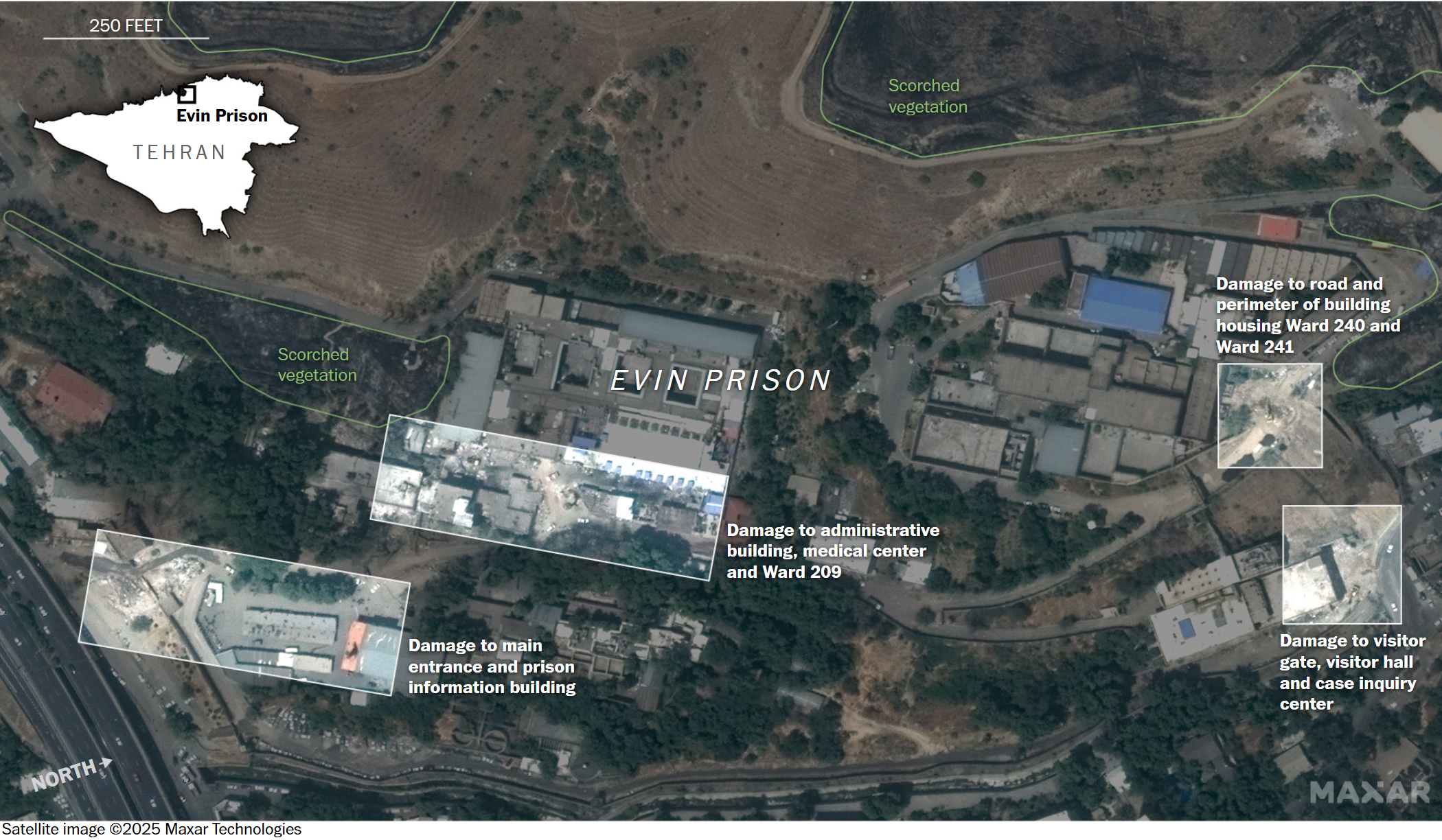
“Based on the locations [of the damage], it appears there must have been at least four separate munitions, as nothing that was hit would seem volatile enough to cause damage to spread elsewhere,” said Sean O’Connor, an imagery analyst at the defense intelligence firm Janes.
William Goodhind, a geospatial analyst at Contested Ground, a research project that uses satellite imagery to track armed conflict, said the images indicate at least six strikes. Based on the damage locations, he said the strike appeared aimed at two outcomes: to target access points, such as the gates on the north and south sides of the complex, and to kill prison staff members who would have been in the central buildings. He noted that it looked as though a “lower yield munition was used [rather] than larger-scale airstrikes, where the intent is to level the building.”
More than 60 acres of vegetation surrounding the prison were scorched in fires in the aftermath of the attack, the satellite images show. Some of the structural damage may been inflicted by the fires.
In the center of the prison, a building that contains administrative offices was destroyed and a medical center was heavily damaged, the images show. Videos posted to social media, including ones shared by the Iranian government, show burned-out cars and tangled metal. An exterior wall on the medical center is blackened and bars on its windows are crumpled. Inside, medical equipment and beds are covered in shattered glass.
A doctor who worked at the medical center was also killed, as well as a prison social worker and her 5-year-old son, according to death notices reviewed by The Post.
The attack appears to have also damaged another building across a courtyard from the medical center, which two former prisoners said was the solitary confinement block of Ward 209. The ward is run by the Ministry of Intelligence and often houses political and high-value detainees who are typically blindfolded while they are moved through the facility.
One inmate who spoke to a friend by phone said he saw blindfolded prisoners walking around immediately after the strike with no guards in sight, the friend told The Post.
Satellite images and videos show extensive damage to the visitor gate at the northern edge of the complex, where, according to the former prisoners and a family member of a detainee, Iranians come to visit detained relatives. The attack happened during established visiting hours, they said.
A man who said he arrived at the gate shortly after the explosions described seeing burned cars and prisoners attempting to escape while guards shot at their feet.
“I saw many dead bodies lying on the ground,” he said. “No one had come yet to cover them or to confirm if they were dead.”
The man said he carried the bodies of five people who appeared to be dead and pulled others out of the rubble. The image that stays with him, he said, was one of a father and a daughter who had brought a document for the release of a family member.
“For about two hours, her father was trying CPR,” he said. “Nothing happened, and she died.”
The strike near the visitor gate shattered the windows of apartment buildings nearby and killed 61-year-old Mehrangiz Imanpour as she walked in the area, a family member said.
The apartment building’s CCTV showed that Imanpour left her home around 11 a.m., less than one hour before the strike on the prison. She had gone to pay someone who had done work in her home, her family said. Two days later, authorities told the family her body had been found in a street near the visitor gate.
Video from near Imanpour’s apartment shortly after the strike shows the street covered in earth and dust, and damaged vehicles lining the road. In the distance, the visitor gate is destroyed. A building facade is shattered.
Imanpour’s family member said she was kind and self-made, a gifted artist and painter. “If you were to describe her, there aren’t enough positive things to say about Mehrangiz,” the person said.
Large swaths of Evin are not functional, and family members of two prisoners told The Post that some inmates have been moved to facilities where crowding is rampant and conditions are grim.
“They locked everyone up in a large hall that can hold a maximum of 30 or 40 people, but now they are keeping more than 120 people there,” said a family member of a male prisoner who was relocated to the Greater Tehran Penitentiary.
Women prisoners remained in Evin the night of the strike before being moved to Qarchak Prison, according to a former Evin prisoner who has spoken with women detainees and a report by Human Rights Activists in Iran.
“[Women prisoners] cleaned the place themselves. There were guards everywhere, pointing guns at their heads, and no water, no gas, no telephone access,” the person said. “Families were very worried.”
Qarchak has been denounced by human rights organizations for its pest infestation, contaminated water and lack of basic social services.
“In this situation, [prisoners] are the most vulnerable,” the former prisoner who ran toward the entrance said. “Who knows what is going to happen next.”
Mikhail Klimentov contributed to this report.

The post Israeli strike hit four areas in notorious Tehran prison. Civilians among the dead. appeared first on Human Right Activists In Iran.

Israel hid massive damage from Iran’s missile strike; satellite images reveal 5 military bases hit

The Economic Times – Satellite radar data from Oregon State University, analyzed by The Daily Telegraph, indicates that during the recent 12-day conflict between Iran and Israel, six Iranian missiles penetrated Israeli airspace and struck five military facilities, including a major air base, intelligence centers, and a logistics hub.

These impacts are in addition to at least 36 other Iranian missiles that penetrated Israel’s air defense systems, which caused damage to residential and industrial buildings.

While most Iranian missiles were intercepted, the success rate of Iran’s strikes improved as the war progressed, possibly due to improved launch tactics or the deployment of more advanced missile systems.

This analysis also reveals that Iran’s success in penetrating Israeli defenses with its missiles peaked at 16 per cent by the seventh day of the war, before declining thereafter.

Satellite data indicates that Iran adapted its attack strategy to overwhelm Israeli defenses by using fast missiles alongside slower drones to divert attention.

Despite this, about 84–87 percent of Iranian missiles were intercepted, according to various sources.

Human Rights Activists in Iran (HRANA), a US-based organization, reported that more than 900 people have been killed and over 3,000 wounded as a result of Israeli strikes on Iran.

The Iranian health ministry has stated that the number of wounded exceeds 4,000.

The post Israel hid massive damage from Iran’s missile strike; satellite images reveal 5 military bases hit appeared first on Human Right Activists In Iran.

Over 650 die in Iran after first week of Israeli strikes

MSN – More than 650 people have been killed in Iran following a massive Israeli bombing campaign launched a week ago, an activist group said on Friday.

The US-based Human Rights Activists News Agency (HRANA) reported that 657 people had died and 2,037 injured in the nationwide airstrikes.

The Iranian government does not publish daily figures on casualties.

The HRANA relies on a broad network of informants and publicly available sources.

The group said the dead included at least 263 civilians and 164 members of the military.

Another 230 fatalities remain unidentified.

The network also reported damage to civilian infrastructure, including a projectile striking a children’s hospital in Tehran, which did not result in injuries.

In the western province of Ilam, a fire station was damaged, HRANA said, while an Israeli attack on a car factory in western Iran triggered a large fire.

Israel maintains that its objective is to prevent Iran from acquiring nuclear weapons, which it considers an existential threat.

The post Over 650 die in Iran after first week of Israeli strikes appeared first on Human Right Activists In Iran.

Ceasefire Brings hope to War-Weary Civilians as Iran-Israel Conflict Claims Over 900 Lives

The Indian Awaaz – A fragile ceasefire has brought a much-needed reprieve to millions of civilians caught in the deadly crossfire of the Iran-Israel conflict, which has reportedly claimed close to 900 lives. U.S. President Donald Trump, who characterized the intense hostilities as a “12-day war,” announced that both nations had simultaneously sought his administration’s intervention for peace.

The truce was declared after Iranian state media reported that a ceasefire had been “imposed on the enemy,” following what Tehran described as a military response to “U.S. aggression.” This announcement came just hours after Iran launched missile strikes on the U.S. Al Udeid Air Base in Qatar, a retaliatory move that significantly escalated the conflict by directly involving American forces.

The Human Rights Activists News Agency (HRANA) reported a staggering toll of at least 865 fatalities in Iran as of June 22nd. This includes 215 military personnel, 363 civilians, and 287 unidentified individuals. More than 3,300 people have also been injured. These figures are considerably higher than those released by Iranian health authorities, which reported 224 deaths and over 2,500 injuries. Both sources, however, underscored that the majority of casualties were civilians.

The humanitarian crisis in Iran has deepened dramatically. Initially targeting military infrastructure, Israeli airstrikes increasingly struck residential areas and even prisons. This escalation has led to massive internal displacement, forcing millions to abandon their homes. Among the deceased were aid workers, children with disabilities, and nuclear scientists, highlighting the widespread and indiscriminate impact of the violence. Iran’s judiciary specifically noted that parts of Tehran’s Evin Prison, known for holding political detainees, were also targeted by Israeli forces.

In Israel, the human cost has also been severe. Iranian missile strikes have resulted in the deaths of at least 24 civilians and nearly 600 injuries. The southern city of Beersheba bore the brunt of attacks in the final hours before the ceasefire, with emergency services confirming at least three deaths and multiple injuries. Rescue teams are currently sifting through rubble in damaged buildings, searching for survivors.

President Trump confirmed that his diplomatic and security teams worked tirelessly overnight to broker the truce, which reportedly took effect around 4 a.m. local time. Israeli strikes on Iranian cities ceased shortly before the ceasefire, despite a significant intensification of hostilities in the lead-up to the agreement.

Israeli Prime Minister Benjamin Netanyahu has yet to issue a public statement regarding the ceasefire. However, reports indicate that he convened an emergency meeting of the Security Cabinet, instructing ministers to refrain from public comments on the agreement’s terms.

The rapid escalation over the past 12 days has overwhelmed emergency services in both nations. Hospitals are struggling to cope with the influx of wounded, while rescue teams continue their efforts to clear debris and provide assistance to those affected. The UNHCR and other international humanitarian agencies have urgently called for immediate de-escalation, robust protection for civilians, and unhindered access for critical relief operations.

Despite the declared truce, an air of uncertainty persists. Iran has stated its willingness to halt its responses if Israeli attacks cease, but Israeli officials have largely remained silent on the agreement’s specifics. The conflict has starkly illustrated how quickly regional tensions can spiral into full-scale warfare, with ordinary citizens disproportionately bearing the devastating consequences.

The post Ceasefire Brings hope to War-Weary Civilians as Iran-Israel Conflict Claims Over 900 Lives appeared first on Human Right Activists In Iran.

Iran celebrates end of war as ‘victory’ over ‘enemy aggressor’ while hunting for internal dissidents

All Israel News – Iranian President Masoud Pezeshkian congratulated the Iranian people for their “historic punishment” of the “enemy aggressor” during a speech to celebrate Iran’s victory over Israel in a victory parade in Tehran, according to the regime-affiliated Fars News Agency.

“After the courageous resistance of your great and history-making nation, we are witnessing a ceasefire and cessation of the 12-day war that was imposed on the Iranian nation by the adventurism and incitement of the Zionist regime,” Pezeshkian stated.

“During this period, the world watched the authority of the great Iran, which enjoyed the support of its people, and although the beginning of this imposed war was a terrorist enemy, its end was marked by the will and authority of the great people of Iran. Today, in a situation where the enemy aggressor agreed to stop fomenting war, he suffered a severe and historic punishment,” Pezeshkian continued.

Iranian Quds Force Commander Esmail Qaani was also seen for the first time since the start of the campaign against Iran, when he participated in the victory celebrations in Tehran.

Later on Wednesday morning, during an Iranian cabinet meeting, Pezeshkian said, “The Zionist regime’s actions made us realize more than ever that it is all the people of Iran – not just one party, one minority, or one group – who are capable of defending the country.”

Despite Pezeshkian’s statements, reports coming out of Iran prior to the regime’s decision to cut off internet access in the country, indicated that the government has begun to use the Basij Force, a kind of paramilitary force, infamous for cracking down on dissent and for violent oppression of Iranian protesters.

Iranian accounts on social media posted messages detailing police and Basij checkpoints set up throughout Tehran, in an attempt to find people protesting the regime, taking pictures of Israeli strikes, or engaged in other anti-regime behaviors.

In his speech to the cabinet, President Pezeshkian personally thanked the Basij Force.

The Public Relations Department of the Islamic Revolutionary Guard Corps (IRGC) announced the details of the funeral ceremony of the IRGC commanders killed by “the brutal Israeli aggression” during Operation Rising Lion.

According to the Fars News Agency, the public funeral ceremonies for “the senior martyred commanders, along with other martyred commanders of the Zionist regime’s brutal aggression” will be held on Saturday, June 28, in Tehran, while the funeral for IRGC commander Hossein Salami, and Brig,-Gen. Haj Masoud Shanei, his office director, will be held June 26 in their hometown of Golpayegan.

Meanwhile, the Far News Agency claimed that three Mossad spies were executed by hanging earlier this morning, in the Urmia Prison in the western part of the country.

“Three spies affiliated with the terrorist intelligence agency of the Zionist regime, Mossad, were executed by hanging in Urmia,” the site reported.

Fars News said the three men, Idris Ali, Azad Shojaei, and Rasoul Ahmad Rasoul, were accused of smuggling assassination equipment into Iran. The three were charged with “‘waging war against God’ (moharebeh) and ‘spreading corruption on earth’ (efsad fel-arz) through collaboration with hostile foreign governments.”

However, despite the accusation of contributing to the assassination of government figures, the three were not connected to any of the recent assassinations during Operation Rising Lion.

Iran International, a news site affiliated with opposition movements, said the three Kurdish [men] were implicated in the killing of Mohsen Fakhrizadeh, an Iranian nuclear physicist and scientist who headed Iran’s nuclear program until his surprise killing in November 2020.

Fakhrizadeh was killed by a remotely-operated machine gun, rigged with facial recognition software, and satellite uplinks. While the operation is largely believed to have been carried out by the Mossad, it required willing participants to bring in the components, assemble them, and make sure the system was operating properly.

The three men, who ran a liquor smuggling operation, are accused of smuggling the components into Iran.

However, Iran International cited sources familiar with the families in Iran, who claimed the men were forced into giving a confession through torture.

The Human Rights Activist News Agency (HRANA) reported that so far, 823 Iranian citizens have been arrested on security charges since the start of the war. HRANA said that 286 individuals were arrested for activities on social media or for publishing posts about the Israeli attacks, while 537 were arrested for “security reasons.”

Iranian police announced that checkpoints will continue throughout Iran despite the end of the conflict, according to Iran International.

The news outlet cited the spokesperson of the Internal Affairs Commission, who said in a speech that the police deputies have called for the strengthening of checkpoints.

The post Iran celebrates end of war as ‘victory’ over ‘enemy aggressor’ while hunting for internal dissidents appeared first on Human Right Activists In Iran.

Iran death toll hits 1,054 amid Israeli strikes as ceasefire comes into effect

NEWS AZ – The death toll in Iran from Israeli military strikes has risen to 1,054, with 4,476 others injured, the US-based Human Rights Activists News Agency (HRANA) announced.

Of those killed, 417 were civilians, and around 2,000 of the wounded were non-combatants, according to HRANA, News.Az reports, citing Iranian media.

A ceasefire between Iran and Israel took effect earlier in the day and remains in place.

Since the start of the conflict, at least 823 people have been arrested in Iran, the human rights group added.

The post Iran death toll hits 1,054 amid Israeli strikes as ceasefire comes into effect appeared first on Human Right Activists In Iran.

How Iran Used War With Israel To Stress Test Its Chinese-Style Internet Controls

Worldcrunch – When rockets began raining down on Tehran the night of June 13, and open military conflict between Israel and Iran erupted, it wasn’t just the skies that went dark. Almost immediately, internet speeds in Iran dropped sharply. Access to already-blocked platforms and websites became even more restricted. Then, on June 18, the government cut off nearly all connections to the outside world. For 72 hours, 91 million people were plunged into a digital void: no WhatsApp, no Google, no email, no VPN, no way to reach beyond the country’s borders.

It was the most severe internet blackout in the history of the Islamic Republic, and full access still hasn’t been restored. At present, network connectivity remains at just 20% of normal levels. NetBlocks, the organization that tracks global internet disruptions, reported almost no data traffic flowing between Iran and other countries between June 18 and June 21. Not even during past crackdowns, like the November 2019 protests or the 2022 “Women, Life, Freedom” movement, was the digital shutdown so complete. Back then, at least some inbound data traffic still trickled through.

Officially, Iran’s Ministry of Communications claimed the blackout was a defensive move, designed to shield the population from Israeli cyberattacks. And there had indeed been attacks in the days leading up to it, targeting banks, government servers, and military infrastructure.

The cyber war between Iran and Israel, however, didn’t start last week. It goes back much further.

A “National Internet” megaproject
One early turning point came in 2010, when the Stuxnet virus sabotaged Iranian centrifuges in the Natanz nuclear facility, setting back the country’s atomic program by years. In response, Tehran’s leadership began working to safeguard its digital infrastructure from outside attacks.

That’s when the so-called “National Internet” megaproject was born. At its core, the plan is to build a nationwide intranet, cut off from the rest of the world. The idea is that the government can flip the switch whenever it sees fit. Some observers now fear that what was meant to be an emergency measure could become the new normal. The system was first deployed during the 2019 protests, not just to block demonstrators from organizing but also to stop videos and photos from spreading. The blackout ended up lasting longer than the unrest itself, likely to stress-test the system and find weak spots.

“Since 2019, all international traffic has been routed through a single hub,” says Azadeh Akbari, Assistant Professor of Digital Transformation at the University of Twente in the Netherlands. “The state has completely centralized the infrastructure. It makes surveillance easier and serves as a show of authoritarian power.”

The National Internet was largely developed under former Communications Minister Mohammad-Javad Azari Jahromi, a one-time intelligence officer. The idea was to create a self-contained infrastructure, complete with domestic search engines, messaging apps, email services, and online banking, modeled on China’s system.

This network has now been reactivated. For the most part, it’s still running. Iran has homegrown alternatives to nearly every major online service, from a ride-hailing app to its own version of Amazon. But one thing is notably absent: social media and messaging platforms. Iranian alternatives do exist, but hardly anyone trusts them.

As a common joke goes: “Iranian messengers have three checkmarks: one for the sender, one for the recipient, and one for the guy reading over your shoulder.” Many Iranians would rather stay out of touch for days than risk using those apps. Even when the government announced on June 19 that foreign numbers could now be registered, supposedly to let people abroad contact loved ones inside Iran, few people took the offer seriously.

A 72-hour blackout
While the government pitches the shutdown as a protective measure, many people experience it as a terrifying loss of control. In brief conversations with those who’ve managed to get online, one word keeps coming up: “powerlessness.” For Iranians abroad, the 72-hour blackout meant total silence from family members, just as bombs were falling.

For the first time, even telephone lines were restricted. Calls from foreign numbers to Iranian phones were blocked, cutting off what was often the last reliable line of communication. While the Israeli bombs and missiles were striking, that silence caused widespread panic.

From a strategic standpoint, shutting off the internet may have made sense. Reports suggest that high-ranking officers were located and killed using the GPS data from their phones. Akbari, who specializes in digital surveillance, suspects the regime may have used the total blackout to move Supreme Leader Ali Khamenei to a safe location. Israel’s Defense Minister had openly threatened to target him.

But this digital blackout didn’t just sever family ties. It stripped civil society of its most vital tools in an instant. Despite years of war rhetoric, the government had no warning system in place for missile attacks, something that was standard even during the Iran-Iraq war in the 1980s. In the early days of the conflict, it was civil society that stepped in, using Telegram channels and Twitter accounts to share air raid alerts. That too disappeared when the shutdown took full effect.

Iran ranks near the bottom (176 out of 180) in Reporters Without Borders’ press freedom index. Trust in state media is virtually nonexistent, and the national broadcaster is seen as a mouthpiece for propaganda. The war was barely covered, with most airtime dedicated to boasting about supposed victories over Israel. In that vacuum, independent news outlets and social media often serve as the only real sources of information. Without access to them, the public is left completely in the dark.

Some government offices, however, managed to stay online. This was discovered by internet activist Mark Pashmforoush and his team, who have been working on digital freedom tools since the 2019 shutdown. He developed a VPN service called Oblivion. According to his findings, some government agencies began selling VPNs at inflated prices during the blackout. But these connections were under state control. Anyone who used them became traceable, and therefore, vulnerable. A double win for the surveillance state.

False hope in Starlink
Many have pinned their hopes on Elon Musk’s satellite internet system, Starlink. But this, too, has proven misleading. “Starlink is not legally authorized in Iran,” says Pashmforoush. “Right now, about 30,000 receivers are active in the country, but the price has shot up to around $3,000 per device.” Before the war, they went for about $850. On top of that comes a monthly fee of roughly $100, a steep price for most Iranians.

The risks are just as high. Starlink hardware must be smuggled in, dodging countless checkpoints along the way. Using it can lead to espionage charges in kangaroo courts. In the worst cases, it could result in the death penalty. Even forgetting to turn on a VPN when logging into a government website could make a user identifiable. The fear of being tracked is real.

And yet, the need to connect to the outside world is stronger. Pashmforoush, who monitors Telegram groups dedicated to Starlink sales, has seen demand steadily rising.

The so-called war-related shutdown, along with the entire National Internet project, is being marketed by the state as a show of “digital sovereignty.” In reality, it targets the very digital spaces that hold society together, says Azadeh Akbari. Having once been a women’s rights activist in Iran, she is intimately familiar with the government’s methods. What she sees now is a shift from digital authoritarianism to full-blown digital totalitarianism.

“The digital sphere is just an extension of social life,” Akbari says. “Cutting it off destroys support networks, neighborhood bonds, grassroots organizing: everything that keeps a society functioning during a crisis.”

The post How Iran Used War With Israel To Stress Test Its Chinese-Style Internet Controls appeared first on Human Right Activists In Iran.

Female Humanitarian Aid Worker Among 54 Political Prisoners, 2 Women, Facing Execution in Iran

In 2024, Iran executed at least 930 individuals, the majority for charges that failed to meet the threshold of “most serious crimes” required under international law.

Furthermore, given the systemic lack of fair and transparent trials within the Iranian judiciary, even executions for crimes that may meet this threshold constitute arbitrary deprivations of life, in clear violation of international human rights standards. Currently, 54 political and security prisoners in Iran face the death penalty, including two women. One of these women is being persecuted for her humanitarian work in refugee camps, where she supported individuals forcibly displaced by the Islamic State. These cases underscore the urgent need for robust international action to hold Iran accountable for its widespread and unlawful use of capital punishment as a tool of repression.

Pakhshan Azizi, a female resident of Mahabad, was arrested on August 4, 2023, and detained in Tehran’s Evin Prison under harsh conditions. Accused of “Baghi” through alleged membership in opposition groups, she was sentenced to death and four years of imprisonment by the Tehran Revolutionary Court, presided over by Judge Iman Afshari, sanctioned by the United Kingdom and Canada for his role in serious human rights violations, particularly for violations for the right to a fair trial and the right to freedom of expression of political protesters. Judge Afshari also sentenced three of Azizi’s family members to one year in prison for the charge of “assisting a criminal to evade trial and conviction’. They were initially arrested alongside Azizi but were released on bail. 

The Supreme Court has recently upheld the sentence imposed by Afshari, raising urgent concerns about the imminent threat to Azizi’s life. 

Her lawyers have highlighted that the evidence presented to the Supreme Court demonstrated that she had had no involvement in military activities. Further, Ms. Azizi has been solely engaged in humanitarian efforts, providing services to vulnerable women and children, namely to those directly impacted by the Islamic State in Sinjar. Numerous pieces of evidence support Ms. Azizi’s claim that she has worked in refugee camps housing displaced Yazidis in Syria. Certification Letter from the Kurdish Red Crescent and Shams Rehabilitation Organisation detail her service caring for women and children survivors of conflict. These letters confirm her volunteer role at multiple camps including Al-Hol and Nowruz. Numerous pieces of evidence supporting Ms. Azizi’s humanitarian activities have been presented. Her lawyers have expressed concern over the rushed handling of the case and called for a thorough and fair review of the evidence.

HRA highlights that the use of capital punishment in cases like Ms. Azizi’s is part of a broader strategy by Iranian authorities Ms. Azizi has faced prolonged detention, denial of legal representation.  This is not her first encounter with state repression; she was previously detained in 2009.

HRA is closely monitoring Ms. Azizi’s case alongside the 53 other individuals facing the death penalty, including Varisheh Moradi, another woman currently detained in Evin Prison. 

The international community must unequivocally condemn the use of the death penalty. Governments, human rights organizations, and global institutions should urgently call on Iranian authorities to commute Ms. Azizi’s sentence, ensure her access to a fair trial, and halt the executions of other political prisoners in Iran.

International organizations and donors involved in humanitarian relief efforts in Syria, in particular, should urgently speak out against Ms. Azizi’s death sentence. As a dedicated aid worker who has contributed to humanitarian efforts, her commitment to alleviating human suffering underscores the injustice of this cruel and disproportionate punishment.


The Latest Comprehensive List of 54 Political and Security Prisoners Sentenced to Death in Iran

The post Female Humanitarian Aid Worker Among 54 Political Prisoners, 2 Women, Facing Execution in Iran appeared first on Human Right Activists In Iran.
Iran Prepares for a Presidential Election. Guardian Council Vets Six Candidates with Questionable Records

Iran Prepares for a Presidential Election. Guardian Council Vets Six Candidates with Questionable Records

In the wake of Iranian President Ebrahim Raisi’s death last month, Iran is gearing up for a presidential election. 

Historical Lack of Free and Fair Elections in Iran Dating Back Decades

Iranian elections have a dark past, consistently marked by a lack of free, fair, and transparent processes. In 2010, the highly disputed re-election of President Mahmoud Ahmadinejad led to widespread allegations of vote-rigging and fraud, sparking the largest protests since the 1979 revolution. The Green Movement, as it came to be known, saw millions of Iranians take to the streets demanding democracy and more. The government responded with a violent crackdown, resulting in numerous arrests, injuries, and deaths–some of those arrested remain detained today. 

The 2021 election saw the lowest voter turnout in history, highlighting growing public disillusionment. Despite this, the ruling elite persist in claiming legitimacy, even as each election sees diminishing public participation. This lack of engagement underscores the deepening disconnect between the ruling elite and the general populace. 

Six Candidates Cleared for Upcoming Iranian Presidential Election 

As the upcoming election approaches, six candidates have been approved. The approval process for presidential candidates in Iran is overseen by the Guardian Council, a powerful body comprising six Islamic jurists appointed by the Supreme Leader and six jurists approved by the Parliament. This council rigorously vets each applicant, assessing their qualifications, political and religious beliefs, and backgrounds—not on true merit. As a result, numerous candidates are often disqualified, leaving only a select few approved to run in the election.

Iran has had a significant history in manipulating the elections. The 2009 presidential election in Iran was marred by significant controversy and accusations of fraud. After Mahmoud Ahmadinejad was announced as the winner with nearly 63% of the vote, widespread protests erupted, driven by opposition candidates who claimed vote manipulation. These protests, part of the Iranian Green Movement, persisted into 2010. The government’s violent suppression of these protests, resulting in deaths and arrests, further fueled beliefs of a rigged election. Prominent opposition figures such as Mir Hossein Mousavi, his wife Zahra Rahnavard, and Mehdi Karroubi, leaders of the 2009 Green Movement, have been under house arrest since February 2011. Despite international outcry their situation remains unchanged, with severe restrictions on their communication and movement. Mehdi Karroubi, vocal in his criticism of the Iranian government’s actions, including its handling of incidents like the downing of a Ukrainian passenger plane, has faced worsening health conditions under house arrest. His attempts to hold the Iranian leadership accountable have led to increased restrictions on his freedoms. The continued detention of these opposition figures without trial has been condemned internationally, with entities such as the UN calling for their immediate release.

In the 2021 presidential election, controversy arose even before voting began, with the Guardian Council disqualifying many popular candidates, seen as a move to ensure the victory of hardliner Ebrahim Raisi. This election saw the lowest turnout in the history of the Islamic Republic, at around 49%, with a significant portion of protest votes. International observers and human rights organizations dismissed the election as neither free nor fair, labeling it a “show election.” Voter turnout in Iran’s presidential elections has been on a declining trend over the past two decades, reflecting growing public disillusionment with the electoral process. Notably, turnout was around 85% in 2009, despite controversies, likely due to a highly polarized environment. It saw a slight decline to around 72% in 2013, remained stable at about 73% in 2017, and drastically fell to a record low of approximately 49% in 2021. This decline has been attributed to widespread skepticism about electoral integrity and the pre-selection of candidates by the Guardian Council. Statistics on voter turnout are usually provided by the Iranian government, which is often accused of reporting higher participation figures than the reality.

This rigorous and  vetting process lacking any transparency narrows the pool of candidates presented to voters, limiting genuine political competition and reducing the electorate’s ability to choose from a diverse range of political views. The skewed candidate selection process undermines the claim of a democratic nature to the elections, reinforcing the status quo of the ruling elite and perpetuating the brutal suppression of human rights across the country.

The upcoming election is a stark example of this process. The Guardian Council has officially announced the list of approved candidates. The final slate of candidates includes:

Masoud Pezeshkian: b.1954 (70), Mahabad. Former Minister of Health. He had previously ran for the presidency in 2013 but withdrew and in 2021 was disqualified by the Guardian Council for the election. Pezeshkian has a demonstrated history of involvement in restricting access to the highest attainable standard of health while additionally being implicated in unethical practices involving condoning the violation of women’s rights. 

Mostafa Pourmohammadi: b.1959 (65), Qom. Former Minister of Interior and Justice, and Revolutionary Prosecutor notorious for his involvement in the mass executions of the 1980s. He was a member of the “Death Squad” in 1988, notorious for the mass executions of political prisoners that summer.  Since 2021, he has been the President of the Center for IslamicRevolution Documents. More details

Saeed Jalili: b. 1965(59), Mashhad. Secretary of the Supreme National Security Council (2007-2013). Member of the Strategic Council on Foreign Relations, has a history of systematic repression of political activists and notable complicity in the brutal crackdowns on peaceful protests. Notably, Saeed Jalili was the Secretary of the Supreme National Security Council when the house arrest decision of the aforementioned Green Movement leaders was carried out in 2010.  More details

Alireza Zakani: b. 1965 (59), Rey. The current mayor of Tehran and former head of the Basij Student Organization, he was involved in the events of July 9, 1999, and the attack on Tehran University dormitory. Alireza Zakani has a long history of persecuting minorities and political opponents. He was previously disqualified from the 2013 and 2017 presidential elections. During Zakani’s tenure, a group called the HijabBans was established to oversee women’s dress codes in Tehran’s metro. Zakani has been sanctioned by the UK for his involvement in serious human rights violations. More details

Seyed Amir-Hossein Ghazizadeh Hashemi: b. 1971 (53), ​​Fariman, Khorasan Razavi Province. Former Deputy Speaker of Parliament (2020-2021) Current Vice President of Iran and head of the Foundation of Martyrs and Veterans Affairs and Member of the Islamic Revolution Stability Front since 2019. Hashemi has been a staunch supporter of the so-called Hijab bill as well as the ‘Protection of Users’ Rights and Basic Applications in Cyberspace’ which seeks to restrict free access to the internet among other things.  More details

Mohammad Bagher Ghalibaf: b. 1961 (63), Torghabeh, Khorasan Razavi Province.  Former Commander Of the IRGC Air Force (1997-2000). Speaker of the Iranian Parliament, has long maintained leading involvement in the illegal crackdown on peaceful protestors including their arbitrary detentions and torture. Ghalibaf himself has spoken publicly about his involvement in and support in such actions. In addition, Ghalibaf is a staunch supporter of the so-called Hijab bill. More details

The elections, rather than serving as a tool for the people to express their will, act as a mechanism for the ruling authorities to present outward legitimacy. This can be seen notably in the candidacy of individuals who played leading roles in the arrest of protestors in 2010 following disputed elections. 

It is noteworthy that several other prominent figures applied but were not approved by the Guardian Council to run in the upcoming election. This list includes:

Eshaq Jahangiri: Former First Vice President

Mehrdad Bazrpash: Current Minister of Roads and Urban Development

Sowlat Mortazavi: Current Minister of Cooperatives, Labour and Social Welfare

Mahmoud Ahmadi Bighash: Former IRGC commander

Mostafa Kavakebian: Former representative of Tehran in the Parliament. More details

Sayyid Shamseddin Hosseini: Former Minister of Economic Affairs and Finance

Abdolnaser Hemmati: Former Governor of the Central Bank

Mahmoud Ahmadinejad: Former President

Mohammad Mehdi Esmaeili: Current Minister of Culture and Islamic Guidance. More details

Vahid Haghanian: Former Executive Deputy of the Office of the Supreme Leader

Ali Larijani: Former Speaker of the Parliament. More details

Elias Naderan: Former MP

Hasan Sobhani: Former MP

Hasan Kamran: Former MP

Ahmad Akbari: Former MP

Ghasem Jasemi: Former MP

Hamideh Zarabadi: Former MP

Mohammad Nazemi Ardakani: Former Minister 

The current configuration severely limits any potential for significant political change from within the system, effectively making the elections a mere formality. The process ensures competing interests do not become a true threat to the ruling elite. Moreover, the Guardian Council’s role extends to overseeing the presidential elections themselves, further ensuring that the elected president will align with the broader interests of the ruling elite, thereby maintaining the status quo.

This system reveals a façade of democracy, where the true power dynamics operate on a level that is far removed from the democratic ideals professed to the public. The system not only undermines the democratic essence of elections but also perpetuates a cycle of power that is self-serving for those at the helm.


Iranian Prisons are Places of Relentless Suffering

Incarcerated Individuals tell HRA: “Abuse of power is rampant. We are left at their mercy”

Iran’s prisons are harrowing places where abuse and neglect are rampant. The following report is based on testimonies from former and current incarcerated individuals in Iran. Conversations between individuals and HRA reveal severe and systemic issues that fly in the face of Iran’s international human rights obligations as well as universally agreed upon minimum standards for the treatment of prisoners. 

In Iran, the management, administration and regulations of the prisons falls under the jurisdiction of the Prisons Organisation which operates directly under the supervision of the Head of the Judiciary. The Head of the Judiciary appoints the head of the Prisons Organization who is responsible for the implementation of corrective measures, rehabilitation programs, and ensuring the rights and welfare of prisoners. This investigation was prompted by a notable void in reporting on prison conditions, which is likely attributed to the restricted nature of such reporting and the considerable challenge faced by third-party monitors in accessing penal facilities directly. The administration of prisons is tightly integrated with the judicial system’s broader goals and policies, and they have notably been known for their lack of transparency.

Conditions described by current and formerly incarcerated individuals in Iranian prisons such as EvinRajaei ShahrVakil AbadGhezel HesarQarchak, and Adel Abad reveal significant breaches of international human rights law. In addition to clear violations of international human rights law, the testimonies detail blatant disregard for upholding the Mandela Rules.The Nelson Mandela Rules, while not legally binding, are considered “soft law” and represent essential principles

In 2015 The UN General Assembly adopted the Mandela Rules as the universally agreed minimum standards for the treatment of prisoners and several UN Member States have since incorporated the provisions of the rules into their domestic legal frameworks. Iran’s lack of overall adherence to these principles can be seen as a failure to uphold the universally agreed upon minimum standards. 

The Mandela Rules on the Standard Minimum Treatment of Prisoners 

Testimonies collected by HRA indicate grossly inadequate healthcare within prisons, with limited access to medical professionals and neglect of serious health conditions. This situation is a clear violation of the right to health as stipulated in the Mandela Rules.

Accommodation and Hygiene: 

“Adel Abad was a place of relentless suffering. The rooms were semi-dark and poorly ventilated, making it hard to breathe. Temperature extremes were common, with freezing winters and scorching summers.”

Mandela Rule 12 requires that prison accommodations provide adequate living space, ventilation, and lighting. 

Mandela Rule 13 stipulates the need for sanitary facilities that are hygienic and accessible. 

Mandela Rule 15 emphasizes the provision of adequate clothing and bedding.

The detailed testimonies collected by HRA highlight the violation of basic accommodation standards. Poor ventilation, inadequate lighting, and extreme temperatures directly contravene the Mandela Rules, creating inhumane living conditions that fail to respect the dignity of prisoners.

While engaging with HRA, Zahra, a political prisoner who spent 5 years in Evin Prison said “The cells were dimly lit and poorly ventilated, making the air thick and oppressive. Summers were unbearable, and winters were freezing.” Another individual detailed a similar situation describing “semi-dark and poorly ventilated [rooms], making it hard to breathe.” They continued, “Temperature extremes were common, with freezing winters and scorching summers.”

Food and Water

“Since the merger of the prisoner populations from Rajaei Shahr and Ghezel Hesar (Qezalhasar), the dynamics here have drastically changed. The overcrowding has worsened, and food shortages have become more severe.” 

Mandela Rule 22 ensures prisoners receive nutritious and sufficient food and drinking water.

Throughout HRA’s conversations, incarcerated individuals  consistently report inadequate and poor-quality food, with those unable to afford additional supplies from prison stores suffering from malnutrition. This testimony reveals stark violations of the Mandela Rules’ requirement for nutritious and sufficient food.

Ali, a 28 year old male incarcerated at Rajaei Shahr Prison four years told HRA, “The food was inedible, and many relied on the expensive prison store to supplement their diet.” Another individual currently incarcerated at Ghezel Hesar Prison said “The food is insufficient and often spoiled, forcing those with money to buy from the expensive prison store.”

The dire situation in these prisons, as described by the incarcerated individuals, underscores a critical failure to meet the basic nutritional needs mandated by Mandela Rule 22. The overcrowding exacerbated by the merger of incarcerated individuals populations from Rajaei Shahr and Ghezel Hesar has only intensified food shortages, leaving many inmates malnourished and dependent on expensive prison stores for survival. This blatant disregard for providing adequate and nutritious food highlights a profound violation of human rights within Iran’s prison system.

Healthcare

“The denial of these essential services is a clear reflection of the system’s failures.”

Mandela Rule 24 mandates that prisoners have access to the same standard of healthcare available in the community, without discrimination.

Testimonies indicate grossly inadequate healthcare, with limited access to medical professionals and neglect of serious health conditions. This situation is a clear violation of the right to health as stipulated in the Mandela Rules.

In Evin Prison one individual described that “Healthcare was minimal, with only an inexperienced nurse available and a doctor visiting infrequently.” Another serving time at Vakil Abad Prison from 2019-2023 disclosed to HRA  “Medical services were grossly inadequate, with many serious conditions ignored.” Another individual informed HRA that the existence of medical care “was a farce”. 

The denial of essential healthcare services within Iranian prisons is a damning indictment of the system’s failures to uphold basic human rights. Mandela Rule 24 unequivocally mandates that prisoners have access to healthcare equivalent to that

available in the wider community, without discrimination. These testimonies reveal a systemic failure to provide the necessary medical care, further underscoring the urgent need for reform within Iran’s prison system.

International Human Rights Law 

International Covenant of Civil and Political Rights (ICCPR): The Right to Humane Treatment

Article 10 of the ICCPR states that all persons deprived of their liberty shall be treated with humanity and with respect for the inherent dignity of the human person.

Indeed the degrading treatment described in great detail in conversation with almost all individuals including the pervasive violence reported violates Article 10 of the ICCPR, which emphasizes the humane treatment of all prisoners.

Nasrin, who is serving time since 2021 in Qarchak (Shahre-Rey) Prison, recounted to HRA “The humiliating behavior of some guards, who conduct nude body searches and degrade us in front of others, only adds to the misery.” Mehdi, a 40 year old male serving time at Ghezel Hesar Prison, in dialogue with HRA informed that : “The prison is a hotspot for violence, with easy access to weapons like large handmade knives that many of us carry for protection.”

Individuals described brutal violence. One stated that “Physical abuse by guards was common, and there were frequent hunger strikes in protest.” Another, age 60, incarcerated since 2006, stated “Some guards exploit these conditions, demanding bribes for basic necessities or the promise of safety.”

Physical abuse by guards and the exploitation of prisoners for bribes constitute inhuman and degrading treatment, falling under the purview of torture. The reports of frequent abuse and the calculated neglect by authorities indicate systemic issues within the prison system.

Conclusion

The systemic issues within Iranian prisons highlight a severe failure to adhere to international human rights obligations and principles. The harrowing testimonies from both current and former incarcerated individuals expose a grim reality of widespread abuse and severe neglect. Healthcare in these prisons is grossly inadequate, with limited access to medical professionals and widespread neglect of serious health conditions. Combined with appalling hygiene standards, subpar food and water provisions, and violence and degrading treatment by guards, it is evident that Iranian prisons fall alarmingly short of international standards and principles.

Iran must urgently address these violations to align itself with international standards and obligations, ensuring the humane treatment and dignity of all incarcerated individuals. 

HRA urges the international community, including international human rights organizations, governments, and the United Nations, to take immediate action regarding the stark realities revealed by these testimonies. It is imperative that in all dialogue concerted efforts be made to pressure Iran to adhere to international human rights standards, ensure the humane treatment of incarcerated individuals, and allow independent monitoring of prison conditions. 

*For a more in depth look at the unlawful conditions of Prisons mentioned in this article, please visit www.spreadingjustice.org and search the name of the Prison in the top right hand search bar.

*For a brief overview see below related Individuals involved in rights violations associated with unlawful prison conditions subdivided by Prison and General Associations: 

Shiraz Central Prison (AKA Adel Abad Prison): 

  1. ISHAGH EBRAHIMI: Director-General of Fars Province Prisons Since Sep 2019
  2. RUHOLLAH REZAEI DANA: the director of Shiraz Central Prison Since June 2020
  3. ALI MOZAFFARI: Chief Justice of Qom Province Since August 2019 

Evin Prison:

  1. ALI ASHRAF RASHIDI-AGHDAM: Deputy of Health and Correction and Education of Tehran Prisons General Administration Since August 2015
  2. GHOLAMREZA ZIAEI: Head of Evin Prison From July 2019 to June 2020
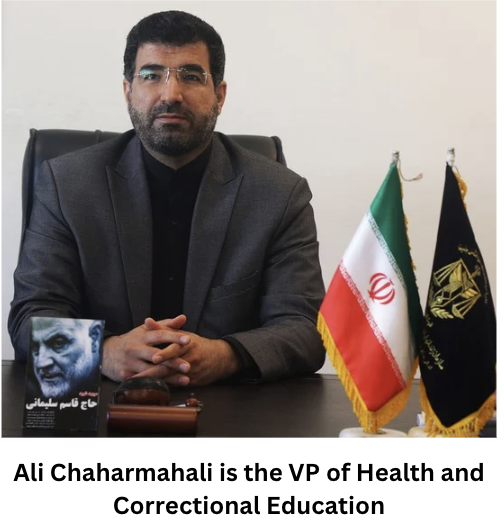
  3.  ALI CHAHARMAHALI: Head of Evin Prison from August 2016 to July 2019
  4. HAMID MOHAMMADI: Director of Evin prison from June 2020 to September 2021
  5. HASSAN GHOBADI:  Head of Evin Prison Security At least from March 2012
  6. SEYED-HOSSEIN MORTAZAVI-ZANJANI: Warden of Evin Prison From 1986 to 1988 
  7. MOHAMMAD MOGHISEH: Judge of the Evin Prison from 1989 to 1991 

Ghezel Hesar Prison

  1. ASHKAN KAMALI: Head of Ghezel Hesar Prison in Karaj Since August 2020
  2. HAMID MOHAMMADI: Director of Ghezel Hesar Prison From  2019, to June 2020
  3. MOHAMMAD MOGHISEH: Assistant judge of Ghezel Hesar Prison in 1985   1986 – 1988 Head and Judge of Rajaei-Shahr Prison in Karaj 

Rajaei-Shahr Prison (AKA Gohardasht Prison): 

  1. ALLAH KARAM AZIZI: The head of Rajaei-Shahr Prison From July 2019 to  August  2023
  2. GHOLAMREZA ZIAEI: Head of Rajai-Shahr Prison in Karaj From October 2017 to July 2019
  3. HAMID MOHAMMADI: Prior to his appointment as the director of Ghezel Hesar Prison, he was the director of Rajai-Shahr Prison in Karaj
  4.  ALI HAJI-KAZEMThe warden of Rajaei-Shahr Prison
  5. HAMID NOURY: Prison guard and assistant prosecutor of Rajaei-Shahr Prison Until 1991
  6. HASSAN GHOBADI:  Deputy health of Rajaei-Shahr Prison at least from January 2019
  7. SEYED-HOSSEIN MORTAZAVI-ZANJANI: Warden of Rajae-Shahr Prison From 1983 to 1986
  8. MOHAMMAD MOGHISEHHead and Judge of Rajaei-Shahr Prison From 1986  to 1988

Tehran Province Women’s Penitentiary (AKA Qarchak Prison in Varamin) 

  1. SOGHRA KHODADADI: Head of the Women’s Ward of Qarchak Prison Since December 2020

Mashhad Central Prison (AKA Vakil Abad Prison): 

  1. ALI ABDI: Head of Vakil Abad Prison From September 2019 to December 2021. And since December 2021 he is the deputy of Judiciary and Execution of Judgments of the General Administration of Khorasan Razavi Prisons Organization
  2. HADI ESMAIEL ZADEGAN: Acting and then Director of Vakil Abad Prison Since November 2021

General:
1. SEYED HESHMATOLLAH HAIATOLGHEIB:

  • Dorud city prison chief
  • Police Deputy of the General Directorate of Prisons in Lorestan Province
  • Deputy General Directorate of Prisons in Markazi Province
  • Deputy of the General Directorate of Prisons in Isfahan Province
  • Head of the Isfahan Central Prison (while maintaining the organizational position of deputy director general of prisons in Isfahan province)
  • Deputy of the General Directorate of Prisons in Isfahan Province
  • Head of the General Directorate of Prisons in Isfahan Province
  • 2011-2015: Director-General of Yazd Province Prisons
  • 2015- 2019: Director-General of Fars Province Prisons
  • July 2019 to August 2021 and again February 2022: Director-General of Tehran Province Prisons
  1. ALI CHAHARMAHALI:
  • Vice President of Health, Correctional and Education of Prisons in Tehran Province
  • 11 August 2016- 28 July 2019: Head of Evin Prison
  • 28 July 2019-16 February 2022: Head of Great Tehran Penitentiary
  • 16 February 2022-now: Director-General of Alborz Province Prisons
  1.  IRAJ FATTAHI: 
  • 2016- January 2023: Head of Karaj Central Penitentiary
  • January 2023: Vice President of Health, Correctional and Education Department of Prisons of Alborz Province
  1. ALI HAJI-KAZEM: 
  • Former head of Karaj Central Penitentiary
  • June 2005: the warden of Rajaei-Shahr prison
  • From February 2022: Special advisor to Alborz governor on prisons
  1. MOHAMMAD MAHDI HAJ-MOHAMMADI
  • 2019 – June 2020 Deputy Justice of Tehran Province
  • June 2020 – November 2021 Head of the State Prison and Security and Corrective Measures Organization
  • From July 2023: Head of the Judiciary Office of Special Inspection and Citizen Rights.
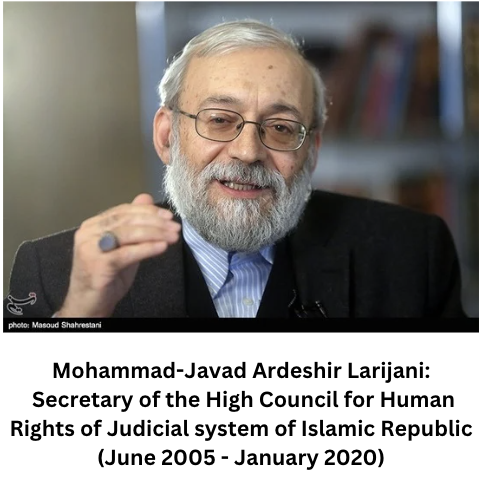
  1. MOHAMMAD-JAVAD ARDESHIR LARIJANI
  • June 2005 – January 2020 Secretary of the High Council for Human Rights of Judicial system of Islamic Republic
  1. GHOLAM-ALI MOHAMMADI
  • July 2005 – September 2020 Deputy Chief Justice of Tehran Province
  • September 2020 – November 2021 Deputy Head of the Judiciary chief office
  • Since November 2021: Head of the State Prison and Security and Corrective Measures Organization